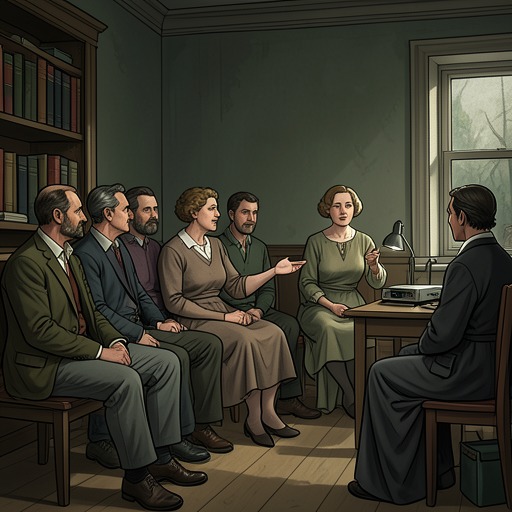
Susan Garth
MiddlemarchSusan Garth is Caleb Garth’s wife and Mary Garth’s mother, a former governess who combines education, household labor, and practical judgment in a family with few financial reserves. Her unsparing view of Fred Vincy’s mistakes, followed by her willingness to surrender savings when he has endangered the Garths, makes her a central measure of the difference between merely fearing disgrace and recognizing the harm done to other people.
Identity and Household
Susan lives with Caleb and their children in the Garths’ old house outside Middlemarch, a former farmhouse now surrounded by townsmen’s gardens. The family is large, and the house’s best furniture has long since been sold. Susan’s daily life joins several forms of work: she cooks, supervises household tasks, mends clothes, and teaches her younger children. At one point, her pupils include Letty and Ben, as well as Fanny Hackbutt, who is due at half past eleven. She says her teaching income is low, but she has set aside ninety-two pounds for Alfred’s premium so that he can attend Mr. Hanmer’s.
Her education remains a source of both pride and pointed practicality. Susan has taken pupils through the kitchen, teaching grammar while attending to domestic tasks; she insists by example that a woman can be educated without being a useless ornament. At home she can make pies, oversee the work around her, and explain grammar to the children at once. Her intelligence does not remove her from household labor; she makes those activities coexist. That combination helps define her authority in the family and sets her apart from a social ideal that treats women’s learning and usefulness as opposites.
Temperament and Marriage
Susan is described as self-controlled and realistic about what cannot be changed. She admires Caleb’s virtues while understanding that he is poor at protecting his own financial interests, and she accepts the consequences without turning them into public complaint. She has given up pride in fine household goods and does not confide to neighbors about what her husband might have earned had he been more prudent. Those neighbors sometimes mistake her reserve for pride or eccentricity.
Her judgment is not presented as impartial in every respect. Susan is inclined to excuse men’s failings as natural, while applying a stricter standard to women, including her own daughter. She can also be emphatic in resisting what she considers foolishness. Yet her marriage is marked by directness rather than resentment. When Caleb admits he has been foolish, she agrees, but tells him that he should have shared the problem with her sooner. She compares concealment about money to his letting buttons burst off his clothes without telling her: had she known, she might have been ready with a better plan. Her criticism is practical and intimate, grounded in the possibility of acting together.
Fred Vincy’s Debt and the Garths’ Sacrifice
When Fred comes to confess that he cannot repay the money Caleb has risked for him, Caleb finds the Garth household under particular strain. He says he will need every farthing in the bank, and the sum required is one hundred and ten pounds. Susan immediately offers the ninety-two pounds she had saved for Alfred’s education and says Mary can advance the twenty pounds she has put by from her salary. Her decision places Fred’s debt against concrete plans and labor: Alfred’s opportunity must be postponed, and Mary’s own savings are also needed.
Susan does not soften the seriousness of Fred’s conduct. She had been disposed to excuse his earlier errors, but now tells Caleb she is disappointed: Fred has attached his risks to his oldest friend, who can least afford a loss. She also recognizes the cost that the rescue will impose on Caleb. Since Alfred’s premium can no longer be paid, Caleb must teach the boy himself; Susan tells her husband to give up his habit of working without pay and to ask Mary how much she can contribute.
The episode changes Fred’s understanding of his wrongdoing. Until then, his distress had centered largely on appearing dishonorable and losing the Garths’ good opinion. Faced with Susan’s readiness to act, he sees that his breach would make him a thief of two women’s savings. His remorse comes from recognizing their needs, not simply from fearing what they will think of him. Susan’s practical generosity thus exposes the moral limitation of an apology that does not reckon with its consequences for others.
Work, Judgment, and Family Loyalty
Susan’s concern for the family extends beyond immediate household management. When Mary is considering a teaching post in York, Susan responds to her daughter’s decision that she must teach by insisting that teaching is delightful work, especially for someone who knows enough and likes children. Her answer treats employment not merely as a last resort but as meaningful labor, even as the family’s finances make earning a necessity.
When Caleb is again invited to manage the Freshitt and Tipton estates, Susan presents the offer to the children as recognition of his past work: those who dismissed him now want him back because they have felt his absence. She helps the family understand the appointment as an honor earned through competent service, rather than simply as a new source of income.
Caleb later considers taking Fred on as an assistant so that the young man can learn land management and become useful. Susan objects that Fred’s family would dislike the proposal and might suspect the Garths want him for Mary. She doubts that Fred and his parents will readily accept a position they may consider beneath their social ambitions. Her caution reflects both knowledge of local class feeling and concern for Mary. Yet when Caleb decides that his clear sense of duty requires him to tell Mary about Fred’s feelings, Susan supports him: she kisses him and blesses him as a good father, though she privately cries and fears that his generosity will be misunderstood. Her affection does not erase her reservations; it makes her willing to stand with him while seeing the risks more clearly.
Views of Marriage and Social Expectations
Susan’s principles reveal a tension between her competence and the gender hierarchy she accepts. She is educated and manages work, money, and family decisions, yet she believes women should be subordinate and applies a more exacting standard to Mary’s choices than to Fred’s conduct. She can excuse Fred as a young man while fearing that Mary would be wrong to bind herself to him. Later, when Caleb reports that Mary loves Fred but will not marry a clergyman, Susan says Mary might have had a man worth twenty Fred Vincys. The remark conveys her protective skepticism about Fred’s prospects, not indifference to Mary’s attachment.
The contrast between Susan’s judgments and her actions keeps her from being reduced to a single principle. She recognizes the costs of Caleb’s generosity, worries about the family’s savings, and doubts Fred’s worth as a husband; still, she accepts the immediate sacrifice that his debt demands and joins Caleb in trying to make Mary’s life easier. Through Susan, the Garth household appears not as a refuge from economic pressure but as a place where care is organized through work, savings, frank disagreement, and choices whose costs fall unevenly on family members.