Dorothea Brooke Casaubon
MiddlemarchDorothea Brooke Casaubon is an idealistic young woman whose marriage to Edward Casaubon brings neither the intellectual partnership nor the useful vocation she had imagined. At Lowick, her first months as a wife unsettle her faith in the marriage she chose; later, her attempts to help her husband, her conversations with Will Ladislaw, and her response to separation expose the conflict between her generous aspirations and the restricted choices available to her. Her story traces not a simple rejection of marriage or service, but a continuing search for work and relationships that can give her ideals practical meaning.
Identity and Background
Dorothea is a young gentlewoman whose religious seriousness and desire to be useful shape her expectations of life. Marriage appears to promise an answer to the open-endedness of her privileged circumstances: before marrying, she had been left to choose her own pursuits, and she hoped that becoming a wife would give her a demanding purpose. Instead, her early experience at Lowick shows that a woman’s freedom from prescribed tasks can become a form of confinement when no one asks for her help and she lacks the authority to choose consequential work.
The narrative also insists that marriage must be seen from both sides. In its account of Edward Casaubon’s expectations, his choice of a young, religious, intelligent wife appears to promise domestic companionship and assistance with his scholarship. He imagines that Dorothea may help him avoid hiring a secretary, while taking her admiration for granted. The account makes clear that he does not consider with equal care whether he can make her happy. This imbalance is part of the setting in which Dorothea’s hopes take shape: each spouse enters the marriage with an image of what the other will provide, but the expectations are not equally examined.
Married Life at Lowick
Returning from their wedding journey, Dorothea and Edward arrive at Lowick Manor in mid-January. The snow-covered landscape, the shrunken-seeming furniture, and the books that appear to be mere imitations of books give physical form to her disappointment. The contrast is especially sharp because Dorothea had expected married life to open into active devotion and intellectual communion. Instead, the domestic routine seems to extend the same purposeless leisure she had hoped marriage would end.
Her distress is not simply disappointment with a particular room or season. Dorothea feels that the energy and religious purpose she brought to the marriage have no adequate outlet. Wedding visits and social duties continue, but they do not provide the substantial work she had anticipated. Her belief that she could strengthen her husband’s life and find inspiration in wifely love has not vanished; rather, it has lost its original shape, leaving her to hope that duty may acquire a different meaning.
A miniature of Edward’s aunt Julia, who had made an unfortunate marriage and was also Will Ladislaw’s grandmother, gives Dorothea a new point of companionship. Looking at Julia’s image, she wonders whether the woman herself understood her marriage to be a mistake and suffered privately. The portrait connects Dorothea’s present uncertainty to another woman’s experience, while also drawing Will into a family history marked by marital difficulty. Dorothea’s response shows her capacity to imagine another person’s inward life even when she has little direct knowledge of it.
Learning, Duty, and the Limits of Assistance
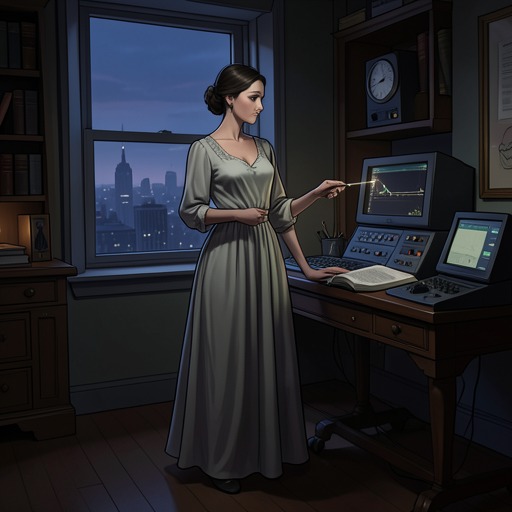
Dorothea tries to make the marriage she wanted by learning skills that might help Edward with his work. When she speaks with Will at Lowick, she explains that she has begun learning Latin and Greek so she can find references for Edward and spare his eyes. Yet she also recognizes that scholarship can exhaust those who pursue it: the labor of reaching great thoughts may leave little strength to enjoy them. Her observation is personal as well as intellectual, since she is attempting to enter her husband’s scholarly world without being sure that it can offer the reciprocal companionship she had imagined.
Dorothea’s plea to Tertius Lydgate to speak plainly about Edward’s health reveals how strongly she fears that crucial knowledge might alter her choices. She says she cannot bear the possibility that something was left undisclosed which, had she known it, would have made her act differently. Her words bring the marriage’s earlier uncertainty into a moment of medical seriousness: she wants facts not merely to satisfy curiosity, but because knowledge bears on responsibility and regret. Lydgate can offer no certain prediction, only the warning that Edward should avoid straining his nervous power and the possibility that he might live for fifteen years or more without much deterioration.
Dorothea’s practical impulses also appear in her comments about other people’s lives. When her mother raises the possibility of a legacy and the disappointment of Fred Vincy, Dorothea refuses to connect his situation to her marriage. She insists that Fred must stop being idle and turns instead to work she can arrange, including sewing to be done by Mary Garth. The episode places her moral judgments alongside everyday domestic labor: she sees work and self-reliance as necessary, even while her own position as a gentlewoman leaves her struggling to find meaningful occupation.
Will Ladislaw and the Experience of Parting
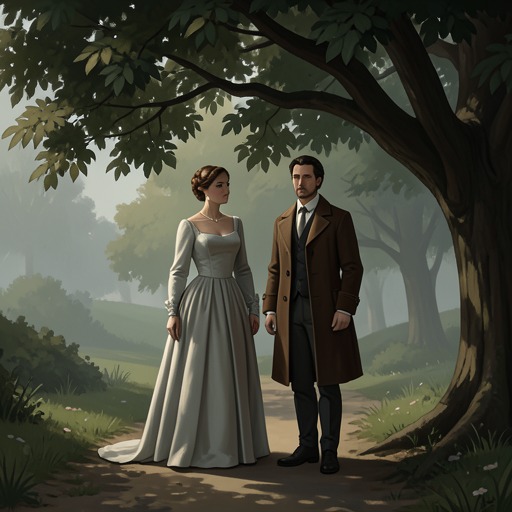
When Will comes to Lowick after rain has driven him indoors, Dorothea is glad to see him and welcomes the chance to speak privately. She remembers their conversations in Rome as a rare form of understanding. In his presence she feels free to talk without fear, and she tells him about her studies and her wish to lighten the burden of someone doing great work. Their exchange brings her ideals into a more open conversation than the one available in her marriage, though it does not establish what Will’s future intentions are.
Later, Dorothea interprets her parting with Will as the end of their personal relationship. She believes that Edward’s codicil has made active friendship impossible and assumes that Will’s departure means he will not return as the same person, if he returns at all. She does not understand that his decision is also governed by a proud refusal to appear to be seeking a wealthy woman for financial advantage. Her grief is therefore shaped by incomplete knowledge: she treats a separation as final because she cannot see the reasoning behind Will’s resolve.
When Will visits again to say that he is leaving immediately, he explains that he now knows things that have changed his feelings about the future. Dorothea recalls that she had thought they were already parting at his previous visit. The scene returns their relationship to the problem of what can and cannot be said: he is departing, she knows that something has changed, but the available evidence does not make her understanding complete. Their meetings become thresholds between closeness and distance, rather than a straightforward progression toward shared life.
Change and Narrative Significance
After the apparent loss of Will, Dorothea tells Celia that she will never marry again. She proposes a different future: taking land, draining it, and creating a small community in which everyone works well and she knows each person as a friend. She wants to consult Caleb Garth, whose practical knowledge could help turn her plans into action. The proposal gives her idealism a concrete form. Instead of seeking purpose chiefly through a husband’s work, she imagines organizing labor and personal relationships directly, though the plan remains an intention rather than a completed undertaking in this evidence.
These episodes make Dorothea’s central difficulty more specific than a conflict between good intentions and unhappy circumstances. She wants connection, useful action, and knowledge of other people, but social convention and her position as a gentlewoman often leave her with leisure rather than responsibility. Marriage initially appears to resolve that problem, yet it does not automatically give her agency or meaningful work. Her movement from hoped-for scholarly service, through disillusionment and grief, to a plan for land and collective labor shows her repeatedly trying to find an effective form for the same underlying commitment.
The narrative’s attention to Dorothea does not make her experience the only measure of the marriage. It explicitly asks readers to attend also to Edward’s inner life and hunger for companionship, even as it examines the assumptions with which he chose a wife. That shift keeps the marriage from becoming a one-sided account of disappointment. Dorothea’s story matters not because her ideals are always fulfilled, but because their repeated obstruction clarifies how private feeling, marriage, work, and social expectations shape what a person can do.