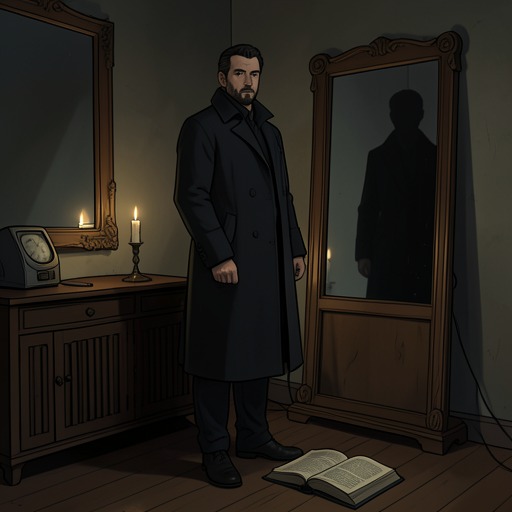
Nicholas Bulstrode
MiddlemarchNicholas Bulstrode is a banker whose money and influence help establish Middlemarch’s fever hospital and affect appointments to local religious office. Yet his public identity as a Churchman and benefactor rests beside a concealed past that returns through John Raffles. The contrast between Bulstrode’s sincere religious self-understanding and the harm and self-interest he has rationalized makes his story a study in how private conviction can coexist with public damage—and how a past treated as settled can become present again.
Identity and Public Influence
Bulstrode moves among Middlemarch’s influential men as a banker and religious figure, speaking in a subdued manner and presenting himself as a supporter of moral improvement. In an early conversation about coquetry, he rejects a worldly explanation in favor of a religious one, attributing it to the devil. The exchange establishes the language through which he interprets conduct: moral categories are not merely public arguments but part of his account of how the world works.
His influence is practical as well as rhetorical. He backs the new hospital and welcomes Tertius Lydgate, whom he hopes to entrust with its management. Mr. Standish objects that Lydgate’s medical approach may expose patients to untested experiments, setting Bulstrode’s confidence in reform against a town’s attachment to established treatment. When Lydgate later takes charge of the Vincy family’s fever case, local opinion divides: some condemn the Vincys’ treatment of Mr. Wrench, while others regard Lydgate’s arrival as providential and credit Bulstrode with bringing him forward. Rumor goes further still, with Mrs. Taft mistakenly supposing that Lydgate is Bulstrode’s son.
Bulstrode’s public standing also gives him leverage in institutional decisions. At the meeting on the hospital chaplaincy, he supports Walter Tyke and argues that the voters have been informed of the competing case. He presents the issue as one whose merits can be stated briefly, and his interventions help shape the choice. Mr. Brooke’s attendance as a director is itself attributed to Bulstrode’s exertions. The scene shows how Bulstrode’s influence works through boards, persuasion, and access to decision-makers, rather than through wealth alone.
The Hospital and the Limits of Patronage
The fever hospital concentrates Bulstrode’s civic ambition. He has put money into the project and wants it to succeed, while Lydgate defends it as work made possible largely by Bulstrode’s efforts and resources. Lydgate sees opposition in the town as a petty feud against the institution; Mr. Toller, by contrast, voices suspicion that Bulstrode’s religious and medical allies resemble one another in their capacity for charlatanism. The disagreement makes the hospital a test of both reform and reputation: its promise depends on patronage, but that dependence invites scrutiny of the patron and his associates.
Bulstrode’s support is not disinterested in the simple sense of relinquishing control. He takes intense interest in the hospital’s construction, including its carpentry, masonry, drains, and chimneys, and would prefer to finance it himself and govern it without a board. At the same time, he wants contributions from others because he is also seeking to buy land near Middlemarch. His plan reserves the hospital for fevers in all their forms and gives Lydgate authority as chief medical superintendent to pursue comparative investigations informed by his studies in Paris. The arrangement combines an ambitious medical program with Bulstrode’s desire for managerial command and competing uses for his capital.
Lydgate understands the danger of becoming personally bound to his benefactor. Farebrother advises him to remain as separate from Bulstrode as possible, even while continuing to do useful work with his help. Lydgate acknowledges that personal feeling may color Farebrother’s warning, but argues that it may still yield a sound judgment. He insists that even if the town’s worst opinion of Bulstrode were true, Bulstrode’s sense and resolution in matters of medical reform would remain valuable to the work. Lydgate claims to cooperate only on that basis, not from personal admiration. Later, however, financial pressure makes the independence he has asserted difficult to maintain: Bulstrode’s offer of a thousand pounds promises to free him from his burdens and restore his footing.
Religious Self-Justification and the Returning Past
Bulstrode’s inner account of events is not presented as a simple performance for other people. When he acquires Stone Court, he interprets the timing of Farebrother’s appointment to Lowick as a chastisement directed at his own shortcomings and those of the nation. He has hoped to influence who receives the Lowick living, but Farebrother reads himself into the parish church just as Bulstrode takes possession of the deeds. The narrator stresses that Bulstrode’s explanation is sincerely his own: egoism does not necessarily cancel belief, and may even strengthen it when a person’s preferred account of events is confirmed.
Stone Court is both a substantial property and a future project. Bulstrode has bought its farm and homestead as a retreat that he plans to enlarge and improve over time, imagining that the estate can be made conducive to divine glory. The religious purpose he assigns to the purchase coexists with his attention to land acquisition and influence. That doubleness recurs in his conduct: he can understand himself as serving a spiritual design while advancing his own interests and control.
Raffles’s reappearance ruptures this inward arrangement. Bulstrode encounters him on the road and recognizes him; Raffles, dressed in black, also recognizes Bulstrode. The narrator describes the shock as the arrival of an unmanageable, embodied past. Until then, Bulstrode has been able to treat sin as a matter of doctrine and private repentance, and the consequences of his actions as something understood through his own spiritual interpretations. Raffles makes that past a living relation that cannot be contained within private reflection.
Bulstrode tries to control the danger by offering Raffles a regular annuity, paid quarterly, on condition that he leave the neighborhood. He warns that if Raffles remains, he will receive nothing and Bulstrode will deny knowing him. The bargain reveals both the banker’s composure and the limits of his preferred moral reasoning: rather than disclose the past, he attempts to manage the person who can expose it. Later, his effort to send Raffles away becomes more urgent. Bulstrode arranges a carriage and says he will take Raffles as far as Ilsely, where he can continue by railway or coach; he promises further payments by letter but threatens to withdraw support if Raffles returns to Middlemarch or speaks against him.
Exposure, Marriage, and Departure
The danger Bulstrode fears is not principally legal punishment or destitution. It is that his neighbors—and his wife—will learn facts that make him an object of scorn and bring discredit upon the religion with which he has publicly associated himself. As that fear sharpens his memory, the past ceases to feel like a discarded stage of life. His public respectability, built over years as banker, Churchman, benefactor, and participant in trading concerns, cannot make the earlier history irrelevant. The narrator traces the long persistence of the business and Bulstrode’s failure to make the sacrifices that would have ended it, even after he had begun withdrawing capital.
After Raffles’s death, Bulstrode hopes that the man’s departure has removed the threat. When Mr. Bambridge recounts the history to a growing group of listeners, including the fact concerning Will Ladislaw, Bulstrode’s concealed past is carried into public conversation. The account includes local circumstance and the disclosure Bulstrode had hoped would be buried with Raffles. Bulstrode has accepted the apparent outcome as providential, without admitting to himself that he may have acted to bring it about or that his actions hastened Raffles’s death. His private interpretation of events therefore remains compromised by what he cannot confidently confess, even to himself.
At the town meeting, Mr. Hawley speaks for himself and eight fellow townsmen, calling on Bulstrode to resign his public positions. He argues that conduct may escape legal punishment and still be intolerable to those who wish to defend their own standards. Bulstrode answers as a Christian minister, protesting that hostility and malicious accusation have shaped the proceedings. He attacks the character and motives of his accusers and contrasts their conduct with his own spending on public and religious objects. His defense reveals how thoroughly he relies on the identity of benefactor and Churchman, even when those identities are under challenge.
Harriet Bulstrode’s response makes the scandal a crisis within the marriage as well as in public life. She withdraws to her room, trying to absorb the knowledge that her husband’s concealed history has altered her understanding of their twenty years together. The particulars make what she had regarded as a marriage founded on belief seem like deceit, and she cannot simply dismiss the gravest accusations. Later that evening, she returns to him. He does not look up; she sees him as diminished and withered, but approaches with both new compassion and old tenderness. Her constancy relieves one of his fears, although it does not erase the sense that she remains a judge before whom he has not fully confessed.
Bulstrode prepares to leave Middlemarch and end his days among unfamiliar faces. He fears not only public judgment but the private judgment of Harriet, whose presence makes his self-explanations feel insufficient. When he asks what she would like done about property, he says he intends to leave her the land he owns in the neighborhood as secure provision. He also proposes a practical opportunity for her nephew, Fred Vincy: Caleb Garth had considered managing Stone Court with the stock retained and a share of profits paid instead of ordinary rent, alongside Fred’s employment under Garth. Bulstrode asks Harriet to make the proposal herself, stressing that the land is virtually hers and that Garth need not transact with him. Because Garth had resigned as Bulstrode’s agent, he suggests using Mr. Standish as intermediary and offering Garth the written conditions he had previously drawn up.
Narrative Significance
Bulstrode’s arc turns on the gap between inward intention and outward consequence. His faith is not portrayed as wholly fabricated: the narrative makes room for his sincerity even as it shows how self-interest can enter the theories by which he understands himself. Religious language allows him to interpret setbacks as admonition and benefits as providential, but it cannot make the people affected by his past disappear. Raffles’s return forces the private story into social view, where neighbors, colleagues, and Harriet judge what Bulstrode had treated as a settled matter of inward repentance.
His relationships with Lydgate and Garth also expose the costs of patronage. Bulstrode’s money helps make medical reform possible, but his wish to direct the hospital complicates the independence of the work; Lydgate’s later need for a loan makes that tension personal. Garth’s resignation, by contrast, leaves Bulstrode unable simply to resume their former business arrangement. In the final proposal for Fred’s future at Stone Court, assistance passes through Harriet and is framed to spare Garth direct dealings with Bulstrode. The ending does not restore Bulstrode’s former standing. It leaves him with a diminished public life, a wife whose compassion coexists with moral judgment, and an effort to arrange material provision while he departs under the weight of an unresolved past.