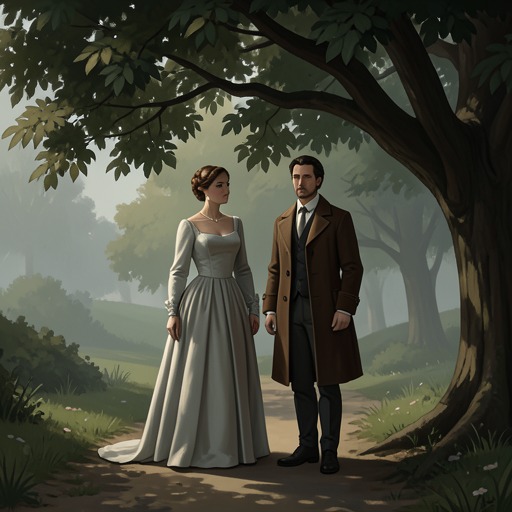
Rosamond Lydgate
MiddlemarchRosamond Lydgate’s marriage to Tertius Lydgate exposes the distance between romantic expectation and domestic reality. She seeks comfort, social standing, and an agreeable home, while he imagines a wife who will sustain his medical vocation without obstructing it. Their incompatible assumptions become material as well as emotional: expensive household habits and mounting debts threaten the life Rosamond wants to preserve, while her efforts to control their circumstances without consulting her husband erode their trust. Yet Rosamond is not simply passive or compliant. Her quiet persistence gives way to independent action, and her encounter with Dorothea eventually unsettles the romantic illusions through which she has understood herself and others.
Identity and Expectations
Rosamond enters marriage with a strong sense of the life she wishes to inhabit. She values refinement and domestic comfort, and imagines that marriage to a well-born doctor will bring a measure of social distinction. The attention surrounding Captain Lydgate’s visit and the possibility of a connection with his family gratify her hopes of rising above ordinary Middlemarch life. She takes pains over her music and clothing, and reads social visits as signs of a future that might carry her and Tertius toward Quallingham and its more elevated connections.
Lydgate, for his part, expects marriage to further his work. He imagines that Rosamond will create order at home and in the accounts, appreciate his intellectual seriousness, and leave his professional ambitions undisturbed. His picture of a wife as receptive and accommodating differs from the practical independence Rosamond displays. Neither enters marriage with a full understanding of the other: he takes her outward gentleness for agreement, while she expects a medical career to support a comfortable and socially advantageous household.
Marriage and Conflicting Priorities
The strain in their expectations becomes apparent in their attitudes toward Lydgate’s profession. Rosamond wishes that he had not become a medical man, describing the profession as unsuitable and contrasting it with the higher-status occupations she believes he might have pursued. Lydgate regards medicine as central to who he is, and insists that affection for him cannot be separated from respect for his calling. Her teasing answer softens the exchange without resolving its underlying disagreement. The conflict is not merely about a job: his vocation entails demands and values that she does not share, while the social advancement she imagines for them depends in part on his professional success.
Their household life also carries a cost that neither initially confronts clearly. Rosamond is accustomed to ordering the best of everything and treats this as proper housekeeping; Lydgate likewise assumes that things should be done properly and does not question the expense of the arrangements he has made. Their setup costs exceed his available capital by four to five hundred pounds. Within a year, household expenses, horses, and other costs approach a thousand pounds, while income from his medical practice falls short of expectations. The couple’s comfort depends on spending beyond their means, even as Lydgate’s work among poorer patients requires him to consider the limits of other households’ resources.
Resistance, Debt, and Secrecy
As debt presses on him, Lydgate tries to draw Rosamond into measures to reduce their spending. He proposes keeping one servant and one horse, and explains that their earlier expenses have left them unable to maintain their household as before. Rosamond sees a reduced style of living as a danger to his professional position and resists the changes. The disagreement makes money a test of whose judgment governs their shared life: Lydgate begins to recognize the need for restraint, but Rosamond continues to measure security through appearances and established comfort.
When Lydgate considers selling the house and its contents, Rosamond refuses even to examine the sale document, telling him that he can return what he wishes. She later brings out the jewellery he has given her, including the amethysts, and allows him to sell it along with the plate. But she also states that she will not stay at home the following day and will go to her father’s. The gesture offers material help while registering emotional distance: the objects are available to ease the debt, but the couple are no longer acting as a united household.
Rosamond then turns from resistance to covert action. When she realizes that Lydgate means to dispose of the house, she visits Borthrop Trumbull, the auctioneer, to intervene. This is her first attempt at conducting business, and she believes her judgment is justified because she considers Lydgate’s intended course mistaken. She also writes to Sir Godwin Lydgate without her husband’s knowledge, asking for a thousand pounds and arguing that Tertius’s talents would be better served away from Middlemarch. She presents the appeal as consistent with her husband’s regard for his uncle, though Lydgate has not authorized it. When he discovers the letter, he tells her that he cannot endure her acting secretly and in opposition to him. Her effort to protect their home and prospects thus intensifies the crisis of confidence between them.
Social Distance and Romantic Illusion
The marriage’s estrangement becomes visible in company. At the New Year’s Day party at the Vincys’, Rosamond is graceful and composed, but she does not look toward Lydgate when he speaks or acknowledge his return to the room. Her manner appears proper to others; inwardly, it is a deliberate form of opposition. Lydgate’s absences are explained as the demands of a medical man’s life, yet the social appearance of a harmonious marriage conceals a lack of emotional closeness.
Rosamond’s attention also turns toward Will Ladislaw, whose visits to the Lydgate home make him a source of lively conversation and musical companionship. She finds his manner entertaining and his freedom from Lydgate’s serious professional preoccupations appealing. After Will leaves Middlemarch, she interprets his playful criticism and exaggerated gallantry as signs of a deeper preference for her, and imagines that he would have been a more suitable husband than Lydgate. The belief persists despite her awareness that Will admires Dorothea. It is a romantic projection that gives Rosamond a sense of flattering possibility while obscuring the actual attachments involved.
That illusion is disrupted when Dorothea unexpectedly sees Will with Rosamond. He is holding Rosamond’s raised hands and speaking to her with fervor; Dorothea pauses, then addresses Rosamond calmly and explains that she has come to deliver an important letter for Lydgate. The scene is charged with the appearance of a romantic intimacy, but its importance lies in how it is interpreted. Afterward, Lydgate asks Rosamond what she thinks of Dorothea. Rosamond answers that Dorothea must be better than anyone and beautiful, adding that Lydgate might become more discontented with her if he spoke to Dorothea often. Her response registers a changed judgment, though it also shows that comparison and insecurity remain present.
Change and Narrative Significance
Rosamond experiences a brief improvement when creditors have been paid and the immediate threat to the household has receded. The relief does not restore the life she expected. Her marriage has failed to fulfill her hopes, there is no longer a prospect of advancement through Quallingham, and Lydgate continues to press for economical changes. His earlier angry words have wounded her pride, while she receives his later tenderness as an inadequate substitute for the happiness she believes marriage should have brought. She sometimes wishes he would move to London, but neither that wish nor the easing of immediate financial pressure supplies a shared future.
When troubling news about Lydgate reaches her, Rosamond returns home with resentment but without knowing what has happened. She wonders why he has not told her everything, yet she also does not raise the matter with him. Lydgate, for his part, feels unable to speak and reads her silence as evidence of suspicion. The silence is mutual and self-reinforcing: each has grounds to resent the other’s reserve, and neither can easily begin the conversation that might clarify their position.
The narrative presents Rosamond’s quiet persistence as a form of power that can operate through domestic decisions, social ambition, and secret intervention, rather than open confrontation. That power is real but limited: her attempt to safeguard comfort cannot reconcile her wishes with Lydgate’s vocation or remove the consequences of their spending. Her errors arise partly from self-deception—above all, the conviction that social distinction and romantic admiration can secure the happiness she seeks. Yet her changed response to Dorothea suggests that her perspective is not fixed. Rosamond remains entangled in a troubled marriage, but the final exchanges allow her to recognize a generosity beyond the rivalrous fantasies through which she had viewed other women.