Mrs. Vincy
MiddlemarchMrs. Vincy, the mother of Fred and Rosamond Vincy and wife of Walter Vincy, is a warm-hearted presence whose maternal devotion shapes several of the novel’s domestic turning points. Her alarm when Fred falls seriously ill draws Tertius Lydgate into the Vincy household; her hopes for Fred’s marriage reveal the family’s assumptions about money and status; and her later acceptance of Mary Garth marks a small but meaningful adjustment in those assumptions.
Family Life and Household Expectations
The Vincys’ comfortable, free-spending habits help explain Fred’s early confidence that his family could absorb his debts. Walter Vincy spends on coursing, his cellar, and entertaining, while Mrs. Vincy maintains running accounts with tradespeople. Their children grow up without a firm standard of economy, and Fred retains the childish notion that his father could pay for anything if he chose. When debts have to be disclosed, Walter’s anger and Mrs. Vincy’s tears make the household atmosphere unpleasant, but Fred regards the storm as temporary and prefers to avoid it by renewing bills with a friend’s signature. Mrs. Vincy is not the cause of his financial recklessness; rather, the family’s easy habits and uncertain attention to limits form part of the setting in which his optimism persists.
Her concern for her children is readily visible, though it does not always mean that she can direct their choices. Rosamond, by mild persistence, can influence her father more effectively than Walter’s bluster might suggest. When Mrs. Vincy hears that the expected legacy will not provide the family with the money it had imagined, Rosamond insists that this has nothing to do with her marriage and turns instead to practical household work, asking whether Mary Garth might sew her cambric frilling. Mrs. Vincy’s hopes about her children’s prospects coexist with Rosamond’s ability to proceed on her own terms.
Fred’s Illness and Lydgate’s Arrival
When Fred returns from Houndsley unwell, he first dismisses his condition as a cold caught on a damp ride. Walter Wrench sees him and does not initially recognize the seriousness of the illness. The next morning Fred is shivering by the fire; Wrench is away on his rounds, and Mrs. Vincy, seeing her son’s changed appearance, begins to cry and decides to send for Dr. Sprague. Rosamond notices Lydgate nearby and suggests calling him in, recalling that he has cured Ellen Bulstrode.
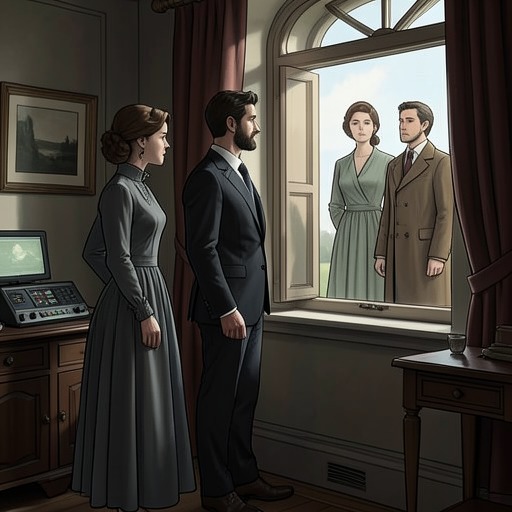
Mrs. Vincy acts immediately: she opens the window and calls Lydgate in, thinking of Fred rather than professional etiquette. Once Lydgate examines him, he recognizes typhoid fever and judges that the medicines already given are unsuitable. He orders Fred to bed, requires a nurse and other precautions, and promises to write to Wrench about what he has done. Mrs. Vincy’s account of the earlier consultation dwells on whether Wrench had said he would return, but Lydgate sets aside the possibility of offending a colleague because Fred’s condition demands attention.
The fear that follows is not merely a momentary outburst. As Fred becomes delirious, Mrs. Vincy is overwhelmed by the possibility of losing him. She follows Lydgate from the sickroom and takes hold of his arm, pleading, “Save my boy.” She remembers Fred as a loving son who had never spoken harshly to her, and his present suffering seems to her like an accusation against the world that has made him ill. Lydgate’s gentler manner when addressing her matters: she responds to him not only as the doctor managing a dangerous case but as someone who can offer hope and guide her through the immediate work of caring for Fred.
Hope, Marriage, and Family Affection
During Fred’s illness, Mrs. Vincy’s hopes leap beyond recovery to his imagined future. She says that if she can see him strong again, perhaps he may become master of Stone Court and then marry anyone he likes. Fred answers that this would not help if the woman refused him. His reply reveals that his own hopes are uncertain in a way his mother’s confident affection does not fully acknowledge. She answers by urging him to eat jelly, retreating to a familiar act of care rather than pursuing the painful implication of his words.
Her readiness to imagine Fred as master of Stone Court shows how inheritance and economic security enter the family’s ideas of marriage. She pictures success as giving him freedom to choose, while Fred knows that another person’s choice cannot be secured by a future estate. Later, the question of Mary’s place in the family becomes less abstract. At a New Year’s gathering, Mrs. Vincy looks at Mary’s appearance and struggles to imagine her in wedding clothes or to feel pleased at grandchildren who might resemble the Garths. Her response reflects the importance she gives to attractiveness and family resemblance, even as Mary is welcomed into the gathering and proves a favorite with the children.
The children’s delight in Mary changes Mrs. Vincy’s view. When Louisa runs to her mother to describe the tale of Rumpelstiltskin, Mrs. Vincy sends her back to listen and thinks that she would not object to inviting Mary again if Fred wished it. The shift is modest but consequential: the pleasure Mary gives the children provides Mrs. Vincy with a reason to receive her more warmly, beyond the question of Mary’s suitability as a prospective bride.
Later Years and Changing Judgments
Mrs. Vincy’s preferences are also visible in her exchange with Mrs. Farebrother, who praises Mary as an excellent young woman. Mrs. Vincy can offer only the reservation that Mary is not better-looking. Mrs. Farebrother answers that good manners and character should matter more than beauty and that Mary could conduct herself in any station. The exchange makes explicit a tension between Mrs. Vincy’s concern with appearance and social prospects and the more practical esteem others have for Mary.
Years later, Mrs. Vincy takes comfort in Fred and Mary’s three sons, at least two of whom she regards as unmistakably Vincys rather than Garths. Her pleasure in that resemblance preserves an old family preference, but it sits alongside the reality of Fred and Mary’s settled life at Stone Court. Fred has become its owner through gradual saving and work, not through the effortless inheritance his mother once hoped for. His marriage and stability thus emerge from the very qualities—work, restraint, and mutual care—that the Vincy household’s earlier habits had done little to teach.
Narrative Significance
Mrs. Vincy’s role is grounded in ordinary acts of care: calling a doctor, grieving at a son’s sickbed, offering food, and making room for a young woman whose value becomes clear through her kindness to children. These acts give domestic feeling practical consequences. Her call to Lydgate places him in the Vincy home at a critical moment, while her fear for Fred brings the doctor’s professional judgment into close contact with a family’s hopes and anxieties.
Her family’s expectations also expose the limits of maternal wishfulness. Mrs. Vincy imagines that a future position at Stone Court will allow Fred to marry whom he likes, yet Fred’s feelings depend on Mary’s willingness, not simply his prospects. Her early doubts about Mary’s appearance gradually yield to the evidence of Mary’s character and the children’s affection. The change is not a dramatic conversion but a domestic adjustment: the household learns to value a person through sustained familiarity, and the family’s future is shaped less by inherited assumptions than by the relationships its members build.