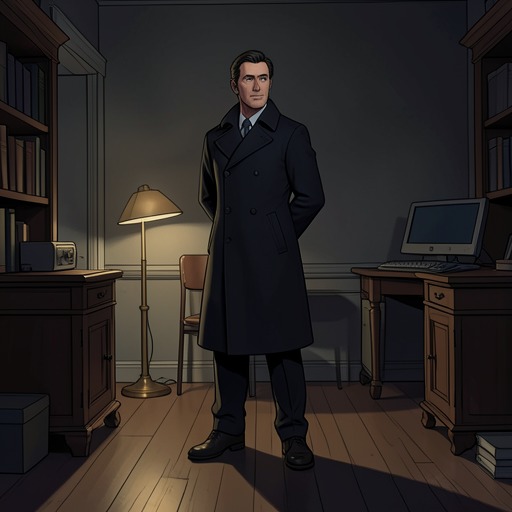
Walter Vincy
MiddlemarchWalter Vincy is a Middlemarch tradesman whose brisk judgments make money, respectability, and family obligation inseparable. Father to Fred Vincy and Rosamond Vincy and brother-in-law to Nicholas Bulstrode, he responds to his children’s choices with a mixture of pride, impatience, and financial caution. His shifts of temper are not merely comic reversals: they reveal how easily parental approval depends on the fortunes and social standing that a family can afford to sustain.
Identity and Family Position
Walter’s standing in the family is expressed through the practical authority of the warehouse and the force of his opinions. He expects his children’s futures to reflect well on the household, and he measures their prospects partly by income, education, and advantageous connections. His exchanges with his wife show a domestic man who can be diverted by cheerfulness and family comfort, but whose confidence is readily shaken by commercial pressure.
He is also Harriet Bulstrode’s brother. Their relationship becomes important when the Bulstrode scandal breaks: the warehouse, ordinarily a place of trade and paternal authority, becomes where Harriet seeks an answer to the obscure danger she senses. Walter’s familial role then requires something more than assessment of prospects. He must tell his sister what has happened and offer her his support without making her responsible for her husband’s conduct.
Rosamond’s Engagement and the Limits of Approval
When Tertius Lydgate seeks approval for his engagement to Rosamond, Walter gives it with striking ease. Having just returned from Stone Court, he is in a buoyant mood and treats Peter Featherstone’s expected death as a matter of legal consequence rather than solemn loss. The word he has settled on for it helps him keep the subject at a distance; in that mood, he can move directly from approval of the engagement to cheerful remarks about marriage and a little more punch.
That consent proves vulnerable to the same practical anxieties that his good humor had temporarily eclipsed. After the reading of Peter Featherstone’s wills, Walter’s outlook changes. His indirect displeasure appears in a small domestic gesture: he throws an embroidered cap out of the smoking-room and onto the hall floor. He then tells Fred to resolve to return to university and pass his examination, applying to his son the discipline he feels circumstances now demand.
The contrast is clearest when Walter’s wife reminds him that Rosamond has already begun buying fine linen and cambric for her wedding clothes. Walter denies that this was by his will. With Fred idle and the times tight, he says he will not pay for the clothes, doubts that Lydgate has any money, and refuses consent to the marriage. He argues that the engagement should be broken or delayed, and complains that Lydgate makes enemies rather than an income. His reversal shows how quickly a father’s apparent welcome can give way when a marriage seems to threaten the family’s financial security.
Walter’s judgments also register status as an economic calculation. He rejects the notion that a son-in-law is worth having merely for his relations, even as Rosamond’s mother worries that her daughter, raised in luxury, may have to live on a small income. The family’s talk of marriage moves between a daughter’s social polish, a physician’s prospects, and the cost of wedding clothes; Walter’s opposition is personal, but it is also a reckoning with what the household can support.
Fred’s Education, Work, and Paternal Conflict
Walter’s ambitions for Fred are tied to education as a route to advancement. After Fred loses the inheritance he had expected from Peter Featherstone, Walter’s disappointment hardens into a demand that his son return to university and pass his examination. Fred, who had imagined that Featherstone’s favor would make study unnecessary, is silent and deeply depressed. Walter’s insistence arrives at the moment when his son’s hopes of effortless independence have collapsed.
Later, Fred informs his parents that he has decided to take up work rather than pursue the path his father had intended. He goes to Walter at the warehouse and makes the disclosure gravely, explaining both what he has done and what he means to do, while accepting responsibility for disappointing him. Walter listens in silence. After nearly a minute, he puts a book back in his desk and turns the key emphatically before asking whether Fred has finally made up his mind.
Walter then tells Fred that he has thrown away his education and gone down a step in life, though he acknowledges that he had given his son the means of rising. Fred replies that he believes he can be as much a gentleman in his chosen work as he would have been as a curate, and that he remains grateful for his father’s intentions. Walter says he washes his hands of him and hopes that, if Fred has a son, the boy will repay his own father’s efforts better. The exchange makes their disagreement about vocation also a disagreement about what counts as advancement: Walter sees the abandoned education as lost social elevation; Fred argues for the dignity of useful work.
Temper, Judgment, and Family Affection
Walter’s disapproval often comes out indirectly. When he is disappointed in business, he swears at a groom; when Bulstrode has vexed him, he makes cutting remarks about Methodism. After the wills disappoint Fred’s expectations, his altered opinion of his son’s idleness appears first in the displaced cap, and only then in direct advice. His moods are legible in objects, turns of conversation, and abrupt changes of tone as much as in formal declarations.
That sharpness is set against his capacity for domestic cheer. Speaking with his wife, he tries to stop the household dwelling on Fred’s troubles by pointing out that they also have Rosamond. He says she got over the loss of her baby well, but swiftly turns to criticism of Lydgate, whom he believes is mishandling his practice and falling into debt. He insists that the couple will get no money from him and that Lydgate’s family should help. Even while refusing financial rescue, he tells his wife not to look dull and offers to drive her and Louisa to Riverston the next day. Affection, in Walter’s household, does not erase reproach; it is often expressed through practical plans and a rapid return to ordinary cheer.
The Bulstrode Scandal and a Changed Responsibility
When Harriet senses that something more serious than financial loss has happened, she leaves a visit with Mrs. Plymdale and hurries to Walter’s warehouse. He rises to meet her, takes her hand, and blurts out that she knows everything. Harriet does not yet understand what he means. Walter then tells her, in slow fragments, what he knows about the scandal involving Bulstrode and Lydgate, while acknowledging that the public talk goes beyond what has been proved, particularly concerning the end of John Raffles.
Walter does not pretend to know the full truth. He warns Harriet that people will talk even when a man has been acquitted, and that public rumor may treat a person as guilty regardless. He says the scandal damages Lydgate as well as Bulstrode, and laments that the family had ever become entangled with either name. But he draws a clear distinction between the accused and Harriet: he tells her that people do not blame her and promises to stand by her whatever she decides. His bluntness, which elsewhere turns family disappointment into rebuke, here becomes a form of protection.
Harriet later wants to do something for Walter’s family and to make amends to Rosamond and Lydgate. She understands that Lydgate’s practice is nearly worthless and that he and Rosamond have little left with which to settle elsewhere. Walter has told her that Lydgate must leave Middlemarch, and her proposal is to accept less for herself so that the couple may be helped. Walter’s account of her sister’s concern thus carries the consequences of his earlier refusal to support the marriage: the couple’s predicament has become a matter for family redress. It also shows Harriet’s response to the scandal taking a practical form, directed toward those who have suffered its consequences.
Narrative Role
Walter is not presented as consistent in the sense of holding one unchanging judgment. His opinions move with the evidence and pressures immediately before him: he approves Rosamond’s engagement when he is buoyant, opposes it when he worries about expense and Lydgate’s prospects, urges Fred toward university after the inheritance fails, and resents Fred’s departure from that route even when Fred acts with seriousness and gratitude. Those reversals make him an especially clear figure for the novel’s attention to how ideals of family advancement meet money, uncertainty, and social standing.
His response to Harriet adds a quieter counterweight to his harsher judgments of his own children. He cannot restore the security that the scandal has damaged, nor can he settle the question of Bulstrode’s guilt; what he can offer is frank information, protection from blame, and continued family allegiance. Walter’s significance lies in that combination. He is quick to calculate what a marriage or career may cost, but in crisis he recognizes that a relative should not be made to bear another person’s disgrace alone.