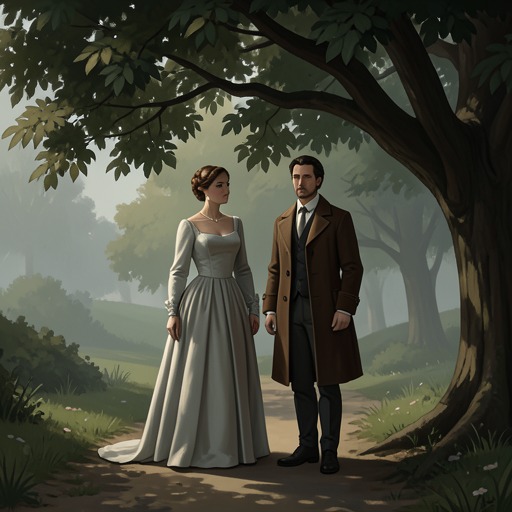
Dorothea Brooke
MiddlemarchDorothea Brooke’s story tests whether idealism can survive contact with ordinary life without becoming either submission or self-righteousness. A wealthy, intellectually earnest young woman, she initially imagines that marriage to Edward Casaubon will give her a meaningful role in his scholarship. Instead, she gradually recognizes the gulf between her hopes and his needs. Her development turns on learning to see other people more fully: she offers practical aid to Tertius Lydgate, defends him when suspicion threatens his reputation, and eventually responds to Will Ladislaw with a love that requires her to surrender wealth and status. The novel closes not with public triumph but with a life of shared affection and useful activity.
Identity and Early Ideals
Dorothea is introduced through an appearance that sets her apart from provincial fashion. Her plain dress makes her finely formed hands and dignified bearing more conspicuous, while her sister Celia is commonly thought to possess more common sense. The contrast does not make Dorothea simply austere: the sisters’ clothes differ only subtly, and Celia’s arrangements have a little more coquetry. Dorothea’s plainness instead belongs to a larger disposition, in which aspiration and restraint coexist.
Her inheritance gives those aspirations material weight. Dorothea and Celia each receive seven hundred pounds a year from their parents; Dorothea is also regarded as an heiress because, if she marries and has a son, that son may inherit the estate of her uncle, Mr. Brooke, worth about three thousand pounds a year. Yet money matters to her less as a means of comfort than as a resource for generous schemes. Her uncle’s habit of letting things be frustrates her, and she longs for the age at which she can exercise greater command over money and put it to better use.
That combination of moral energy and limited practical experience shapes her early decisions. When she understands that Edward Casaubon may propose, she tells her uncle that she will accept: she admires and honors him more than any man she has seen. She later informs Celia that she is engaged to marry him. The decision reflects a sincere hope of finding a serious vocation through marriage, but it also shows how little she yet knows about the inner life she is choosing to join.
Marriage and Disillusionment
In Rome, the new marriage begins to displace the imagined future Dorothea had built around Casaubon. She is seen in Quakerish gray among the classical sculptures, her attention elsewhere, and later sits crying in an apartment on the Via Sistina. She cannot reduce her distress to one grievance. It comes from the accumulation of small changes in her view of Casaubon and of her relation to him, as the realities of married life replace her maiden ideal. Devotedness remains central to her sense of herself; the difficulty is that the person to whom she has devoted herself does not answer her hopes in the way she expected.
The difference emerges sharply when she urges Casaubon to turn his rows of volumes and accumulated notes into a book. She offers to write to his dictation, copy, and extract, imagining that her labor might make his knowledge useful to the world. The proposal reveals both her genuine wish to contribute and her mistaken assumption that his scholarship is ready to become a coherent public work. The disappointment is not merely intellectual: she has hoped to be a helpmate in a shared purpose, and her offer exposes how differently they understand that purpose.
Casaubon, for his part, has seen Dorothea as a wife whose appreciative abilities would enable him to dispense with a hired secretary. He regards her as the helpmate he needs, but scarcely considers whether he can make her happy. This mismatch gives their marriage a structural as well as personal significance: society expects a wife to support her husband’s work, while Dorothea’s own serious capacities and desires receive much less consideration. Her experience makes visible the distance between marriage as an ideal of self-giving and marriage as an institution that can assign unequal roles.
Dorothea remembers the moment when she first understands that she may have been under an illusion in expecting Casaubon to respond to her feelings. She also begins to suspect that his own life contains a sadness and need as great as hers. This recognition complicates rather than cancels her disappointment. She does not at once abandon devotion; she must work out how compassion can remain meaningful when the relationship that inspired it is failing to provide the intellectual fellowship she had imagined.
Moral Judgment and the Marriage Bond
Dorothea’s compassion becomes most evident when she considers the injury between Casaubon and Will Ladislaw. After Will appears at church hoping, as she supposes, for an easy reconciliation, Casaubon refuses to speak to him. Dorothea sees Will’s visit as an amiable effort and is distressed that it has only made the estrangement more visible. Her concern is not a simple choice between the two men: she wants reconciliation because she believes it could restore friendly relations and relieve a conflict that her husband’s response has deepened.
She also thinks materially about what fairness requires. Casaubon’s family owes the Ladislaws a debt, and she begins to question the arrangement of his will, which leaves most of his property to her, subject to a provision concerning children. She believes the will ought to be altered and that Casaubon would accept a just proposal if she raised it. In this moment, her inheritance is not an abstract privilege but a resource whose distribution carries a moral claim. Dorothea’s impulse is to loosen her own advantage rather than defend it.
Casaubon later asks her for a promise concerning his scholarly work. Dorothea does not immediately refuse, but says that she cannot promise while ignorant of what the promise would bind her to; she would act from affection without making an uninformed commitment. During a sleepless night, she imagines being required to sift the uncertain materials of the work and recognizes that she no longer trusts the reliability of the project that has governed her husband’s life. The crisis tests whether the duties of marriage require her to subordinate her judgment as well as her labor.
Her decision to approach him nevertheless arises from compassion, not external compulsion. On the Yew-tree Walk, she understands that neither law nor public opinion binds her to the act she is contemplating; she feels bound by her husband’s nature, her own pity, and an ideal of marriage. She cannot strike back at a suffering person who asks for her help, even when the obligation feels like a yoke. Her moral strength here is inseparable from vulnerability: she chooses care despite seeing the cost, rather than because she has mistaken the situation for a happy or equal one.
Casaubon’s death changes the meaning of that choice. The living man whose distress had called forth her pity is gone, and Dorothea is left to confront the secrecy and suspicion she discovers in the marriage. The pledge she had been willing to honor is no longer sustained by the presence of the person who made the appeal. She feels the force of the past union differently: the husband she thought scrupulously honorable had harbored hidden thoughts, and his claims upon her had helped defeat his own concern for his character. Her judgment, once held in check by wifely devotion, can now reckon with the injury of that secrecy.
A small, deliberate act marks her refusal to inherit the intellectual submission Casaubon had sought. She encloses and seals the Synoptical Tabulation prepared for Mrs. Casaubon, writing that she could not use it because she could not submit her soul to his by working hopelessly at something in which she had no belief. She deposits the paper in her desk. The document, once a possible instrument of marital service, becomes evidence of a boundary: Dorothea can honor the seriousness of another person’s need without surrendering the authority of her own judgment.
Work, Sympathy, and Public Reputation
Dorothea’s capacity for practical generosity extends beyond her marriage. When Tertius Lydgate explains the purpose of the New Fever Hospital, she offers two hundred pounds a year, saying that she has money and does not know what to do with it. Her offer is tied to her admiration for knowledge that can do good. She envies Lydgate’s confidence that his work will be useful, contrasting it with the difficulty of seeing what good comes from so much human effort. Unlike the abstract scholarly labor she had hoped to share with Casaubon, Lydgate’s medical project gives her a concrete object for her wish to serve.
Her sympathy is not confined to supporting a project before it is tested. When Lydgate faces damaging suspicions, Dorothea insists that she will not believe him guilty of anything base and wants the truth found so that he can be cleared. She later tells him she knew from the beginning that the suspicions were mistakes and believes he would not do anything dishonorable. These judgments are acts of trust made in a town where reputation can be shaped by rumor and association. Dorothea’s support does not substitute for establishing the facts; it refuses to treat public suspicion as proof.
In this respect her moral development differs from her early idealism. She once imagines that sincere devotion and noble purpose will naturally be met by a corresponding response. Experience makes her more attentive to actual circumstances: Casaubon’s failure, the damage done by secrecy, and the pressures surrounding Lydgate all require her to judge specific people rather than cling to a single abstract picture of goodness. Her sympathy becomes more discriminating without becoming less generous.
Will Ladislaw and the Choice to Remarry
Dorothea’s relation to Will changes under the pressure of Casaubon’s hostility, the will’s implications, and her own uncertainty about what their intimacy means. When she meets Will as a widow, the encounter is emotionally difficult: she blushes, gives him her hand, and sits opposite him, while neither initially knows what to say. Her altered manner cannot be explained simply by the fact that she is no longer Casaubon’s wife. Their earlier friendship has acquired a new significance, but the novel does not make that significance easy for her to read.
During a later conversation, Will asks what she intends to do in life, recalling their previous parting. Dorothea briefly wonders whether she herself is what he cares for, then doubts the thought. She remembers the limited time they have spent together and suspects that his words may concern a fuller companionship with Rosamond Lydgate. The uncertainty wounds her because she cannot separate what she knows of Will’s attachment from what she imagines his other relationships might mean.
When Will leaves, his departure first brings Dorothea a difficult kind of joy: she understands that he loves her and is renouncing that love, rather than leaving out of a more blameworthy attachment. The recognition gives her strength, but it does not resolve their separation. Soon she sees him on the road, carrying his portfolio; as their paths diverge, she cannot signal that they need not part or stop her carriage to wait for him. The scene makes external movement carry the force of a choice that neither can yet reverse.
The later revelation of the misunderstanding does not make Dorothea retreat into jealousy. She deliberately revisits the earlier encounter and thinks of it as bound up with Rosamond’s life as well as her own. She recognizes that she had begun her visit hoping to bring clarity and comfort to a young woman, then abandoned that sympathy when she believed Will and Rosamond might be in love. Her initial indignation had enveloped both in scorn; reflection restores her concern for Rosamond as a person rather than a rival. That return to justice prepares the way for the truth about Will and for their reconciliation.
Dorothea eventually promises to marry Will. She does not claim to have made the wisest possible choice; she tells Celia that she might have done better if she had been better, but states plainly that she has promised to marry him and will do so. The decision places personal attachment against the expectation that a widow preserve her position and fortune. Dorothea gives up both to marry Will, and she never regrets that sacrifice. Their love is stronger than impulses that might have marred it, and the marriage gives her a life filled with emotion and with beneficial activity.
Change and Narrative Significance
Dorothea’s development is not a passage from idealism to cynicism. It is a movement from imagining that virtue guarantees a fitting role to making moral choices amid imperfect knowledge, unequal institutions, and painful consequences. She cannot make Casaubon the partner she hoped he would be, nor can she rescue every person from public judgment. But she can reconsider an unfair distribution of wealth, decline to promise work she cannot believe in, and defend a man when suspicion threatens to replace evidence.
Her final life with Will joins private feeling to public engagement. Will becomes an ardent public man, and Dorothea shares a life of beneficial activity without needing to invent a purpose for herself. The contrast with her marriage to Casaubon is consequential: there, she had imagined herself as an assistant to a great scholarly achievement whose value she later questioned; with Will, affection and active usefulness coexist without the same demand that she surrender her judgment.
The novel’s interest in Dorothea rests partly on the gap between conspicuous achievement and goodness enacted in ordinary lives. Her worth is not measured by fame or by a completed public work of her own. It lies in the recurring choice to take other people’s needs seriously, including when doing so costs her advantage or requires her to revise her first response. Her inheritance, marriage, and reputation repeatedly limit the available choices, yet she remains capable of choosing how to use what she has and how to understand those around her. That pattern makes her a central expression of the novel’s concern with the unhistoric acts through which human lives become less difficult for one another.