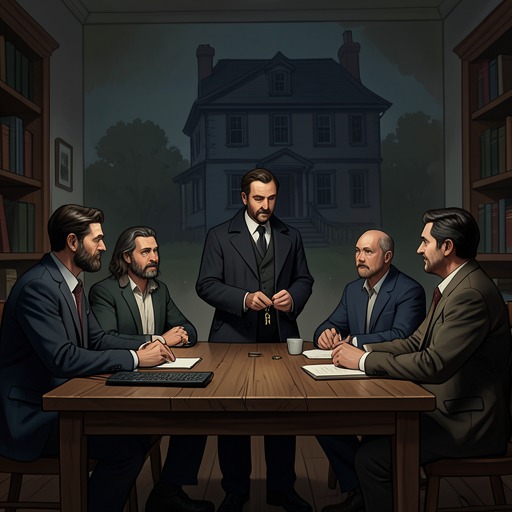
Joshua Rigg Featherstone
MiddlemarchJoshua Rigg Featherstone enters the story as a stranger whose presence at Peter Featherstone’s funeral unsettles the family’s assumptions about the inheritance. He becomes the principal beneficiary of the second will, inheriting land and the residue of the estate, but his eventual sale of Stone Court to Nicholas Bulstrode reveals that the property was never his ultimate ambition. Rigg wants money and the independence to establish himself as a money-changer; his unexpected preference for that trade over landed possession becomes a sharp study of private desire, misjudgment, and the limits of other people’s conjectures.
Identity and Introduction
At the funeral, Rigg is described as a man of about thirty or thirty-three, with prominent eyes, a thin-lipped mouth turned downward, and hair brushed sleekly back from a forehead that recedes above the brow. His fixed, frog-like expression makes him immediately conspicuous among the mourners. Because he has been invited, the assembled relatives infer that he must be a new legatee. His arrival turns speculation into uncertainty: they do not know him, but their guesses about the will must now account for his presence.
Mary Garth is the only person present who has seen him before. She knows only that he has twice visited Stone Court while Peter was downstairs and sat alone with him for several hours. She had mentioned these visits to her father, Caleb Garth, whose observant interest contrasts with the alarm and suspicion on the other faces. Rigg enters the panelled parlour and takes a seat near the door as the company waits for the will to be found and read. He gives no sign of surprise at becoming the focus of the room’s attention.
The Wills and the Inheritance
The first will names Rigg as residuary legatee and sole executor, and provides that he is to take the name Featherstone. The announcement produces a visible stir among the mourners, who stare at him as the unexpected beneficiary. The second will changes the terms: it revokes the earlier dispositions except for the smaller legacies and leaves Rigg all the land in Lowick parish, together with its stock and household furniture. The residue of the property is instead assigned to the construction and endowment of almshouses near Middlemarch, to be called Featherstone’s Alms-Houses.
The relatives’ reactions reveal how deeply their expectations had become entangled with the estate. Mr. Vincy protests that the later will must be invalid, but Mr. Standish points out that it is regular and accompanied by a solicitor’s letter. Rigg, meanwhile, is not merely the beneficiary at the centre of the family’s hopes and resentments: he is the person on whom the legal disposition places the land and property. Peter’s decision to leave the residue to almshouses rather than to his relatives makes Rigg’s inheritance both substantial and sharply bounded.
After the reading, Rigg shows little concern for the family’s innuendoes. He approaches Mr. Standish and asks practical questions about business, speaking in a high, chirping voice and with an unpleasant accent. Fred Vincy, who had once found Rigg laughable, now regards him with disgust, while a local mercer watches for a chance to cultivate the new proprietor as a possible customer. The change in Rigg’s standing makes him an object of calculation as well as resentment: others assess what his wealth might mean for them, even as he turns to the business of managing his affairs.
Rigg and John Raffles
A later exchange at Stone Court makes Rigg’s family history clearer. John Raffles, his estranged stepfather, presses him for money, presenting an investment in the tobacco trade as a way to provide for Rigg’s mother and to establish himself in a settled occupation. Rigg refuses. He believes that any money given to his mother would be taken by Raffles, and rejects the older man’s account of himself as a reformed, business-minded provider.
Rigg’s refusal rests on remembered grievances. He accuses Raffles of kicking him when he was young, consuming the best food meant for him and his mother, selling what he could and leaving them in need. He says his mother will receive a weekly allowance, but threatens to stop it if Raffles returns to the premises or follows him into the country. Should Raffles come back, Rigg says, he will be driven away by the dogs and the wagoner’s whip. The encounter reverses their former balance of power: the boy Raffles once mistreated now controls the property and can set terms for the household. Raffles does not depart chastened; he laughs, produces a brandy flask, and tries to extract brandy and a sovereign before leaving. Rigg’s authority is real, but it does not erase the older man’s persistence or the damage embedded in their relationship.
Stone Court and the Money-Changer’s Ambition
Rigg’s sale of the Stone Court land to Bulstrode is first registered through correspondence between the two men. The transaction also sets in motion the later discovery of a letter, an ordinary scrap of writing whose significance depends on who finds it and can understand it. In the account of the sale, however, the more striking revelation is Rigg’s own motive. Peter had imagined his legatee enjoying Stone Court, and other observers naturally assumed that acquiring the estate would be the fulfilment of Rigg’s hopes. They had mistaken possession for desire.
From boyhood, Rigg had been drawn to the money-changers’ shops he saw through the windows of a seaport. He wanted to become a money-changer himself: to run a shop on a busy quay, hold the keys to the safes, and handle coins from many nations while customers looked on from the other side of an iron grille. He had acquired the knowledge needed for this purpose, and although wealth might also enable him to marry respectably or pursue other pleasures, those possibilities mattered less than the occupation he had singled out as his chief good. When others believed he was settling at Stone Court for life, he was already looking toward a place on North Quay and a shop fitted with safes and locks.
His decision reframes the inheritance. Stone Court is valuable not because he mistakes it for the life he wants, but because its sale can bring him nearer to the business that has long captivated him. Bulstrode interprets the ease of acquiring the property as a possible providential sanction for his own plans, while Rigg’s destination remains outside the frame of that interpretation. The same transaction therefore means different things to the two men: for Bulstrode, a landed retreat and an occasion for religious self-explanation; for Rigg, a step toward money-changing.
Character and Narrative Significance
Rigg is revealed through a reversal between public appearance and private purpose. At the funeral he is defined by the strangeness of his face and the mystery of his invitation; once the will is read, others define him by the land he inherits. The later account supplies the desire they could not see: Stone Court is less compelling to him than the shop on North Quay. The episode demonstrates how readily people project their own measures of wealth and happiness onto someone whose aims they do not know.
His self-command also contrasts with the emotional turbulence of the inheritance gathering. He does not appear astonished when named, and after the will is read he turns calmly to business, while the disappointed relatives struggle with anger, grief, and thwarted expectation. That composure does not make him benevolent: his dealings with Raffles are hard and grounded in a history of abuse, and he exercises control over his mother’s allowance. But the narrative gives the refusal a concrete cause in Raffles’s past conduct rather than presenting it as an unexplained display of cruelty.
Rigg’s story also complicates the idea that a legacy determines its recipient’s future. Peter’s relatives read the estate as the centre of the contest, and Peter himself imagines the new legatee enjoying it. Rigg instead treats the land as a means to a different end. His inheritance, sale, and planned move toward a money-changer’s shop connect family greed and testamentary uncertainty to the difficulty of knowing another person’s desires. In this way, the unexpected heir becomes more than a twist in the reading of the wills: he is the clearest example of how private ambition can remain invisible beneath the public facts of property and status.