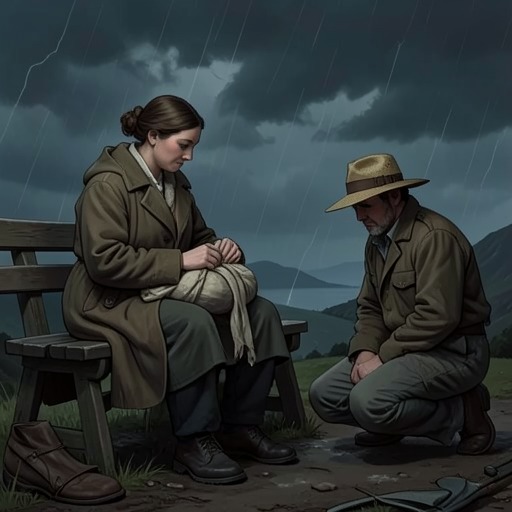
A poetry fragment attributed to Christabel LaMotte
PossessionA poetry fragment attributed to Christabel LaMotte is a small, uncertain piece of evidence whose force lies in what it cannot settle. Sent among papers found with Sabine de Kercoz’s things, the scraps invite Maud Bailey to connect poetic images of bearing, pain, and spilled milk with the unanswered question of what happened to Christabel’s child. The fragments suggest a possible history, but neither their authorship nor the child’s fate is established.
Discovery and Attribution
Ariane Le Minier sent Maud a page of poem scraps recovered among Sabine’s belongings. Ariane had no specimen of Christabel’s handwriting with which to verify the pages; she could only say that she thought they might be Christabel’s and that they appeared to confirm that something had gone wrong. The attribution therefore remains tentative, and the scraps reach Maud not as an authenticated manuscript but through a chain of discovery and interpretation.
One fragment invokes Our Lady bearing pain and follows with the line “She bore what the Cross bears.” These few words place physical bearing beside religious suffering, but they do not identify the speaker, a particular event, or the child’s fate. Their compression makes them resonant evidence without making them a definitive account.
The “Spilt Milk” Fragment
A further scrap is associated with the poem “Spilt Milk.” Its surviving images include a sudden stillness, likened to a stone, and “A white Disfigurement” followed by “A quiet creeping Sleek.” The fragment’s broken, spare form offers no narrative explanation of what has been lost. Instead, its title and images provide material that Maud reads against the possibility of a concealed birth and its aftermath.
Maud’s Interpretation and the Unresolved Loss
Maud is saddened by the poems Ariane has enclosed. She takes the second fragment to mean that the child was born dead, and understands “Spilt Milk” as evidence of terrible guilt on Christabel’s part over whatever happened to the infant. She also gives the image a bodily meaning: milk produced by a woman who cannot feed a child becomes pain. Her reading turns the scraps into an indirect account of maternal loss, but it remains an interpretation rather than a fact confirmed by the poems.
That uncertainty matters because the surrounding inquiry has not established whether the child survived. The records at the Convent of St Anne contain no trace of Christabel, and their already scant contents had been cleared out in the 1920s. The possibility that the child was born and murdered in a barn is doubted, while the suggestion that it may not have survived is itself conjectural. Against these gaps, the poem scraps preserve an emotional possibility without resolving the historical one.
Significance
The fragments make private suffering legible only in partial, mediated form: anonymous-seeming scraps pass from Sabine’s papers through Ariane to Maud, whose reading supplies a possible narrative. Their religious language, images of bodily bearing, and association with spilled milk encourage a connection to childbirth and grief, yet the uncertain handwriting and missing records prevent that connection from becoming proof. The poems therefore deepen the mystery around Christabel’s child while showing how readers construct meaning from damaged or incomplete evidence.