Randolph Henry Ash’s gold watch
PossessionRandolph Henry Ash’s gold watch is at once a timepiece, an object of scholarly display, and a personal link through which Mortimer Cropper imagines his closeness to Ash. Its appearances connect public arguments about preserving the past with private acts of inheritance and mourning.
Cropper’s possession and public display
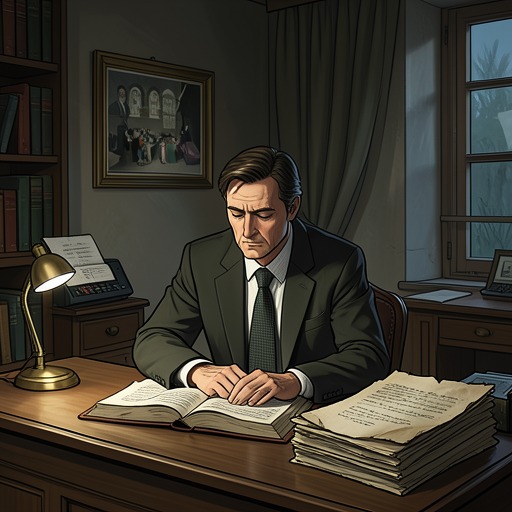
Cropper bought the watch with his own funds, but his arguments about the care of historical objects made its ownership uneasy even to him: by his stated principles, it might belong safely in the Stant cabinets. He considered placing it in his own hand beside a hologram of itself, turning the original and its illuminated likeness into a demonstration of the museum of the future.
The watch also marks the end of Cropper’s lecture. He checks it for the elapsed time—50 minutes and 22 seconds—and uses it to time the questions that follow. He had once publicly claimed it with a joke about continuity between Ash’s time and his own, but gave up that performance. The lecture’s public case for circulating vivid representations of relics therefore sits beside a more intimate attachment: Cropper privately believes that the watch was meant to come to him and that, by holding it, he holds something of Ash. Its ticking becomes a personal claim that his carefully reasoned argument about stewardship cannot entirely contain.
A keepsake passed between generations
The watch’s meaning contrasts with the small drawings and letters exchanged between Ash and Sophia Wapshott. Ash presents his drawing of an ash tree as a reciprocal gift for Sophia’s drawings of ducks, and explains its mythic associations. The watch, by contrast, circulates through Cropper’s acquisition and institutional ambitions. Together, these objects show how Ash’s legacy reaches later generations through material things as well as through texts.
A separate chain of family transmission surrounds the papers associated with Christabel LaMotte. Maud Bailey explains that, after LaMotte’s death in 1890, her sister Sophia sent papers and poems to her daughter May, who was Maud’s great-great-grandmother, with the expressed wish that the work be handed down through the female line. That account concerns LaMotte’s papers, not the watch, but it places Cropper’s possessive attachment within the novel’s wider contrast between objects held by individuals and legacies passed through families or entrusted to institutions.
The watch in Ellen’s mourning
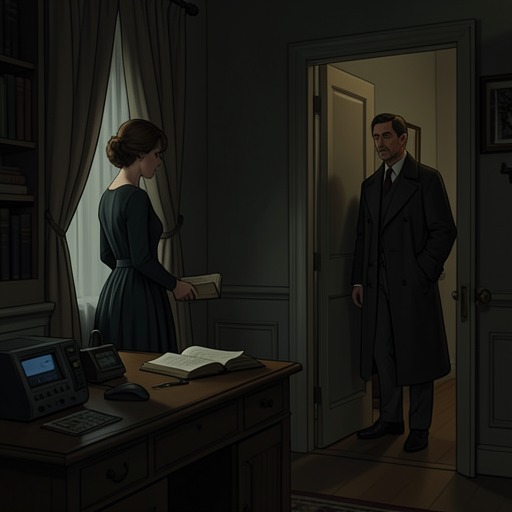
After Ash’s death, Ellen has the watch in her dressing-gown pocket as she enters his workroom. Looking at it, she recalls that three o’clock is the last morning he will spend in the house. The timepiece thus anchors a moment of impending separation while she faces the practical and emotional task of deciding what will happen to the papers and scientific collections he left behind.
In Cropper’s hands the watch supports a claim of scholarly intimacy; with Ellen, it belongs to the immediate history of a marriage and a final morning. Its recurrence does not erase the difference between those relationships. Instead, the same object makes visible how Ash’s material legacy can be treated as an acquisition, an institutional responsibility, or a private remnant of shared life.