Maud Bailey’s mermaid brooch
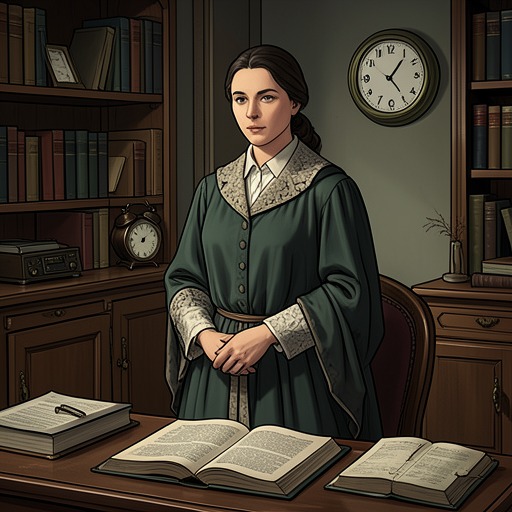
PossessionMaud Bailey’s mermaid brooch is both a family keepsake and a crafted object whose details invite new readings. Maud has kept it since childhood, when she found it in a family dressing-up box and associated it with the Little Mermaid. In Yorkshire, a specialist eye identifies it as an unusually fine Victorian piece, likely by Isaac Greenberg, and draws attention to its branching coral, workmanship, and mermaid figure. The brooch’s passage from heirloom to closely examined artifact makes material inheritance one of the means by which the novel links private memory, historical research, and the persistence of things across time.
Appearance and Identification
The brooch depicts a mermaid seated on a rock, her dark shoulders turned toward the surface. Her hair falls down her back, while her tail follows the line of the rock; coral encloses the scene. Roland had initially taken the surrounding branches for twigs. The older woman in the shop, examining it under a small Anglepoise lamp, recognizes the coral and judges the piece to be the work of Isaac Greenberg, whose work had been exhibited with corals and rocks at the Great Exhibition. She remarks on the lifelike tail fins and carefully rendered hair, and contrasts the craftsmanship with work that, in her view, has since been forgotten.
The brooch is therefore not merely a familiar ornament but an object whose appearance changes under sustained attention. Maud had worn it as a treasured but little-appreciated item; the craftswoman’s reading makes its material and artistic qualities newly visible. The scene turns close looking into a form of historical recovery: the object’s workmanship can still be read, even when its maker and precise history are not established in the conversation.
Family Heirloom and Personal Association
Maud tells the shopkeeper that she found the brooch in the family button box when she was young. The box belonged among a larger collection of old buckles, buttons, and miscellaneous objects used for dressing up. Her mother considered the brooch unattractive Victorian junk, but Maud kept it because it reminded her of the Little Mermaid. More recently, she has also associated it with the fairy Melusina.
That history gives the brooch a layered identity. Its place in the family predates Maud’s understanding of it, and the account does not establish who first owned it or how it entered the box. Maud’s own associations have accumulated around the object rather than resolving its origins: childhood reading first supplied a meaning, and her later knowledge of Melusina added another. The craftswoman’s attribution introduces a further, historically oriented interpretation without displacing Maud’s personal ones.
The Brooch as an Encounter
The brooch becomes more than a subject of conversation when the shopkeeper asks for a close look. Maud first hesitates between removing the brooch and taking off the scarf that covers her head. She does both, setting the scarf on the counter and handing the object to the woman. This practical act of making the heirloom available for inspection also exposes Maud’s carefully pinned hair, which Roland sees as pale braids wound around her head.
Roland’s attention shifts from the brooch to Maud. In the drained light of the shop, he first perceives her as unusually exposed; as her expression changes, he sees fragility and vulnerability instead. He feels a sympathetic discomfort at the tightness of her hairpins, and both raise their hands to their temples, momentarily echoing one another. The passage makes the act of looking reciprocal: the craftswoman studies the brooch, while Roland’s close attention to the object’s removal reveals a new aspect of Maud to him. The brooch’s temporary separation from her clothing thus creates a brief, charged encounter without changing its ownership.
Material History and Transformation
The craftswoman’s recognition places the brooch within a local tradition of skilled Yorkshire work. Her reference to Greenberg and the Great Exhibition offers a plausible account of its craftsmanship, but the scene does not supply a documented provenance. What it does establish is the contrast between the object’s survival and the apparent disappearance of the skills that made it. The brooch remains available to be handled and interpreted, while the work it represents is described as no longer produced in the same way.
This emphasis on making and survival resonates with Randolph Henry Ash’s reflections on the Yorkshire jet industry. He describes fossil material fashioned into polished ornaments and writes of long-dead forms receiving new lives as brooches; he is drawn to the persistent shape-shifting of things that are dead but not vanished. The mermaid brooch is not identified as one of Ash’s objects, and the novel does not state that he saw it. The connection is thematic: both passages consider how crafted objects preserve traces of earlier lives and invite the present to remake their significance.
Narrative Significance
The brooch gathers together personal memory, female-line inheritance, and the interpretation of the past. Its meaning is not fixed by a single owner or explanation: Maud’s childhood association with the Little Mermaid, her later connection with Melusina, and the craftswoman’s account of Victorian workmanship coexist. The encounter also shows that historical knowledge can begin in attentive examination of an ordinary-looking possession, not only in archives or manuscripts.
Across the novel, objects and papers move through families and scholarly hands, acquiring both emotional and historical value. Maud’s brooch makes that process visible on a small scale. Its family history is incomplete, its precise provenance remains uncertain, and yet its design can still connect a present-day wearer to a maker, a period, and a continuing chain of interpretation. Its importance lies not in conclusively solving its past but in showing how an inherited object can hold several histories at once.