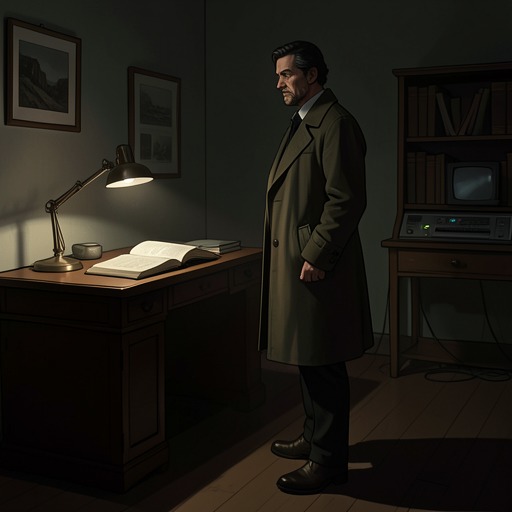
Ash’s letter to Priscilla Penn Cropper
PossessionAsh’s letter to Priscilla Penn Cropper survives as a pointed exchange between a skeptical poet and an energetic spiritualist investigator. In response to Priscilla’s account of a planchette communication attributed to Samuel Taylor Coleridge, Randolph Henry Ash rejects spiritualist manifestations as evidence, but respects her pursuit of truth and her campaign for women’s rights. The document passes through Priscilla’s family into Mortimer Cropper’s hands, where its first encounter becomes the formative episode in his devotion to Ash and his collecting career.
Origin and family custody
Priscilla Penn Cropper, Mortimer Cropper’s great-grandmother, was a native of Maine and the daughter of committed abolitionists who had sheltered people escaping slavery. She spoke in favor of women’s emancipation and participated in other reform movements. She also believed in mesmeric healing and took an active interest in spiritualist experiments. At her New York home, the visionary Andrew Wilson reportedly conversed with the spirits of Swedenborg, Descartes, and Bacon. Her spiritualist inquiries prompted the letter from Ash, although the letter she must have sent him has never been found. Cropper feared Ash might have destroyed it, leaving his own reply as the surviving side of the exchange.
The letter entered Mortimer Cropper’s life through family preservation rather than an institutional archive. His father gave him the handwritten pages, kept in tissue, to see whether he could decipher them. Cropper describes the encounter as a formative shock: touching the document made the long-dead poet feel present to him. The letter thus carried two histories at once: Ash’s response to Priscilla’s inquiry and the beginning of Cropper’s personal attachment to Ash’s papers.
Priscilla’s fortune came from her patent medicine, Regenerating Powders, whose proceeds helped finance Everblest House. Her descendant’s account connects that family history to a broader inheritance of reform, spiritualist activity, and collecting. The surviving letter became one of the family’s most significant documents, preserved among the treasures that would later underpin the Stant Collection at Robert Dale Owen University and its associated museum.
Ash’s reply: skepticism and respect
Ash begins by acknowledging Priscilla’s report about the planchette and the supposed communication from Samuel Taylor Coleridge. He says that Coleridge’s writing would interest him, but objects to the idea that a liberated spirit should be made to move tables, appear in drawing rooms, or produce what he regards as trivial writing. His objection is not simply that spiritualist claims are foolish: he frames them as an affront to the peace of the dead and as an inadequate way of investigating what lies beyond ordinary understanding.
The letter offers a naturalistic explanation for séance phenomena, describing them as a combination of fraud and collective agitation. Ash places the popularity of spiritualism in a period of intellectual uncertainty, when historical and scientific inquiry challenges inherited religious narratives. He nevertheless leaves room for mystery. Wandering spirits or traces of painful memory may exist, he allows, but he argues that such possibilities should be investigated through patient study of minds and living organisms, including microscopy and spectroscopy, rather than through rappings, table movements, levitation, or planchette writing.
Ash’s skepticism is informed by an experience he does not fully explain. He tells Priscilla that he has known a good person with a clear mind to be unsettled by such experimentation, and that the result was harmful. The letter therefore combines scientific caution with concern about spiritualist practice’s effects. It does not claim that every mystery has been resolved; instead, it disputes the reliability of the methods Priscilla has used and asks her not to send him further spirit writings.
That request does not end in hostility. Ash explicitly distinguishes his refusal of the communications from his regard for Priscilla herself. He says he respects her pursuit of truth and expresses enthusiasm for her work on behalf of women, which he expects will ultimately succeed. The letter’s argument therefore turns on a contrast: Ash refuses the evidence produced by the planchette, but he recognizes the intellectual seriousness and political purpose he associates with its recipient.
Publication and afterlife
Mortimer Cropper later printed the letter in full in the ninth volume of his edition of Ash’s collected letters. An excerpt also appears in a footnote to Mummy Possest, Ash’s spiritualist poem, in the edition of his complete works overseen by James Blackadder. Cropper disputes Blackadder’s identification of Priscilla with the poem’s fictional Mrs Eckleburg, arguing in a separate article that the two differ in important respects. The letter consequently participates in scholarly disagreement as well as in Cropper’s family history: it is evidence about Ash’s views, but its interpretation and the identity of its recipient remain subjects of debate.
The document also shapes the form of Cropper’s autobiographical writing. His accounts repeatedly reach a high point when he transcribes the letter and recalls first reading it, then lose momentum as they turn to ordinary childhood memories or later details of his scholarly relationship with Ash. The pattern suggests how completely the letter organized his recollection of his own life: it was not merely one object among many, but the moment to which his autobiographical narrative kept returning.
Cropper’s preservation of the letter links private inheritance with institutional collecting. The document’s family custody made it available to him; his edition then carried it into the public scholarly record. Yet the missing letter from Priscilla to Ash remains an archival silence, limiting what can be known about the exchange’s original terms. As a result, Ash’s reply is both unusually revealing and incomplete: it records his response to a spiritualist appeal, while leaving the initiating document—and Priscilla’s exact words—unavailable.
Significance
Ash’s letter gives concrete form to the novel’s tension between spiritualist belief and materialist inquiry. It resists both easy credulity and the assumption that every mystery can already be dismissed: Ash allows that unfamiliar phenomena may exist, but insists that they require patient observation rather than séance performance. His reply also connects that epistemological dispute to gender and public life. Priscilla’s spiritualism is rejected, yet her campaign for women’s emancipation receives unambiguous respect.
The letter’s changing custody and use further complicate the idea that an archival document simply speaks for itself. For Priscilla it was a reply to her investigations; for Cropper it became a treasured encounter with Ash and the origin of a scholarly vocation; in later editions it served as evidence in arguments over Ash’s beliefs and the fictional representation of Priscilla. Its absent counterpart prevents the exchange from being reconstructed in full. What remains is a text whose survival preserves Ash’s words while also exposing how family memory, editorial choices, and scholarly interpretation shape the history those words are made to tell.