Blanche Glover’s suicide note
PossessionBlanche Glover’s suicide note turns a private death into a precise account of the conditions that made independent life precarious. Written as a testament, it identifies poverty, pride, and the failure of an ideal of women’s shared life as Blanche’s reasons for dying; it also asks that Christabel LaMotte not be blamed, and places Blanche’s art in the care of her closest companion. The document preserves not only the circumstances of Blanche’s end but her claim that her work has value, even when the present cannot recognize it.
The note as a testament
Blanche begins by insisting that she acts in sound mind, after long reflection, and that her reasons can be stated plainly. The form is deliberately practical: she explains what has brought her to this decision, identifies what she owns, and directs how her possessions should be treated. She recognizes that the document is not legally enforceable, but asks its readers to honor it as if it were. Its modest legal status sharpens its moral force: the note cannot command compliance, so it appeals to the conscience of whoever survives to read it.
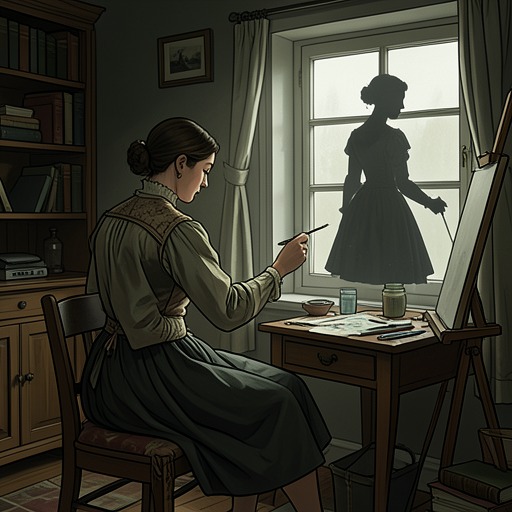
The first reason is poverty. Blanche can no longer afford paint and has sold little work in recent months. She has left four flower paintings in the drawing room, wrapped and ready for Mr Cressy, a former buyer from Richmond Hill; she hopes their sale will provide money for her funeral. She explicitly asks that the expense not be charged to Christabel, whose obligations she acknowledges. Financial hardship is thus not an abstraction in the note: it enters the final arrangements through the cost of materials, the unsold paintings, and the need to finance burial.
Independence and the failed shared ideal
Blanche’s second reason is pride, expressed as a refusal to return to paid domestic service. She describes work as a governess as intolerable even in a kind household, and rejects dependence on Christabel’s charity as well. Her insistence is not simply on self-sufficiency as an ideal; it is also a refusal to survive by surrendering the independence she and Christabel had tried to build. The note presents the alternatives available to her as sharply constrained: poverty on one side, a life of service or dependence on the other.
The third reason is the failure of that experiment. Blanche recalls trying, first with Christabel and later alone in the small house, to show that single women could live useful and fully human lives together without relying on men or outside assistance. The proposed life was to be frugal, charitable, philosophical, artistic, and harmonious with one another and with nature. Blanche does not assign the failure to a single cause. She believes the outside world was hostile to the experiment, while also admitting that she and Christabel may sometimes have lacked the resourcefulness and firmness it demanded. The admission gives the note its unusual balance: it records structural opposition without making the women’s own limitations disappear.
Blanche nevertheless refuses to treat the experiment as meaningless. She hopes its early days of economic independence, and the work left behind, may encourage stronger women to try again. Her warning is that independent women must expect more from themselves, because men and conventionally domesticated women will expect nothing of them except failure. The note therefore moves from personal explanation toward a public challenge: the failed household is not proof that women cannot live independently, but a test whose outcome may be revised by those who follow.
Possessions, art, and friendship
The inventory makes the closeness and unequal circumstances of Blanche and Christabel visible through ordinary objects. The house belongs to Christabel, and Blanche recognizes that the furnishings bought from their shared savings belong more to the wealthier partner. She leaves Christabel free to decide what to do with them. Her books—Shakespeare, Keats, and Tennyson—are intended for Eliza Daunton, if the battered volumes are still useful to her; Blanche remembers that they read them together. The directions preserve a record of shared reading as well as a distribution of property.
Her few pieces of jewelry carry a more intimate history. Blanche intends to wear her seed-pearl cross that night and offers her other trinkets to Jane, except for the jet brooch showing two hands clasped in friendship. Christabel had given her the brooch, and Blanche asks that it be returned to its giver. The object makes their bond legible at the moment the note documents its rupture: a token of friendship passes back to Christabel, while the act of returning it acknowledges that Blanche will no longer be there to wear it.
Blanche’s most emphatic claims concern her paintings. She counts twenty-seven finished works in the house, along with sketches and drawings, and distinguishes two paintings owned by Christabel, “Christabel before Sir Leoline” and “Merlin and Vivien.” She hopes Christabel will keep them and hang them in the room where she works, as she has done before, so that they may recall happier times. If seeing them is too painful, Blanche still forbids their sale or gift during Christabel’s lifetime and asks her to provide for them afterward as Blanche would have done. The paintings are at once artworks, shared memories, and the most enduring part of Blanche’s self-understanding.
She entrusts the fate of her remaining work to Christabel’s artistic conscience, asking that the pieces stay together until taste and judgment make their worth recognizable. Blanche knows she will soon lose the ability to protect them; afterward, they must make their own “dumb and fragile way.” This image joins the practical vulnerability of paintings without a secure market to Blanche’s hope that a future audience might understand her. Her assertion that good art endures for a time does not promise immortality. It offers a limited, hard-won continuity beyond the artist’s life.
Death, belief, and the surviving record
Blanche states that she intends to emulate the author of the Vindication of the Rights of Women, but to improve on that example by sewing the large volcanic stones Christabel kept on her writing desk into her mantle pockets, so that death will be quick and certain. The stones are both practical means and charged remnants of the shared household: objects from Christabel’s desk accompany Blanche out of the house. The note’s account of the method makes the distance between the women’s once-shared life and Blanche’s solitary end especially stark.
Her belief in spiritual survival shapes the note’s closing movement. Blanche recalls the marvels heard at Mrs Lees’s spiritual meetings and the testimony she believes they provided that the dead continue painlessly in a fairer world. She trusts that her Maker will forgive her and make better use of her capacities for love and creative work, which she feels have been unwanted and unused in this life. Calling herself superfluous in the present, she imagines a realm where she will know and be known, and hopes for eventual speech, forgiveness, and reconciliation across the veil. The appeal to faith does not erase the material causes she has set out; it offers a language for the continuation she cannot find within her current circumstances.
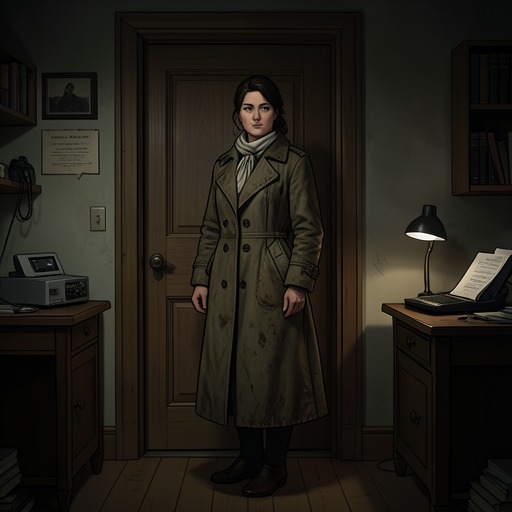
The note closes with Blanche’s self-identification as a spinster, a brief formal signature after its detailed account of poverty, artistic ambition, friendship, and conviction. Later, Maud Bailey reads the document among the scant surviving materials on Blanche’s suicide: a newspaper report, the inquest transcript, a copy of the note, and a few letters. The note’s own wish to be understood by those not yet born thus acquires an archival afterlife. It also leaves unresolved questions about Christabel’s whereabouts and what she thought when she read it. As both testament and surviving evidence, the document gives Blanche a voice while making clear how much of the women’s shared life has disappeared.