Christabel LaMotte’s will
PossessionChristabel LaMotte’s will is a signed and witnessed document whose bequest places her literary papers and copyrights with Maia Thomasine Bailey, LaMotte’s niece and Maud Bailey’s ancestor. Its belated recovery turns a family instruction into a central piece of evidence in the struggle over the Ash–LaMotte letters, while the document’s uncertain legal status prevents the discovery from settling the dispute outright.
Contents and Intended Heir
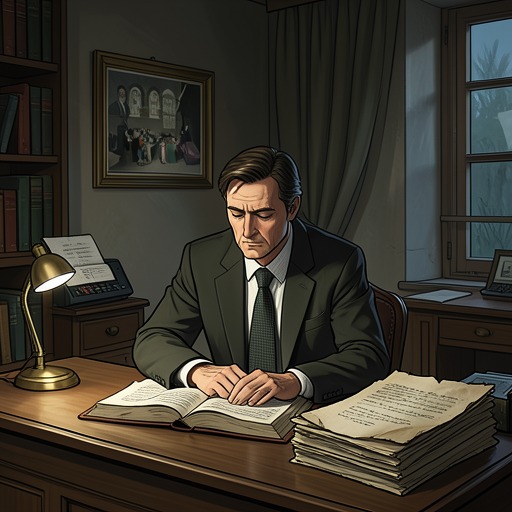
The will was dictated to LaMotte’s sister, Sophia Bailey, on May 1, 1890, when LaMotte was too weak to write clearly. It gives Sophia LaMotte’s money, furniture, and china, and provides £60 for Jane Summers of Richmond if she is still alive. LaMotte directs that all her books, papers, and copyrights go to Maia Thomasine Bailey, in the hope that Maia will become interested in poetry. Lucy Tuck, LaMotte’s lady’s maid, and William Marchmont, her gardener, witnessed the document.
The bequest looks forward to a future reader as well as naming an heir: Maia is to receive not only possessions but the means of encountering LaMotte’s writing. The wording recalls LaMotte’s earlier wish that her papers be sent to a niece in the hope that she might care about poetry. Maia married a cousin, moved to Norfolk, and raised ten children; the surviving account does not say that she pursued the literary interest LaMotte hoped to inspire.
Discovery and Archival Context
The will had been folded among Sophia’s accounts. Euan MacIntyre explains that the accounts show Sophia found Jane Summers and paid her bequest, then apparently kept the document after carrying out that part of her sister’s instructions. The separation between a fulfilled cash bequest and the surviving paper left the larger bequest to Maia obscure to later claimants.
LaMotte’s surviving papers were deposited in the Women’s Studies Resource Centre at Lincoln by Maud’s family. They include manuscripts of Melusina, The City of Is, two books of fairy tales, and scattered lyrics, but the family’s archive is incomplete: Maud says that little care had been taken of the papers and that nothing further had come to light. Blanche Glover’s journal, acquired secretly at a Sotheby’s sale, supplies another fragment of the record. Against this history of scattered, lost, and privately held documents, the will’s presence among ordinary household accounts gives it both evidentiary force and an archival vulnerability.
Property and Copyright Claims
The will matters because ownership of a manuscript and copyright in its text are not treated as the same right. Euan distinguishes physical letters, which belong to their recipient, from copyright, which belongs to their writer. Since LaMotte had requested the return of her letters and Randolph Henry Ash complied, Euan argues that the returned letters belong materially to LaMotte’s estate. The will’s gift of her papers and copyrights to Maia therefore supports Maud’s claim, as a descendant and custodian of the family manuscripts, to the physical correspondence and copyright in LaMotte’s side of it.
The claim does not extend automatically to copyright in Ash’s letters. At the gathering where the competing claims are discussed, Euan says that Maud is the heir to the LaMotte letters and probably to the manuscripts of Ash’s letters, but that copyright in the latter belongs to Ash’s heirs. The distinction makes the correspondence a divided legal object: its pages may pass through one line of inheritance while rights in the words on them remain with another.
Limits and Consequences
The document is not presented as an incontestable legal settlement. Euan acknowledges that it is not a properly registered will and that Sir George Bailey could dispute Maud’s title; procedural loopholes leave the claim open to challenge. His view is that Maud should be able to prove ownership of the collection, but the prospect of litigation—and the danger that legal fees could consume the proceeds—makes the practical consequences uncertain. The will thus strengthens Maud’s position without ending the contest.
Its force also depends on a chain of custody and interpretation: Sophia preserved the paper, Maud’s family deposited LaMotte’s manuscripts, and Euan found and verified the signature while Maud was away. When Mortimer Cropper later claims the letters for his own purposes, Euan publicly asserts that Maud owns the manuscripts on both sides, relying on the will and on the return of LaMotte’s letters. The document’s significance lies not in a simple declaration of ownership, but in how it links family memory, archival survival, copyright, and the contested right to control private correspondence.