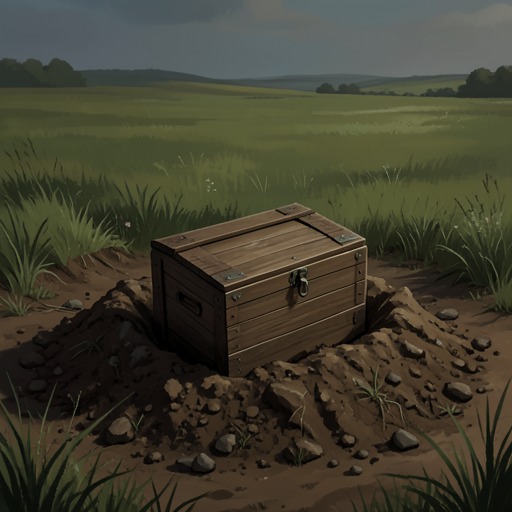
The specimen case from the Ashes’ grave
PossessionThe specimen case from the Ashes’ grave is the container in which Ellen Ash placed objects she could neither destroy nor leave unprotected after Randolph Henry Ash’s death. Buried with him, it held the surviving evidence of his relationship with Christabel LaMotte alongside tokens bound to Ellen herself. Its later removal by Mortimer Cropper and opening before the gathered researchers transform a private act of mourning into a public revelation, while the unopened letter inside leaves questions of ownership and interpretation unresolved.
Contents and Private Custody
Ellen’s journal records a decision made among the objects left in Ash’s workroom: a packet of letters tied with faded violet ribbons, a bracelet she had woven from their hair, his watch, an unfinished letter in his hand, a letter addressed to herself, and a sealed envelope. The case is not merely a receptacle for papers. It gathers objects with different claims on the dead: the shared correspondence, the hair that physically joins Ellen and Ash, a lock kept in the watch, and a letter whose intended recipient was Ash. Placing them together preserves the distinctions among their histories even as burial conceals them.
Ellen’s choice follows a conflict between her promise and her knowledge. As Ash lay dying, he asked her to burn what others should not see; she promised, and did burn some material. She understood his fear that biographers would turn private pain into curiosities, recalling his objections to intrusions into the lives of Charles Dickens and the Carlyles. But she could not burn everything. Their letters could not simply be entrusted to the future, and the other woman’s letter was not Ellen’s to destroy. The case therefore becomes a compromise: the papers are hidden from casual scrutiny, but preserved rather than annihilated.
The burial also carries Ellen’s unresolved feeling for the woman she understands as, in one sense, Ash’s true wife and the mother of his child. She does not want to read the letter addressed to Ash, because knowledge might become a further instrument of pain; instead she puts it away with the shared love letters. The case protects the correspondence from public rummaging, but it cannot settle the emotional and ethical claims embodied in its contents. Its silence is deliberate, not empty.
The Case as Evidence
The box survives as a reference point in the later investigation through Ellen’s account of Ash’s death and burial. Beatrice Nest recalls hearing Cropper discuss the possibility of recovering it after Hildebrand Ash inherited it, while acknowledging that disturbing a churchyard burial would require a bishop’s Faculty. Cropper presents himself as a discreet custodian and argues that the object belongs both to Hildebrand and to the world. The exchange exposes how scholarly preservation can shade into appropriation: reverence for Ash’s legacy does not remove the legal and moral limits on taking what was buried.
When Cropper finally digs, the specimen case emerges from the earth as an oblong, corroded object. In the storm he scrabbles at the soil and clutches it, then works at its rusted join with oil and a knife. Opening the outer container reveals Ash’s glass specimen container, cloudy and stained but intact. Within an oiled-silk bag lie the hair bracelet, a blue envelope containing a long, finely plaited thread of pale hair, another oiled-silk package holding a thick bundle of ribbon-tied letters, and a long, once-white envelope addressed to Randolph Henry Ash, under cover.
These contents confirm that the grave held more than a single cache of correspondence. The hair bracelet, whose silver clasp shows two hands joining, and the plaited hair connect bodily tokens to the written record; the letters establish the concealed relationship that Ellen had chosen not to destroy. Cropper identifies the bundle as the lovers’ letters. The sealed envelope, however, remains unopened at the moment of discovery. Maud Bailey recognizes the handwriting only tentatively, and Euan MacIntyre immediately notes the unresolved property question: whether an undelivered letter belongs to its sender or to the addressee in whose grave it lies.
From Burial to Public Discovery
The case’s passage from Ellen’s private custody to Cropper’s hands repeats the novel’s central tension between preservation and access. Ellen buries the objects because she refuses both the public exposure Ash feared and the destruction of material she cannot rightly burn. Cropper, by contrast, treats recovery as a professional undertaking and imagines himself as custodian of evidence of worldwide interest. The physical integrity of the container makes that conflict consequential: its contents survived, but only because they were hidden from the very scholars who would later claim a right to examine them.
The object also gathers together several forms of evidence that do not speak with equal clarity. The correspondence can be read; the hair can be handled and compared; the unopened letter can only be inspected from the outside until someone decides whether to break its seal. Its contents therefore do not simply solve a mystery. They produce a new decision about who may read, own, or interpret private writing. In this way, the case preserves the past without making it fully available, and its opening reveals both what Ellen saved and what she had not chosen to disclose.