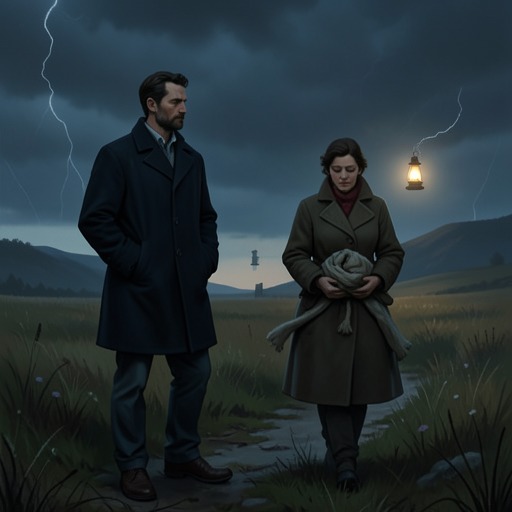
Grummer’s tree-letters
PossessionGrummer’s tree-letters are a group of four brief messages by Randolph Henry Ash, remembered in the Wapshott family as letters from “that there poet.” Addressed to a child named Sophia, they combine drawings and observations about trees with a rare glimpse of Ash’s affectionate attention to a young reader. Their movement from a personal gift into an inherited family holding, and then into the orbit of Mortimer Cropper’s collecting, makes them a compact example of the novel’s larger concern with who preserves literary evidence and who has the right to possess it.
The letters and their first recipient
The surviving group consists of four little messages, accompanied by drawings of a plane, a cedar, a walnut, and an ash. The letter addressed to Sophia begins by thanking her for drawings of ducks and drakes, singling out an upended duckling searching among the roots and grubs at the bottom of a pond. Ash says he cannot draw as well as she can, but that gifts ought to be reciprocated. His answer to the child’s pictures is a lopsided drawing of his namesake tree.
The ash gives the letter its central lesson. Ash calls it both common and magical: not magical in the same way as the mountain ash, but associated with the Norse belief that the world was held together by a tree rooted in the underworld and reaching toward Heaven. He adds practical and literary details, noting the tree’s use for spear shafts and climbing, and recalling that Tennyson had observed its black buds. Nature study, mythology, everyday use, and literary reference occupy the same small space; the exchange treats a child’s curiosity as a proper occasion for serious attention.
Ash also explains why he calls his recipient Sophia rather than Sophy. He connects the name with wisdom, specifically heavenly Wisdom, which kept order before Adam and Eve sinned in the garden. Yet he does not make the child’s future wisdom the only point of the letter. He insists that she is now in her playing-time, a time for delighting in ducks, and signs himself her elderly admirer. The combination of learned allusion and tenderness distinguishes these messages from formal scholarly correspondence.
A rare image of Ash
Cropper regards the Sophia letter as exceptionally unusual: it is the only letter to a child that he knows to exist. This matters because Ash has a general reputation for impatience with children and is not known to have tolerated his wife’s nephews and nieces. The letters therefore complicate the familiar public image of the poet. They do not erase his impatience elsewhere; instead, they preserve a particular relationship in which attention, reciprocal gift-giving, and playful instruction are visible.
The letter’s form helps make that relationship legible. Ash responds to Sophia’s drawings with his own imperfect drawing, then expands the exchange into a miniature account of tree lore. His admission that his drawing is inferior does not diminish the gift: it makes reciprocity, rather than mastery, the point. The surviving messages thus register not only what Ash knew about trees but how he adapted that knowledge for a child.
Family custody and the proposed sale
The letters came to light through Daisy Wapshott, whose husband Rodney had inherited them from his mother, apparently named Sophia and apparently Ash’s godchild. Rodney’s mother had described the papers as letters from a famous poet, although the family did not know exactly how they had entered her possession. A local bookseller told Cropper about them after hearing of what the Wapshotts called “Grummer’s tree letters.” Cropper then spent six months approaching Daisy before travelling from Piccadilly to the outskirts of Preston to see the papers in person.
Daisy explained that she had married Rodney during the War, after meeting him while they were fire-fighting; she had been a lady’s maid, while he seemed a gentleman but showed little inclination for work. They ran a general haberdashery, in which she did most of the work. Rodney’s mother had given him the letters, saying that he might be the literary one. He showed them to the vicar, who thought them of little interest. Daisy herself had said she would never part with them, describing them as only letters to a child about trees.
That initial refusal is qualified by the family’s understanding of the papers as an inheritance meant to continue. Rodney wanted the letters to go to their daughter Katy in case she proved to be the literary one. Katy had taught English before having children and had often expressed interest in the papers. Daisy had kept Katy’s old bedroom ready for her return, and she treated the letters in a comparable way: not simply as saleable documents, but as something belonging to her daughter “in a sort of way,” held in trust. The distinction between legal possession, family expectation, and personal attachment remains unresolved in the conversation.
Cropper presents the Stant Collection in Harmony City as the largest and finest collection of Ash’s correspondence anywhere in the world. He argues that the small letters would add detail to his effort to know everything Ash did and everyone who mattered to him, and promises preservation in controlled conditions with access limited to accredited scholars. He also says the collection has ample funds and offers an advantageous price. Daisy does not immediately agree to transfer the papers; she says she must consult Katy. The exchange sets Cropper’s institutional language of preservation and scholarly access against a family claim grounded in inheritance and an intended recipient.
From private gift to literary evidence
Cropper’s interest is sharpened by the letters’ rarity, but his collecting method also gives the encounter an acquisitive edge. Before securing Daisy’s agreement, he photographs the other letters, having already made a private record of documents in case owners later refuse a sale or even copies. In other cases, his clandestine photographs have been the only surviving record of vanished papers. With the Wapshott letters, he expects that a purchase can be arranged, but he knows the owner may refuse. The episode shows that an archive can preserve evidence while also depending on strategies that circumvent an owner’s control.
The letters’ later significance extends beyond Cropper’s approach. In a later account of family papers, Maud Bailey explains that when Christabel LaMotte died in 1890, her sister Sophia sent a package of papers and poems to her daughter May, Maud’s great-great-grandmother. Sophia’s covering letter reportedly conveyed Christabel’s wish that May should have the papers, because Christabel believed in passing things down through the female line. That family transmission belongs to the history of LaMotte’s papers, not to the Wapshott chain of custody; together, however, the accounts make inheritance a recurring alternative to the scholar’s attempt to gather literary material into a collection.
A further echo appears when James Blackadder offers Roland Michell a full-time research fellowship on Ash, funded by a Scottish philanthropic trust after Blackadder’s television appearance. The offer illustrates the continuing institutional and financial machinery built around Ash’s legacy. Against that machinery, Grummer’s tree-letters retain the scale of their origin: an older poet’s answer to a child’s drawings, preserved because one family passed them to another rather than because they were initially recognized as important. Their modest subject—trees—becomes a record of affection, transmission, and the uncertain boundary between safeguarding documents and claiming them.