Sabine de Kercoz’s journal
PossessionSabine de Kercoz’s journal is an incomplete record of Christabel LaMotte’s presence in the de Kercoz household and the events surrounding it. Preserved in a notebook but interrupted by missing pages and an uncertain continuation, it offers evidence through both what it records and what it cannot settle. Its discovery changes the scholars’ understanding of LaMotte’s past without turning the surviving account into a complete explanation.
Form and Preservation
The journal survives in a notebook whose entries do not make a continuous record. A note by Ariane Le Minier marks a stretch of missing pages and observes that the writing that follows has become perfunctory and repetitive. Le Minier had not photocopied the remainder of the month before Christmas evening, when she examined it; she nevertheless made the material available for Maud Bailey to see.
The notebook’s incompleteness is not merely a physical defect. It shapes what can be known about the period it documents: some passages are absent, others offer less detail, and the surviving sequence does not resolve every question it raises. The journal therefore functions as a partial witness, requiring readers to distinguish its recorded events from later conjecture.
The Unfinished Record
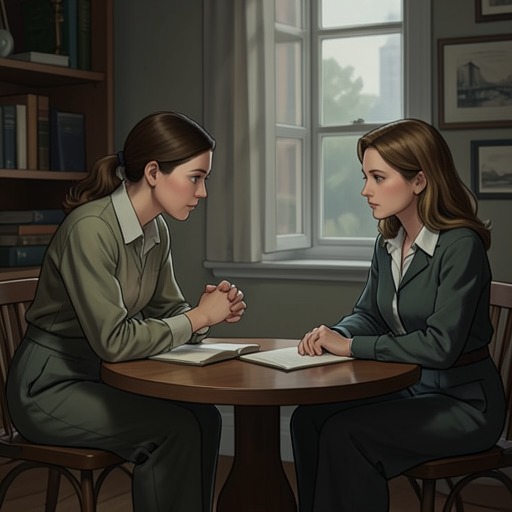
The final surviving entry is dated May 10. Sabine reports that a letter addressed to her father arrived from M. Michelet, with a second letter enclosed for Christabel. The message had been sent by a friend on the possibility that LaMotte might be staying with the family; if she was not there, the sender asked that it be returned. LaMotte appeared composed when told of it, but after seeing the letter she caught her breath, set it aside unopened, and left it unopened throughout the day. Sabine did not know whether or when she eventually read it.
After that entry, the journal ends and the notebook nearly ends. Le Minier considers the possibility that Sabine continued writing in another book, but says that no such continuation has been found. The gap leaves LaMotte’s response to the letter, and the journal’s account beyond May 10, unknown. The document preserves the moment of a possible communication while withholding its outcome.
Discovery and Scholarly Consequences
Le Minier sent Maud Bailey a note explaining that the journal had ended and that its possible continuation remained undiscovered. She deliberately chose not to tell Bailey much of its contents, hoping Bailey would experience the surprise and pleasure of encountering the narrative herself. Le Minier proposed that they compare notes with Professor Stern when she returned from the Cévennes, making the journal part of an ongoing, collaborative investigation rather than a settled account.
The discovery also unsettles a received picture of LaMotte. Le Minier had understood LaMotte scholars to regard her as having lived a secluded life in a happy relationship with Blanche Glover. The journal led her to ask whether another lover might have fathered the child, and whether Glover’s suicide was connected with the history recorded there. She raises these as questions, not conclusions: the surviving material prompts new lines of inquiry but does not establish their answers.
Narrative and Interpretive Significance
The journal’s evidentiary force lies in the tension between intimate detail and archival silence. Sabine records the letter’s arrival and LaMotte’s reaction, yet cannot say whether it was opened; the notebook itself then stops, with no confirmed continuation. Its fragmentary form makes absence part of the historical problem rather than an invitation to supply an unsupported ending.
In the novel’s broader investigation, the journal gives scholars access to a perspective on LaMotte’s life that challenges the assumptions they brought to it. But access is mediated: Le Minier controls how much she initially discloses, the surviving pages are incomplete, and the scholars must compare interpretations rather than treat the notebook as transparent or conclusive. The journal thus advances the inquiry while preserving uncertainty about the very history it helps reveal.