Randolph Henry Ash’s draft letters to Christabel LaMotte
PossessionRandolph Henry Ash’s draft letters to Christabel LaMotte are two unfinished appeals to resume a conversation after a breakfast party at Crabb Robinson’s. Folded into Ash’s copy of Vico and discovered by Roland Michell in the London Library, the unsigned, undated drafts expose a striking urgency beneath Ash’s customary reserve. Their variant wording records not a completed correspondence but a possibility: Ash’s desire to speak again, and the uncertainty over whether he ever sent either letter.
Discovery and Physical Form
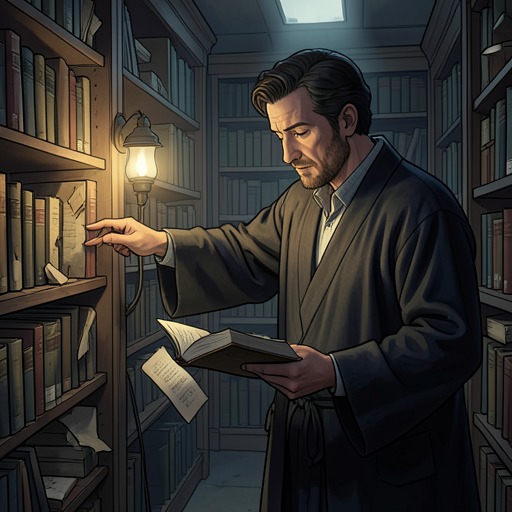
At eleven-fifteen, while examining Ash’s annotations in Vico, Roland found two complete sheets of writing paper folded beneath page 300. Both were in Ash’s flowing hand, carried his Great Russell Street address, bore the date June 21st without a year, began with “Dear Madam,” and were unsigned. One draft was considerably shorter than the other. Their placement among Ash’s working papers made them part of the same material trail as Roland’s examination of his marginalia, but the sheets were distinct from the Vico annotations he was methodically transferring to his card index.
The discovery came as Roland pursued a chain of interpretive clues in Ash’s reading. A passage on golden apples and grain led him to connect Proserpina with Ash’s imagery; on a bill for candles, he also found Ash’s thought about an individual joining a community of thought and dying while the species continued. Those notes prompted further questions about Ash’s ideas and the dating of his papers. The letters, tucked into the same volume, abruptly shifted the investigation from interpreting a dead poet’s reading to encountering words addressed to a particular, unidentified woman.
Two Versions of an Appeal
Both drafts return to the “extraordinary conversation” at Crabb Robinson’s table and seek a way to continue it. The longer version presents Ash as deeply affected: he recalls the woman’s sympathy, wit, and judgment, says that he has thought of little else, and asks whether he might call on her the following week. Its language presses toward certainty, insisting that they must speak again and dwelling on how much they managed to communicate amid the party’s conversation.
The shorter version adopts a more measured opening, describing their conversation as “pleasant and unexpected” and asking whether it might resume “more privately and at more leisure.” It recalls the circumstances that brought the woman to the breakfast: she had come to honour Crabb because he had assisted her father and valued his work. It also preserves the social setting with comic specificity, recalling Crabb’s stamina at eighty-two, his guests’ varied professions, the anecdote of the Bust, and the arrival of buttered toast.
The longer draft expands the appeal into an account of literary recognition. Ash wonders whether the two of them understood each other unusually well, or whether that impression comes from the over-excitement of a middle-aged poet whose meanings have been ignored. He recalls her judgment of his dramatic personae, including her understanding of Alexander Selkirk’s monologue, his poem about John Bunyan, and his treatment of Iñez de Castro. The drafts thus make the woman’s response to Ash’s writing central: the proposed private meeting grows out of his sense that she has read him with uncommon attention.
Dating and Scholarly Stakes
The letters give no year, so Roland tries to place them from their references. He reasons that they must follow the 1856 publication of Ash’s dramatic poems, Gods, Men and Heroes, which had disappointed Ash’s hopes and received hostile reviews describing the verse as obscure and the characters as extravagant. The works mentioned in the draft belong to that collection: the castaway’s reflections in “The Solitary Thoughts of Alexander Selkirk,” the prison meditations of “The Tinker’s Grace,” and the strange declaration of love in “Pedro of Portugal.”
This dating remains an inference rather than a settled identification. Roland considers whether Crabb Robinson’s papers might establish the breakfast gathering: they were held at Dr Williams’s Library in Gordon Square, and Robinson had supported University Hall as a place where lay students could experience collegiate life. The party’s combination of poets, students, a mathematical professor, a political thinker, and a reclusive woman offers a possible route to locating the encounter, but the drafts themselves do not name their addressee or specify a year.
The uncertainty extends beyond the meeting. Roland wonders whether a correspondence followed and whether it might alter scholarly understanding of Ash’s work, or whether the impulse to write faltered before a letter was sent. He had thought of Ash as a poet whose energetic and wide-ranging work came from a quiet, exemplary marriage and a guarded, courteous body of correspondence. The drafts complicate that picture without resolving it: they disclose a voice of unusual intensity, but do not establish what happened after the words were put on paper.
Roland’s Possession of the Drafts
After reading the letters again, Roland cannot bring himself to return them to page 300 of Vico and place the book back in Safe 5. Looking around to ensure that no one is watching, he slips them between the leaves of his own copy of Oxford Selected Ash, which he habitually carries. He then resumes copying the Vico annotations onto index cards until the library bell ends the study session; he has even forgotten lunch.
The removal is deliberate, and the surrounding details sharpen its ethical significance. Roland knows that the volume belongs among the protected papers and that Blackadder would be pleased the material remained secured in Safe 5 rather than being taken to Robert Dale Owen University in Harmony City. Yet Roland is reluctant to tell Blackadder and enjoys possessing the new knowledge privately. The library’s notices about mutilation and theft do not stop him from carrying the letters out, concealed in his book, and onto the number 14 bus toward Putney.
Significance and Unresolved Ending
The drafts function simultaneously as evidence and as an open question. Their two versions preserve the movement from a comparatively restrained request to a more expansive confession of intellectual recognition, but their lack of signature, year, and proof of delivery prevents that movement from becoming a confirmed exchange. Their address to an unnamed woman also leaves the reader, like Roland, to connect the clues rather than take the identity or outcome for granted.
That incompleteness is consequential. The letters promise that further communication might transform what is known of Ash’s life and writing, yet the surviving pages do not show whether the promise was fulfilled. Roland’s theft makes the uncertainty newly active in the present: an unresolved private document becomes knowledge he can control, while its removal compromises the scholarly custody that might establish its place in Ash’s papers. The letters therefore introduce both the possibility of a hidden relationship and a conflict over who may possess, interpret, and disclose its evidence.