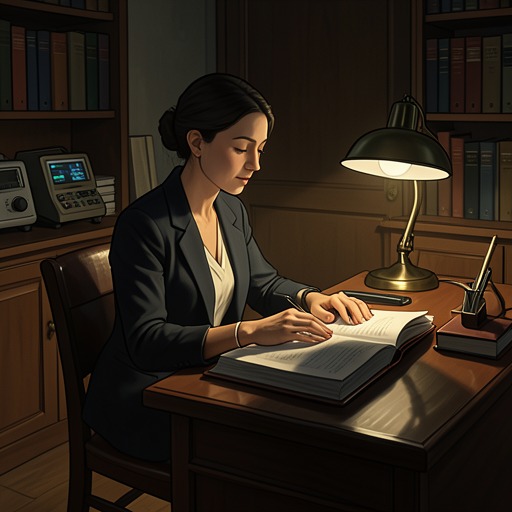
Christabel LaMotte’s secret letter to Randolph Ash
PossessionChristabel LaMotte’s secret letter to Randolph Ash is the sealed, long-undelivered message that finally reveals their daughter’s existence. Preserved with Ash’s buried possessions and opened only after the papers are recovered, it changes the meaning of his relationship with LaMotte and connects their hidden past to Maud Bailey’s family. Its force lies not simply in what it tells, but in the decades of silence, custody, and uncertainty through which it reaches its addressee.
Form and Physical Preservation
The letter survives as a sealed envelope among the objects laid out after Ash’s death: a packet of letters tied with faded violet ribbons, a bracelet woven from his hair and LaMotte’s, Ash’s watch, and an unfinished letter in his hand. LaMotte’s message is addressed to Randolph Henry Ash and marked for delivery under cover. When Mortimer Cropper opens the iron box and Ash’s glass specimen container, the envelope is found alongside the correspondence and the hair objects. Its seal has kept the communication unread even as the other papers have been exposed to handling and dispute.
The placement makes the letter part of a material archive rather than a free-floating confession. Ellen Ash had resolved to bury with her husband things she could neither burn nor leave exposed to later scavengers, including the lovers’ letters. The sealed envelope belongs to that concealment, but it is also distinct from the bundle of correspondence: its unread state leaves open the question of whether it had ever reached Ash and who, in law, owns a message that remained unopened. The physical object therefore carries both a personal appeal and an unresolved question of custody.
The Delayed Reading
The recovered envelope is handed to Maud, who recognizes the handwriting but is not immediately certain. In a hotel room, before a gathering of seekers with competing interests in the papers, the message is read aloud by candlelight as wind rattles the windows. That scene converts an object preserved in a grave into a public disclosure. The room’s assembled listeners hear the private words together, while the letter’s original addressee is absent and cannot answer.
LaMotte begins by explaining that she has heard Ash is gravely ill. She knows that telling him now may disturb his peace, and acknowledges that the news should perhaps have been given twenty-eight years earlier—or never. She says that she thinks of him continuously, prays for him, and has known for years that she wronged him. The letter’s address to an old beloved, and its recognition of the harm caused by silence, frame the revelation as an overdue attempt at truth rather than a detached family notice.
The Revelation and Its Limits
The central disclosure is concrete: Ash has a daughter. LaMotte writes that the daughter is well, married, and the mother of a beautiful boy, and says that she is sending Ash her picture. The daughter does not know that either of her parents is her parent. The message thus reveals a family bond withheld from both father and daughter, while confirming that the child has grown into an adult life of her own.
The letter does not immediately provide the full history. LaMotte distinguishes the bare fact from the account she owes Ash, and says that history consists of hard facts as well as the passion and colour people lend them. She promises to tell him the facts. That distinction leaves the message suspended between disclosure and explanation: the reader learns the secret, but the letter itself signals that the circumstances and emotional meaning require a further narrative. Its admission of wrongdoing is likewise not a complete account of responsibility; it opens the history rather than settling every question about it.
Custody, Rights, and Consequences
The letter’s discovery revives the legal distinction between ownership of a manuscript and copyright in its words. Euan MacIntyre explains that letters as physical objects belong to their recipient, while copyright remains with their sender; in this case, LaMotte had requested the return of her letters and Ash had complied. LaMotte’s will leaves her manuscripts and copyrights to Maia Thomasine Bailey, and Maud is identified as the descendant through whom that inheritance connects to the present dispute. The physical letters and the rights to publish their contents therefore do not automatically belong to the same person or family.
The sealed message complicates that distinction further. Because it is found unopened in Ash’s grave, the assembled scholars and lawyers consider whether it belongs to its sender, if Ash never received it, or to its addressee, whose burial it accompanied. Its contents establish why the issue matters beyond ownership: the letter supplies decisive evidence of Maia’s parentage and places Maud’s family history inside the correspondence under contention. The scene makes the readers of the document participants in a dispute over who may possess, interpret, and disclose private history.
Narrative Significance
The letter turns absence into evidence. Earlier documents and surviving archives offer only fragments, gaps, and contested interpretations; here, a sealed message resolves one major uncertainty while preserving others. It gives the concealed relationship a descendant and makes the consequences of silence visible across generations, yet its promise of a fuller history keeps the past from collapsing into a single, final explanation.
Its route from LaMotte’s hand to Ash’s grave and finally to Maud’s hands also dramatizes the tension between privacy and recovery. Ellen’s decision to bury papers protects them from immediate exposure, but burial delays the revelation until Ash can no longer receive it. When it is eventually read aloud, the letter no longer functions only as intimate correspondence: it becomes family evidence, a contested manuscript, and a narrative act that alters the present. The secret is disclosed, but the long interval between writing and reading remains part of what the letter means.