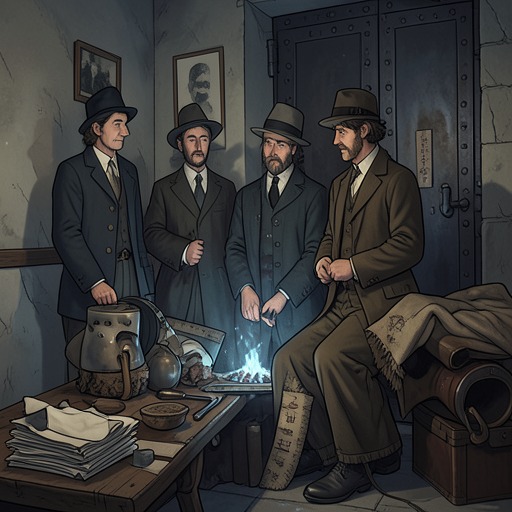
The concealed Ash–LaMotte correspondence
PossessionThe concealed Ash–LaMotte correspondence is the surviving exchange between Randolph Henry Ash and Christabel LaMotte, hidden beneath a dolls’ bed at Seal Court and found by Maud Bailey and Roland Michell. Its recovery transforms an archival suspicion into a tangible, reciprocal record: two bundles of letters bearing both names reveal the beginning of a connection that neither public scholarship nor the scattered papers had made fully legible. The letters are not simply proof of a relationship; their concealment, preservation, and divided custody make them a charged object at the crossing of intimacy, historical knowledge, and ownership.
The hidden object and its recovery
At Seal Court, Maud works methodically through the dolls’ bed: she removes the dolls, pillow, counterpane, blankets, crocheted shawl, feather mattresses, and straw palliasse. Beneath them she finds a wooden box. A hinged board gives way to a linen-wrapped package, bound round and round with tape like a mummy. The successive domestic layers turn the discovery into an act of uncovering rather than a simple opening: the correspondence has been hidden inside a bed made for dolls, beneath the objects that make it look like an ordinary plaything.
Maud loosens the old knots rather than cutting the tapes. Beneath the linen are two parcels wrapped in oiled silk and tied with black ribbon. Inside are open letters in two neat bundles. One address identifies Miss Christabel LaMotte at Bethany, Mount Ararat Road, Richmond, Surrey; the other identifies Randolph Henry Ash at 29 Russell Square, London. Roland recognizes the hands and responds to the recovery by observing that Ash did send a letter. Maud grasps the larger consequence: the find contains both sides of the exchange, not a single isolated document. Asked how she knew to search the dolls’ bed, she says that the poem came to mind and that the answer had seemed clear, while also calling the discovery sheer luck.
The care required at the moment of opening echoes the correspondence’s earlier concealment. Maud resists cutting the tapes, and the old ribbon and oiled silk are handled as evidence whose arrangement matters. The papers emerge not as loose, interchangeable texts but as two ordered bundles with addresses, wrappers, and a place of hiding. Their material form supplies a history of custody even before the words are read.
The first exchange and its voices
The first letter read aloud is Ash’s first draft to LaMotte. He recalls their conversation at Crabb Robinson’s breakfast party, praises her perception and wisdom, and asks whether he may call on her. His proposed topics range across Dante, Shakespeare, Wordsworth, Coleridge, Goethe, Schiller, Webster, Ford, and Sir Thomas Browne, before he adds LaMotte and her ambitious Fairy Project. The letter’s courteous invitation is also an intellectual overture: Ash presents the visit as an occasion for literary discussion and asks directly for a reply.
Maud and Roland then turn to the other bundle for LaMotte’s answer. In the opening portion read aloud, LaMotte denies that she means to tease him and describes herself as living in a circumscribed, self-communing way. Rather than adopt the image of a princess in a thicket, she compares herself to a self-satisfied spider at the centre of a web, identifying with Arachne as an honest craftswoman whose response to visitors may be a snap. She treats her wit as a possible reflection of Ash’s brilliance and presents herself as a creature of her pen. The contrast with Ash’s courteous confidence makes the exchange more than a record of contact: its first surviving voices show her guarding the boundaries of her private and artistic life even as she answers him.
Because the letters speak from different positions, neither is a neutral account of the relationship. Ash’s invitation frames their conversation as literary companionship; LaMotte’s reply frames her own guardedness as a condition of artistic work and self-possession. Read together, the documents offer a view unavailable from either voice alone, while still preserving the writers’ differing ways of presenting themselves.
Concealment, loss, and archival custody
The correspondence’s hiding place belongs to a broader history of incomplete and dispersed records. The archive associated with LaMotte preserves manuscripts of the Tales, undated lyrics, revisions of Melusina, a commonplace book, a few letters, and one of Blanche Glover’s diaries, which covers only three years. Maud explains that the papers had not been carefully maintained and that no additional material had come to light. The dolls’ bed therefore yields an unusually consequential survival within a record already marked by gaps.
Those gaps are not merely accidental in the account of the archive. Maud recalls sharp comments in Ellen Ash’s journal about biographical scavenging and believes Ellen, rather than Patience and Faith, burned some of Ash’s letters; some, she says, were buried with Ellen. The journal itself is represented as a record shaped by decisions about what should remain private. After Ash’s death, Ellen remembers his instruction to burn what others should not see. She describes burning some papers, intending to burn more, but distinguishes from them the letters she could not destroy. She chooses instead to lay those letters to rest with him. That history gives the discovered bundles a double significance: their survival preserves evidence, but it also brings into view the deliberate acts of destruction and concealment that governed what could reach later readers.
The later opening of Ash’s grave reinforces the correspondence’s material afterlife without making the Seal Court discovery identical to that separate cache. In the grave, Cropper finds an oiled-silk package containing a thick bundle of ribbon-tied letters, along with a hair bracelet, a finely plaited thread of pale hair, and an envelope addressed to Ash under cover. He calls the bundle love letters, while the unopened envelope raises a question about whether a letter belongs to its sender or addressee. Together, the two discoveries show that the papers’ survival depends on physical placement and uncertain chains of custody, not on a single complete archive.
Significance and limits of the evidence
The discovery changes the correspondence from a scholarly possibility into a documentable exchange: Ash’s and LaMotte’s addresses, handwriting, and paired bundles establish that both sides are present. Yet the letters do not abolish uncertainty. The finding cannot supply papers that were burned or never preserved, and the first reading does not make the writers’ self-descriptions transparent accounts of every motive. Its evidentiary force lies precisely in the conjunction of what it confirms and what remains absent.
The object also complicates the line between preservation and possession. LaMotte’s papers had been passed through her family, and the surviving archive held only part of what she left. Elsewhere, Ash’s small letters to a child are treated as a family trust rather than simply marketable documents: their keeper says they were intended for a daughter and refuses to hand them over without consulting her. These episodes sharpen the ethical question posed by the newly found correspondence. A letter can be evidence for literary history and still have originated in a private exchange whose writers did not address later scholars.
Its narrative force comes from the way the object is disclosed. The padded bed, the hidden box, the wrapped parcels, and the two different hands delay recognition until material clues can be read together. What had seemed like one poet’s possible letter becomes a reciprocal archive, and the first exchange opens onto a larger history of affection, secrecy, preservation, and loss. The bundle is decisive not because it answers every question about Ash and LaMotte, but because it makes their correspondence present while preserving the signs of everything that kept it hidden.