Hair bracelet
PossessionThe Hair bracelet is a keepsake made from Randolph Henry Ash’s hair and Ellen Ash’s own, its silver clasp shaped as two hands joining. Created during Randolph’s final months and ultimately buried with him, it embodies the intimacy of his marriage to Ellen while sharing the grave-bound archive that preserves his secret correspondence with Christabel LaMotte. Its intertwined strands make private attachment visible as an object, even as the objects gathered around it reveal how much of the past remains withheld.
Making and Meaning
Ellen records that she had worked the bracelet from her hair and Randolph’s during the last months of his life. When she lays out the things involved in deciding what should be preserved, the bracelet appears beside a packet of letters tied with faded violet ribbons, Randolph’s watch, an unfinished letter in his hand, and a sealed envelope. Its clasp, described when the object is eventually recovered, shows two hands joining. The bracelet is therefore not simply a lock of hair kept as a souvenir: its construction binds two people together, and its form gives that bond a visible, portable shape.
The bracelet also stands within a larger pattern of objects that carry life forward through material traces. Randolph had written to a child named Sophia about the ash tree, describing its mythic place as the support of the world; elsewhere, in a letter to Ellen from Yorkshire, he reflects on jet as once-living matter transformed and preserved in stone. Those passages do not identify the bracelet directly with either image, but they establish a recurring concern with what survives transformation: living things become crafted objects, and objects preserve histories that might otherwise disappear.
Ellen’s Choice to Preserve It
After Randolph’s death, Ellen sits among his possessions and struggles with the difference between what may be destroyed and what cannot be treated as hers to destroy. She burns some materials in keeping with his expressed wish that private things should not be exposed to biographical scavenging. But she distinguishes the letters she and Randolph shared from what she cannot burn, and resolves to lay those letters to rest with him rather than leave them to uncertain custody. The bracelet is part of that deliberate selection: an intimate object carried into the grave with the papers whose privacy Ellen means to protect.
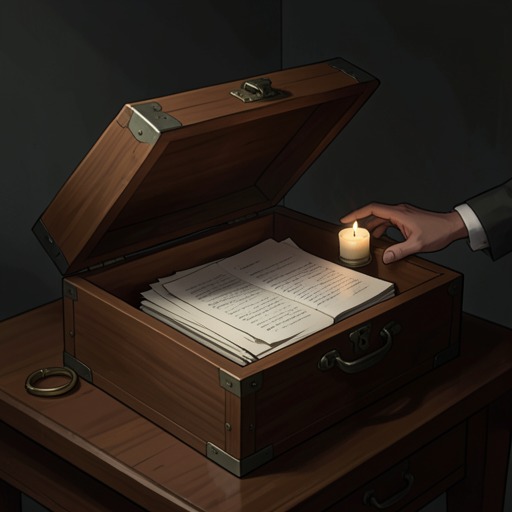
The decision is bound up with silence and grief. Ellen recognizes that what she and Randolph shared has, in the end, largely become silence; nonetheless, the surviving objects still seem to hold a presence. She puts the bracelet with their love letters in a black japanned specimen box lined with oiled silk. She also places inside a long, finely plaited pale strand of hair associated with the sealed letter, arranging the strands beside one another. The choice preserves a distinction as well as a connection: the bracelet belongs to Ellen and Randolph’s shared life, while the other hair and the concealed letter point toward a truth Ellen does not want to read.
Recovery from the Grave
The specimen box remains with Randolph’s grave until Mortimer Cropper opens it. After oiling the rusty join and working a knife beneath the lid, he reveals Randolph’s glass specimen container, still intact despite being cloudy and stained. Inside an oiled-silk bag lies the bracelet, identified by its silver clasp of two joining hands. The same recovery produces the blue envelope containing the pale hair, the ribbon-tied bundle of love letters, and a sealed envelope addressed to Randolph under cover.
Cropper recognizes the bundle as the lovers’ letters, while the unopened envelope prompts a question about ownership: whether it belongs to its sender because it was never received, or to Randolph because it lay unopened in his grave. The bracelet thus emerges not in isolation but as one element in a contested archive. Its physical presence confirms that Ellen’s burial choice preserved a set of objects across decades; the other contents show that this act of preservation also kept a hidden relationship and its unresolved evidence out of reach.
Intimacy, Memory, and Material Evidence
The bracelet’s two intertwined sources of hair and clasp of joined hands make it a compact image of marital attachment. Yet its burial alongside Randolph’s letters gives that image a more complicated context. Ellen’s act does not erase the correspondence with Christabel; instead, she places the evidence of that other attachment in the same grave, where the bracelet and the letters become parts of one concealed collection. The objects preserve intimacy without making it fully legible.
When the box is opened, the bracelet helps turn private memory into recoverable evidence, but it cannot by itself explain the relationships the archive contains. Its meaning rests partly in what it physically records—the hair, the braid, the clasp—and partly in its custody: Ellen made it, chose to bury it, and Cropper later retrieved it with the papers. In the novel’s treatment of archives, that chain of keeping and recovery makes the bracelet both a token of affection and a witness to the limits of what material remains can disclose.