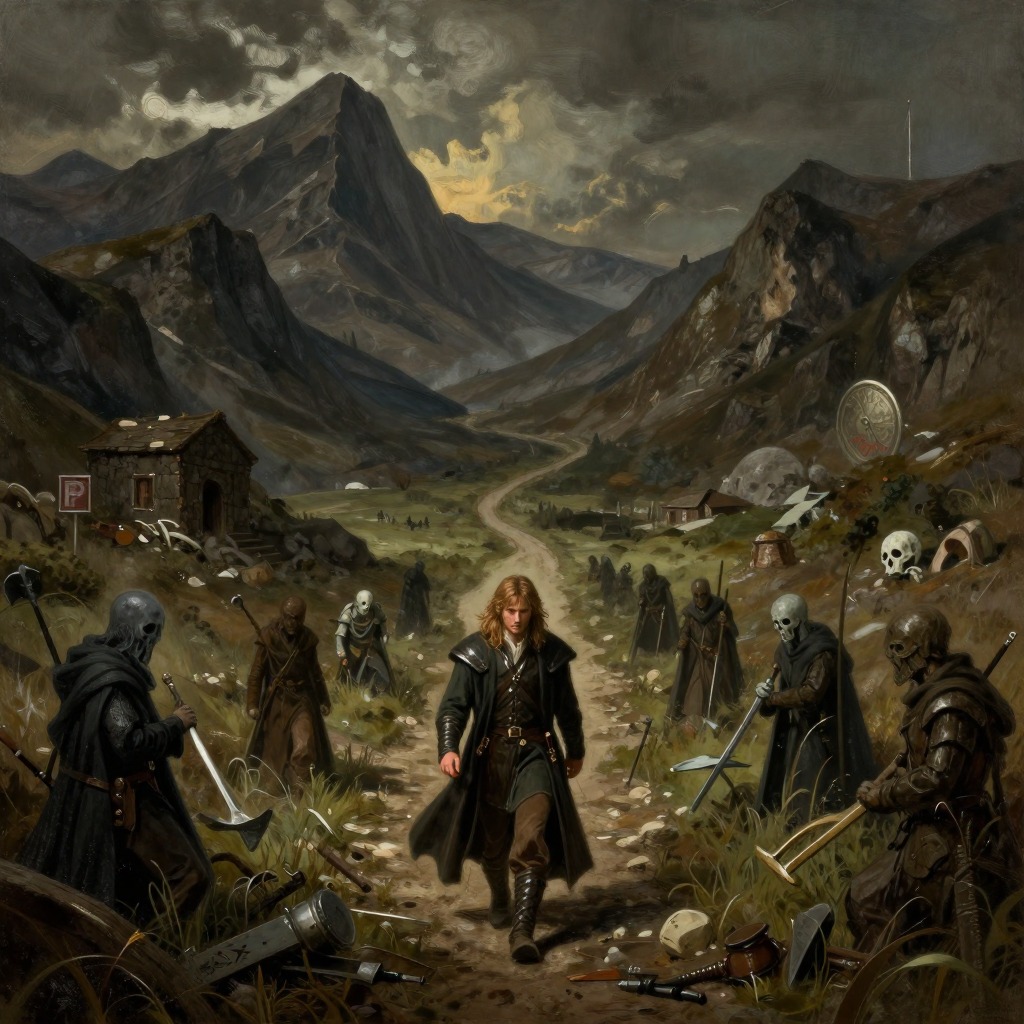
Dunharrow
Dunharrow is a high, bleak mountain refuge in Rohan, a place whose very name carries the weight of forgotten ages. It is not a city or a fortress in any living sense, but a wide upland meadow called the Firienfeld, laid upon the lap of the great mountains behind the deep-delved courses of the Snowbourn. To the south rises the Starkhorn, to the north the saw-toothed mass of írensaga, and between them, facing the riders who come there, stands the grim black wall of the Dwimorberg, the Haunted Mountain, rising out of steep slopes of sombre pines. This is the dark Dunharrow, the work of long-forgotten men whose name was lost and no song or legend remembered it. For what purpose they had made this place, as a town or secret temple or a tomb of kings, none in Rohan could say. Here they laboured in the Dark Years, before ever a ship came to the western shores, or Gondor of the Dúnedain was built; and now they had vanished, and only the old Púkel-men were left, still sitting at the turnings of the road. The place is thus a monument to a vanished people, a mystery that even the lore-masters of Rohan cannot unravel, and its very obscurity feeds the dread that clings to it.
The Approach and the Gathering
The road to Dunharrow is itself an ordeal. The king's company climbs through a cutting between walls of rock, up a short slope and out onto the wide upland. Dividing the upland into two there marches a double line of unshaped standing stones that dwindles into the dusk and vanishes in the trees. Those who dare to follow that road come soon to the black Dimholt under Dwimborberg, and the menace of the pillar of stone, and the yawning shadow of the forbidden door. Merry, who accompanies the king, stares at the lines of marching stones: they are worn and black; some are leaning, some are fallen, some cracked or broken; they look like rows of old and hungry teeth. He wonders what they could be, and he hopes that the king is not going to follow them into the darkness beyond. The camps are set on either side of the stony way, but they huddle away from the trees towards the brink of the cliff, as if the very ground near the Haunted Mountain is to be avoided. The greater number of tents and booths are on the right, where the Firienfeld is wider; on the left there is a smaller camp, in the midst of which stands a tall pavilion. From this side a rider comes out to meet them, and as Merry draws near he sees that the rider is a woman with long braided hair gleaming in the twilight, yet she wears a helm and is clad to the waist like a warrior and girded with a sword. This is Éowyn, and her presence here, a woman warrior in a place of gathering doom, foreshadows the role she will play in the war to come.
The Horror of the Paths of the Dead
Dunharrow's true horror lies not in its stones or its camps, but in what lies beyond it: the Paths of the Dead. The forbidden door under the Dwimborberg is the entrance to that dread road, and the very mention of it chills the blood. The way is shut, it is said, made by those who are Dead, and the Dead keep it until the time comes. The days are short, and if one is in haste, one must remember the Paths of the Dead. This is the place where the living fear to tread, and the narrative's horror reaches its peak here. The standing stones, the black wall of the mountain, the yawning shadow of the door—all are crafted to evoke a terror that is not of the seen but of the unseen, the anticipation of what lies within. The old Púkel-men, the carved figures left by the forgotten builders, sit at the turnings of the road like silent sentinels of a doom that no one can name. Dunharrow is thus a threshold, a place where the known world of Rohan meets the unknown realm of the dead, and where the courage of the living is tested against the fear of what lies beyond.
Narrative Significance and the Ride of the Rohirrim
Dunharrow is not merely a setting; it is a turning point in the narrative. It is here that Théoden musters his army for the Ride of the Rohirrim, the desperate gallop south to the aid of Gondor at the Battle of the Pelennor Fields. The gathering at Dunharrow is the culmination of the Muster of Rohan, and the place itself, with its dark history and its proximity to the Paths of the Dead, casts a shadow over the hope of the ride. The king's company, including Merry, arrives at Dunharrow after a long climb, and the sight of the Haunted Mountain and the forbidden door is a grim omen. Yet it is also here that Aragorn, Legolas, and Gimli will take the Paths of the Dead, following the oathbreakers to fulfill an ancient prophecy and to bring the Grey Company to the aid of Gondor. Dunharrow thus stands at the intersection of two great movements of the war: the muster of the Rohirrim and the march of the Dead. It is a place of departure, where the living and the dead both set out on their fateful journeys. The narrative's use of Dunharrow is masterful: it is a place of stillness and dread, a pause before the storm, where the characters and the reader alike must confront the darkness that lies ahead. The horror of the place is not in what happens there, but in what it portends, and in the courage it demands of those who must pass through it or beyond it.