Pelennor Fields
The Pelennor Fields are the wide, fertile townlands of Gondor that lie before the city of Minas Tirith, enclosed by the great out-wall called the Rammas Echor. Built with great labour after Ithilien fell under the shadow of the Enemy, this wall runs for ten leagues or more from the mountains' feet and back again, fencing in the fields of the Pelennor: fair and fertile townlands on the long slopes and terraces falling to the deep levels of the Anduin. At its furthest point from the Great Gate of the City, north-eastward, the wall is four leagues distant, and there from a frowning bank it overlooks the long flats beside the river, where men have made it high and strong; for at that point, upon a walled causeway, the road comes in from the fords and bridges of Osgiliath and passes through a guarded gate between embattled towers. At its nearest point the wall is little more than one league from the City, south-eastward, where the Anduin, going in a wide knee about the hills of Emyn Arnen in South Ithilien, bends sharply west, and the out-wall rises upon its very brink; beneath it lie the quays and landings of the Harlond for craft that come upstream from the southern fiefs.
The Land and Its People
The townlands are rich, with wide tilth and many orchards, and homesteads there are with oast and garner, fold and byre, and many rills rippling through the green from the highlands down to Anduin. Yet the herdsmen and husbandmen that dwell there are not many, for the most part of the people of Gondor live in the seven circles of the City, or in the high vales of the mountain-borders, in Lossarnach, or further south in fair Lebennin with its five swift streams. There dwells a hardy folk between the mountains and the sea, reckoned men of Gondor, yet their blood is mingled, and there are short and swarthy folk among them whose sires came more from the forgotten men who housed in the shadow of the hills in the Dark Years ere the coming of the kings. Beyond, in the great fief of Belfalas, dwells Prince Imrahil in his castle of Dol Amroth by the sea, a lord of high lineage whose knights are among the proudest of Gondor's defenders.
The Approach of War
As the War of the Ring reaches its crisis, the Pelennor Fields become the stage for the final confrontation between the forces of the West and the armies of Sauron. The out-wall of the Rammas Echor, built to defend the townlands, is the last line of defence before the City itself. When Gandalf passes into the wide land beyond the Rammas Echor, he speaks with Ingold, a man of Gondor labouring on the wall's defences, and warns him that the road looks towards safety no longer. He tells Ingold that but for Gandalf Stormcrow, the men of Gondor would have seen a host of foes coming out of Anórien and no Riders of Rohan. The fields, once a place of peace and plenty, are about to become a battlefield where the fate of the West will be decided.
The Battle of the Pelennor Fields
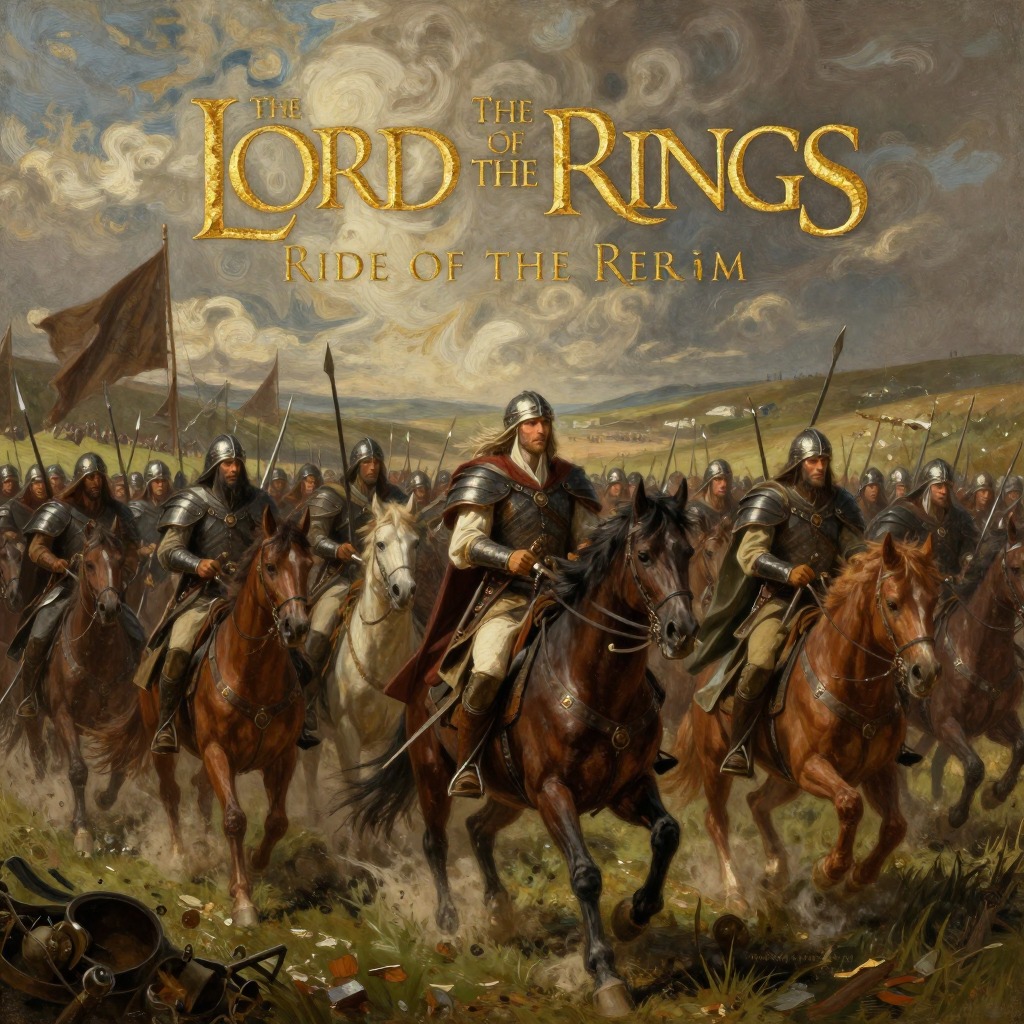
The Battle of the Pelennor Fields is the greatest engagement of the War of the Ring, fought on the open ground before Minas Tirith. The Witch-king of Angmar, Lord of the Nazgûl, leads the forces of Mordor against the city, and the fields are soaked with the blood of both defenders and attackers. It is here that the Witch-king, mounted on his fell beast, confronts the Rohirrim who have ridden to Gondor's aid. When the Witch-king stands over the fallen Théoden, King of Rohan, and declares that no living man may hinder him, a figure in the guise of Dernhelm steps forward. The helm of secrecy falls away, revealing Éowyn, Éomund's daughter, who declares: 'But no living man am I! You look upon a woman. Éowyn I am, Éomund's daughter. You stand between me and my lord and kin. Begone, if you be not deathless! For living or dark undead, I will smite you, if you touch him.' With these words, she strikes down the Witch-king, fulfilling the prophecy that no living man would kill him, and proving that courage can be found in the most unlikely places.
The Aftermath and Significance
The Battle of the Pelennor Fields marks the turning point of the War of the Ring. The victory of the Free Peoples on these fields opens the way for the final march to the Black Gate, and ultimately for the destruction of the One Ring. The fields themselves, once fair and fertile, are left scarred and desolate by the battle, a testament to the cost of war. Yet the courage shown there, particularly by Éowyn, becomes a symbol of hope in the darkest hour. The Pelennor Fields are thus not merely a location but a crucible where the fate of Middle-earth is forged, and where the themes of courage, sacrifice, and the unexpected nature of heroism are brought to their fullest expression.