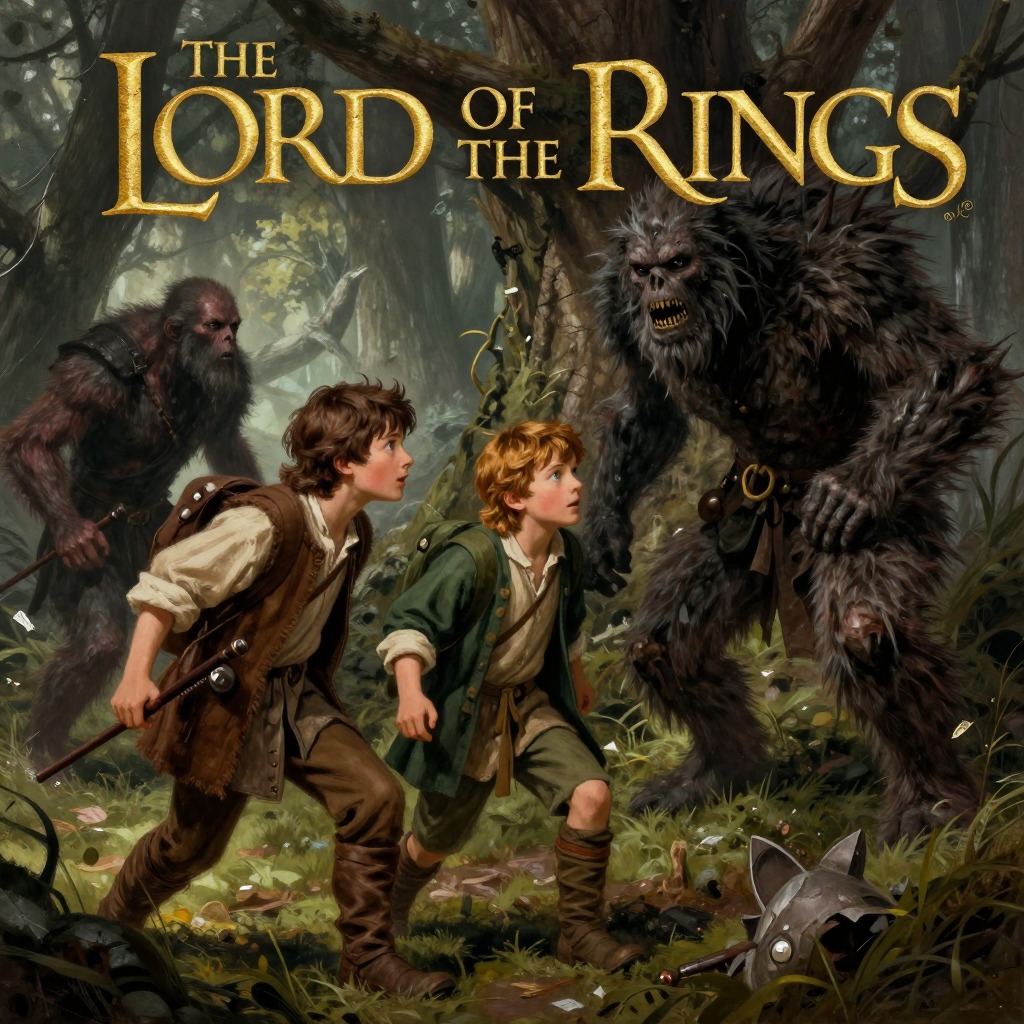
Fangorn Forest
Fangorn Forest, known in the Common Speech as the Entwood, is one of the oldest and most mysterious places in Middle-earth. It is not merely a forest but a living entity, ancient beyond the memory of Elves or Men, and it is the last refuge of the Ents, the shepherds of the trees. Its significance in the War of the Ring is profound: it is within Fangorn that the hobbits Meriadoc Brandybuck and Peregrin Took meet Treebeard, that the Ents are roused to march against Saruman, and that Gandalf returns as the White Rider. The forest is a place where the deep past of Middle-earth still stirs, and where the fate of the Free Peoples is unexpectedly decided by forces older than any army or king.
Geography and Setting
Fangorn Forest lies at the southeastern end of the Misty Mountains, bordering the wide land of Rohan to its south and west. Its position is remote and forbidding: the downs that lead toward it run eight leagues or more to the north, and from there to the issuing of the Entwash there lies still a wide land, another fifteen leagues it may be. The forest itself is dense and dark, its trees ancient and towering, and it is said that the trees can move and speak, though few have heard them. The Entwash, a river that flows out of the forest, is one of its few landmarks, and the forest's edge is marked by a gradual transition from open grassland to the shadow of the wood. To the south, the ground is dry and the turf short, but a long strip of sunken land, some ten miles wide, lies between the downs and the river wandering deep in dim thickets of reed and rush. This is the approach that Aragorn, Legolas, and Gimli take as they pursue the Orcs who have captured their friends, and it is from this vantage that they first glimpse the forest's distant, brooding presence.
The Pursuit and the Forest's Approach
When the three hunters—Aragorn, Legolas, and Gimli—reach the downs after the capture of Meriadoc and Peregrin, they find a great ring where the turf has been torn and beaten by many trampling feet. From it, the orc-trail runs out again, turning north along the dry skirts of the hills. Aragorn halts and examines the tracks closely, and he concludes that the Orcs rested there a while, but that even the outward trail is already old. He fears that Legolas's heart spoke truly: it is thrice twelve hours, he guesses, since the Orcs stood where they now stand. If they held to their pace, then at sundown yesterday they would reach the borders of Fangorn. This calculation sharpens the urgency of the pursuit, for the forest is a place of dread and mystery, and the fate of the hobbits within it is uncertain. Gimli, looking north and west, sees nothing but grass dwindling into mist, and he asks whether they could see the forest if they climbed the hills. Aragorn replies that it is still far away, and he recalls the lay of the land: the downs run eight leagues or more to the north, and then north-west to the issuing of the Entwash there lies still a wide land, another fifteen leagues it may be. The distance is daunting, and Gimli's words carry the weight of their weariness: "My legs must forget the miles. They would be more willing, if my heart were less heavy." The forest, even before it is reached, hangs over the pursuit as a place of both hope and fear—hope that the hobbits may still be found, and fear of what ancient power may dwell within.
The Ents and the Awakening
Within Fangorn dwell the Ents, the oldest living things that still walk upon the earth. They are the shepherds of the trees, and they have watched the forest for ages beyond count. The most famous of them is Treebeard, whose name in the Entish tongue is Fangorn, and it is he who meets Meriadoc and Peregrin after they escape from the Orcs. The hobbits' arrival in the forest is an event of immense consequence, for it awakens the Ents from their long passivity. Treebeard, who has seen many ages pass and has grown weary of the world's doings, is stirred by the news of Saruman's treachery and the felling of trees in his domain. The Ents hold an Entmoot, a gathering of their kind, and after long deliberation they decide to march against Isengard. This is a turning point in the War of the Ring: the Ents, who have not gone to war in millennia, rise up and destroy Saruman's stronghold, flooding the valley of Isengard and trapping the wizard in his tower of Orthanc. The forest, which seemed a place of retreat and mystery, becomes a source of active power that reshapes the course of the war.
Gandalf's Return and the Forest's Role
Fangorn is also the place where Gandalf returns from the dead. After his fall in Moria, he is sent back to Middle-earth to complete his task, and he emerges in Fangorn as the White Rider. His reappearance is first witnessed by Aragorn, Legolas, and Gimli, who are astonished to find him alive and transformed. Gandalf's time in the forest is brief but significant: he speaks of his ordeal and his rebirth, and he takes up his new role as the head of the Istari, the order of wizards. The forest, with its ancient trees and its deep connection to the world's beginnings, is a fitting place for such a transformation. It is a place where death and rebirth are not abstract concepts but lived realities, and where the old order of things gives way to something new. Gandalf's emergence from Fangorn marks the beginning of the final phase of the war, and it is from the forest that he leads the company toward Edoras and the muster of Rohan.
The Forest's Enduring Mystery
The forest remains a place of mystery even after the war is won. Its trees are older than any living thing, and its depths are unexplored. The Ents, having roused themselves to action, return to their slow, patient watch, and the forest resumes its ancient rhythm. Yet the events of the War of the Ring have changed it forever: the Ents have proven that they are not merely guardians of the past but actors in the present, and the forest's power is no longer a legend but a demonstrated force. For the hobbits, the forest is a place of wonder and danger, a reminder that the world is far larger and stranger than the Shire. For the reader, Fangorn stands as a symbol of the deep, enduring forces of nature that outlast the ambitions of Men and Wizards alike. It is a place where the long defeat of the Elves is countered by the stubborn persistence of the trees, and where the hope of the Free Peoples is unexpectedly renewed by the oldest inhabitants of the land.