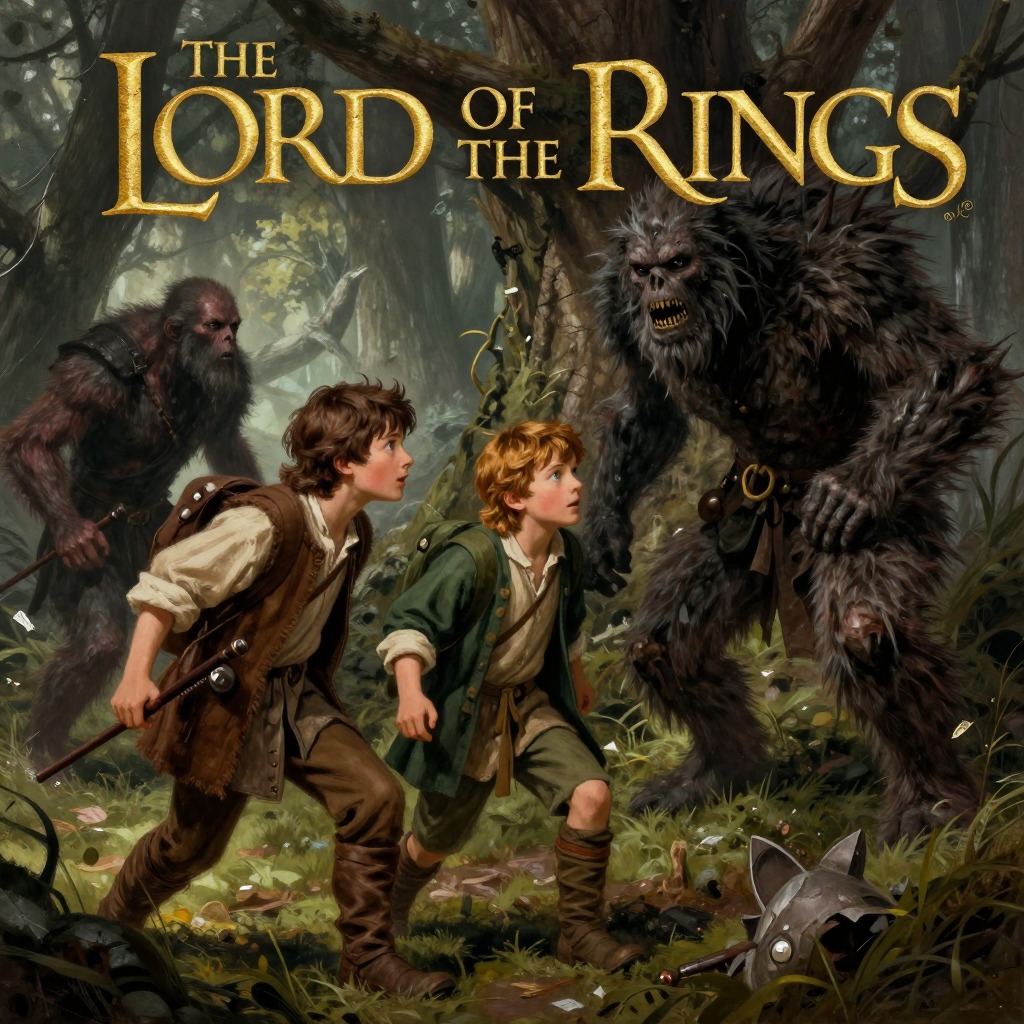
Orcs
The Orcs are the ubiquitous and irredeemably malevolent foot-soldiers of the Dark Powers in The Lord of the Rings, a race of corrupted beings whose very existence is a testament to the malice of Morgoth and his servant Sauron. They are the physical embodiment of the Shadow, a brutal and prolific enemy that serves as the primary obstacle to the quest of the Fellowship of the Ring. Their presence is a constant, grinding pressure on the free peoples, from the jagged blades they wield to the squint-eyed bullies who enforce the will of a fallen master, making them the most tangible and recurring form of evil in the narrative. Yet, for all their numbers and cruelty, the Orcs are also defined by their internal divisions, their fear, and their capacity for treachery, which often proves as destructive to their own cause as the valor of their enemies.
Nature and Origins
The Orcs are a race of creatures wholly given over to evil, their nature shaped by the dark will that created them. They are described as hideous, with a visceral disgust attached to their very appearance and their weapons. An orc-weapon is characterized by its jagged, brutal design, its haft carved into a hideous head with squinting eyes and a leering mouth, a detail that underscores the malice inherent in their craftsmanship. They are creatures of the dark, thriving in shadow and desolation, and their presence is often heralded by a sense of dread and corruption. Their very being is antithetical to life and growth, as they are the agents of the Shadow that seeks to cover all of Middle-earth. The narrative consistently presents them not as a natural people but as a perversion, a corrupted mockery of the free races, whose only purpose is to serve the will of their dark masters, whether that be Sauron in Mordor or Saruman in Isengard.
Servants of the Dark Powers
The Orcs function as the primary military force of the Dark Lord Sauron and the treacherous wizard Saruman. They are the shock troops of the War of the Ring, the countless hordes that pour out of Mordor and Isengard to lay waste to the lands of Men. Their loyalty, however, is born of fear and coercion rather than any genuine allegiance. The narrative reveals a clear hierarchy of power, where the Orcs are mere pawns in the schemes of their masters. This is starkly illustrated in the final days of the war, when Frodo Baggins confronts a ruffian in the Shire and declares that the Dark Tower has fallen and that Isengard has been destroyed, leaving their master a beggar in the wilderness. The Orcs' power is entirely derivative; it collapses the moment the will that commands them is broken. They are tools of a greater evil, and their own agency is limited to acts of cruelty and violence within the framework of their masters' designs.
Instruments of Cruelty and Violence
The Orcs are the primary agents of violence and cruelty in the story, their actions serving as the most direct and personal threats to the protagonists. Their weapons are crude but effective, designed for maiming and killing. The evidence of their brutality is found in the aftermath of their attacks, such as the scene where Aragorn, Gimli, and Legolas search for the captured hobbits. They find a broken mallorn-leaf of Lórien with crumbs on it, pieces of cut cord, and a short jagged orc-knife that had been trampled into a tussock. This scene reveals the Orcs' role as captors and tormentors, and the very nature of their weaponry speaks to their savage intent. They are the ones who bind prisoners, who cut and slash, and who leave a trail of destruction in their wake. Their cruelty is not merely a means to an end but a defining characteristic, a reflection of the hatred that fuels them. They are the face of the enemy that the hobbits and their companions must confront, a constant reminder of the physical peril that pervades their journey.
Internal Divisions and Treachery
Despite their shared malevolence, the Orcs are a deeply fractured race, riven by internal conflict, suspicion, and treachery. Their loyalty to their masters is only matched by their distrust of one another. This is a crucial weakness that the narrative exploits, as their own divisions often undermine their effectiveness. The different breeds of Orcs, such as the larger, stronger Uruk-hai and the smaller, more common Snaga, harbor a mutual contempt that frequently boils over into open conflict. This internal strife is a recurring theme, suggesting that evil is inherently self-destructive. The Orcs' inability to cooperate for any length of time, their tendency to squabble over spoils, and their readiness to betray one another for survival all point to a fundamental flaw in their nature. This treachery is not just a minor detail but a significant factor in the story, as it often provides the opportunity for the heroes to escape or to turn the tide of a battle. The very forces that make the Orcs a threat also contain the seeds of their own undoing.
The Orcs as a Narrative Force
The Orcs serve a crucial narrative function as the embodiment of the relentless, grinding pressure of evil that the free peoples must resist. They are the physical manifestation of the Shadow, a constant and inescapable threat that drives the plot forward. Their presence creates the peril that necessitates the quest, the battles, and the acts of heroism that define the story. They are the enemy that can be fought with sword and bow, the tangible foe that stands in contrast to the more insidious corruptions of the Ring or the betrayals of Saruman. In this sense, they provide a clear and unambiguous target for the heroes' valor. However, their role is not merely to be slaughtered. The Orcs also serve as a mirror, reflecting the capacity for cruelty and hatred that exists in the world. Their squint-eyed, leering faces and their brutal actions are a constant reminder of what the free peoples are fighting against, and their ultimate defeat is a necessary precondition for the victory of the West. They are the dark background against which the courage and hope of the protagonists shine all the brighter, and their downfall is an integral part of the story's resolution, from the fields of Gondor to the quiet lanes of the Shire.