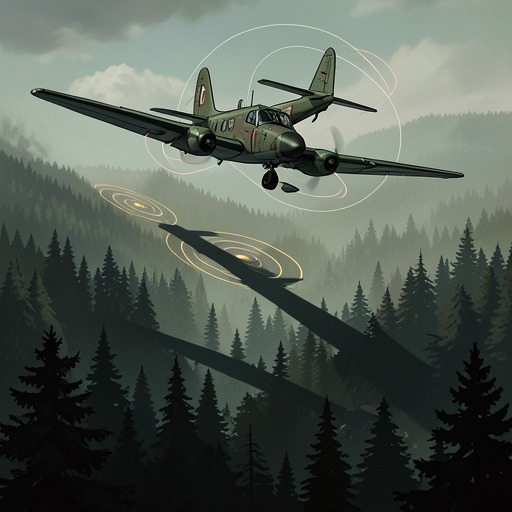
Georgia No-Fly Zone
AfterburnThe Georgia No-Fly Zone was a United Nations-monitored airspace whose operation exposed the gap between an international promise of peace and the coordination required to enforce it. Intended as part of a broader stabilizing presence, the zone became the setting for a fatal failure of communication between U.S. Navy fighters and U.S. Army helicopters supporting a UN mission.
Purpose and Regional Setting
The deployment’s original purpose was to oversee the no-fly zone over the Republic of Georgia. At a briefing, Sykes described that mission as necessary in light of Turkey’s decision to deny basing privileges and permission, although the available account does not specify the latter restriction further. The zone was therefore not simply a boundary in the sky: it was a task the United Nations sought to sustain despite limits on the forces’ access and operating arrangements.
The UN also hoped that a strong military presence could defuse other regional problems. One such concern was Turkey’s repeated threat to invade Armenia to quell unrest there. The zone belonged to a broader effort to use military presence as a means of preventing instability from spreading, even as the surrounding political situation grew more volatile.
Airspace and Operating Practices
The zone placed aircraft with different missions in the same operational environment. According to the plan Marty Cole had seen, Navy fighters were supposed to fly racecourse tracks over the sea unless a specific reason required them to fly inland. When a silver aircraft passed close above his helicopter, the encounter made that distinction immediate: the expected offshore pattern did not explain why the fighter was there.
The episode also revealed that the presence of aircraft in Georgian airspace was not being communicated consistently. Brian Davies asked what had happened with the helicopter’s identification system; the explanation was that no one had told the Navy fighters that Army helicopters had been sent into Georgia to work with the UN team. The danger did not arise only from the difficulty of identifying an aircraft in flight. It was compounded by a coordination failure that left one service unaware of another’s mission.
Friendly Fire and Its Precedent
The airspace’s risks culminated in a deadly incident: a U.S. Navy jet shot down a U.S. Army helicopter flying a UN mission. The event was discussed at the national level after it had already become public news. It turned the zone’s central contradiction into a concrete loss: forces deployed in support of a shared international mission could mistake one another for threats when the information connecting them failed.
The narrative recalls a similar disaster in 1994, when two U.S. Air Force fighters engaged and destroyed two Army helicopters in the no-fly zone over northern Iraq. That precedent makes the Georgia incident more than an isolated mishap. The recurrence points to the hazards of air operations in protected zones when mission assignments, identification, and communication do not align.
A Contested Promise of Peace
The political case for intervention was also under strain. As the northern Black Sea region, from Odessa to Gagra, threatened to become a war zone, the UN and U.S. effort faced the prospect that the area’s instability could make its mission difficult or impossible to sustain. In a policy debate, Scott challenged the claim that intervention was maintaining peace, arguing that the whole area was tearing itself apart; the response was that Ukraine had not yet attacked. The exchange captures a dispute over whether military presence was containing danger or operating amid a crisis that was already expanding.
The Georgia No-Fly Zone thus carries two connected meanings in the account. It represents the UN’s effort to turn a strong military presence into a tool for regional restraint, but it also exposes the limits of that ambition: political authorization and patrol patterns could not by themselves guarantee shared awareness in the air. The helicopter shootdown makes that weakness decisive, transforming a mission framed around peace into an example of the danger its own forces could create.