Crimea
AfterburnCrimea is both a disputed homeland and a strategic theater: the peninsula’s contested ownership shapes the political crisis, while its cities, coastline, and inland positions become the terrain on which military power is tested. The novel moves from arguments over who may govern Crimea to fighting and refueling operations around Kerch and Arsincevo, making the place itself a hinge between political settlement and continued war.
Geography and contested status
The narrative treats Crimea as a peninsula whose location gives it significance beyond any single battle. It places the territory within the wider Black Sea setting and ties its geography to the old dispute between Kiev and Moscow over ownership. That disagreement is not presented as settled background. It remains active in the crisis, influencing how each proposed arrangement for the peninsula can be understood—as a political accommodation, a transfer of authority, or a threat to a claim of belonging.
Ukraine’s relationship to Crimea is also described as uneasy: Ukraine had never been wholly comfortable with its position within the larger political order. As Russian authority fractures into civil war, Ukrainians take advantage of the opening. The sequence makes the peninsula’s status especially unstable: a weakness in central power creates an opportunity for political action, but does not itself settle the underlying dispute. Crimea is consequently more than a piece of territory to be occupied; it is the object of competing claims whose legitimacy remains part of the conflict.
A brief line in the narrative frames Crimea as a homeland, placing human belonging beside the language of ownership and military administration. That contrast matters. Political leaders may discuss control and surrender, but the peninsula is not rendered as an empty strategic prize. The competing claims are made harder to resolve by the fact that Crimea carries local meaning as well as military value.
Political crisis and proposed settlement
The crisis reaches a turning point when General Boychenko, described as the military ruler of the peninsula, offers to surrender. In the broader political dispute, the proposed course is to place Crimea under United Nations control. This offer makes the question of sovereignty immediate: the issue is no longer only which state has the stronger historical claim, but who can exercise authority in the midst of a collapsing order and what outside supervision might prevent further fighting.
The proposal does not make peace self-evident. Admiral Scott challenges the language of peace by asking what peace could mean while the wider area remains in turmoil. His objection captures the gap between a formal political arrangement and conditions on the ground. The peninsula’s status may be addressed through negotiation, yet military danger and competing claims persist around it.
Washington, D.C. and the UN decide to honor General Boychenko’s position, giving the proposal weight beyond the local command structure. The decision connects the peninsula’s future to international policy, but it also shows how much depends on political recognition: a settlement requires external actors to treat the offer as consequential. Crimea thus becomes a test of whether international authority can manage a disputed territory while the surrounding conflict continues.
Yalta and the inhabited landscape
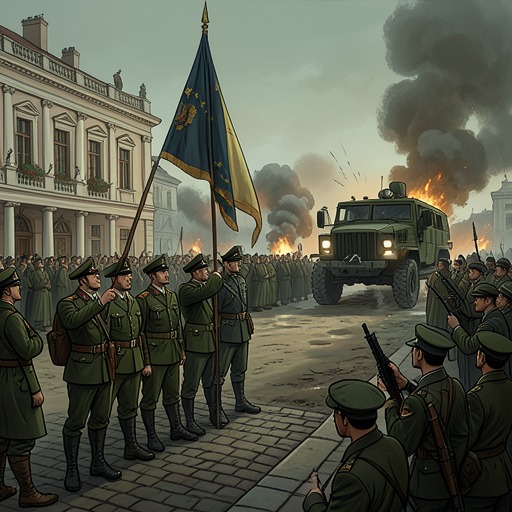
Yalta supplies one of the narrative’s most recognizable geographical anchors. The White Palace is identified in Yalta, Crimea, and a separate geographical description places Livadia less than two miles west of Yalta, associating the village with the czars. These details give the political and military crisis a specific landscape rather than leaving it at the level of maps and declarations. The nearby places mark a region with a historical and civic presence, even as events bring armed forces and emergency decisions into it.
The narrative also records the aftermath of shootings in this Crimean sequence: ambulances arrive within twenty minutes. The detail is brief, but its precision changes the scale of the setting. Crimea’s crisis is not experienced only through high-level decisions about control; violence produces immediate consequences requiring a rapid response. The peninsula’s political uncertainty is therefore accompanied by danger to people in the places where the larger struggle unfolds.
Kerch, Arsincevo, and military action
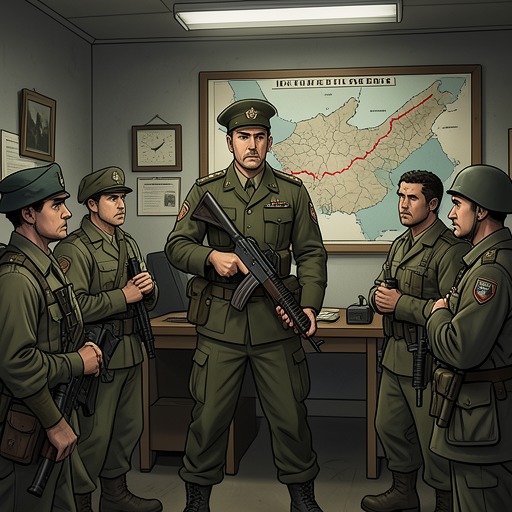
The eastern peninsula around Kerch and Arsincevo becomes a concentrated operational zone. Near Arsincevo on the Kerch Peninsula, Tombstone stands on low ground; another scene locates the action at Arsincevo in the Crimean Military District. By 0830 hours, the U.S. Marine Corps is present there. The precise place and time give the military sequence a ground-level chronology, distinct from the larger diplomatic debate over who should govern Crimea.
Arsincevo is also tied to the logistical effort to keep the Jefferson in action. The novel explains that a modern carrier such as the Jefferson requires replenishment at sea, and it places the carrier’s endurance within the wider problem of resupply. At Arsincevo, the operation involves pumping nearly three million gallons as the Jefferson is refueled. That scale makes the location more than a point on the battlefield: it is part of the infrastructure on which naval power depends.
The military history associated with the peninsula runs from political upheaval into battles and operations around Kerch and Arsincevo. The Black Sea Fleet’s air power is eventually described as broken, a consequential change in the balance of force. The sequence links that larger result to the specific geography of Crimea: command of the surrounding waters and airspace is shaped not only by ships and aircraft, but by control of positions and the ability to sustain forces ashore.
A strategic place under pressure
Crimea’s narrative importance comes from the way political and material pressures meet there. The dispute between Kiev and Moscow concerns ownership; the offer by General Boychenko raises the possibility of international control; and the battles and refueling work around Kerch and Arsincevo show that any political outcome exists alongside armed operations. Each dimension complicates the others. A proposal for peace cannot by itself end the military crisis, and military advantage cannot by itself resolve the peninsula’s contested status.
The novel also places Crimea within the limits of naval endurance. A carrier needs replenishment, and the effort to pump millions of gallons at Arsincevo gives that requirement a concrete location and scale. In this way the peninsula is both a political problem and a practical lifeline: it is where claims of sovereignty are argued, where forces meet, and where continued operations depend on supplies. Its significance lies not in a single decisive scene, but in the accumulation of these pressures across one contested landscape.