Bosporus Strait
AfterburnThe Bosporus Strait is the narrow gateway between the Black Sea and the Sea of Marmara, and in the novel it becomes much more than a route into a contested sea. The U.S.S. Thomas Jefferson first passes through it on its way into the Black Sea; later, an attack that blocks the passage strands the carrier group and threatens its ability to keep operating. The strait’s importance lies in this double role: it is an entrance for ships and a bottleneck on which their continued presence depends.
Geography and Strategic Position
The strait links the Black Sea with the Sea of Marmara, and through it the Aegean Sea beyond. It is eighteen miles long and averages two miles in width, but narrows to half a nautical mile at its tightest point. That constriction gives the route strategic weight disproportionate to its length. Ships moving between the Black Sea and waters to the southwest must pass through this restricted corridor; in the novel, the Dardanelles form the other narrow passage in the same supply chain.
The surrounding geography is also politically charged. The Crimean Peninsula is described as belonging geographically to Ukraine, while the Russian Federation borders it to the east; the dispute between Kiev and Moscow over Crimea and the Black Sea Fleet remains unsettled as the Russian Civil War opens an opportunity for Ukraine to strengthen its position. The strait does not resolve those competing claims, but it connects the waters and forces through which the conflict is unfolding. With the area described as tearing itself apart and assistance from Ankara uncertain, the route becomes a strategic vulnerability as well as a geographic link.
The Carrier’s Passage into the Black Sea
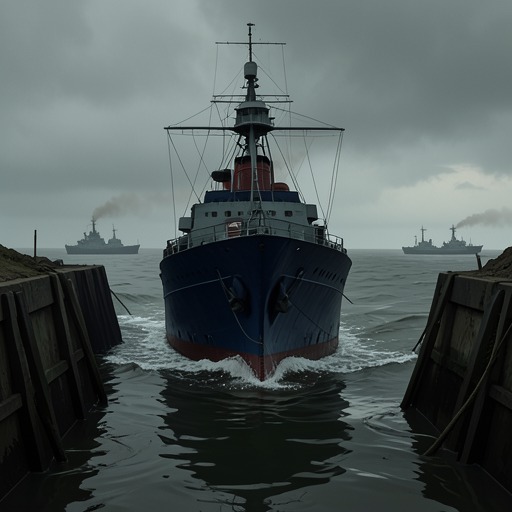
On Friday, 30 October, the U.S.S. Thomas Jefferson enters the Bosporus under the guidance of an experienced captain. The supercarrier proceeds northeast along the narrow channel, threading between its shores toward the Black Sea proper. Its passage is presented at the scale of the ship itself: a vast, gray vessel more than a thousand feet long moving through a confined waterway. The contrast makes clear that this is not open-sea maneuvering. The carrier’s size and momentum demand caution in a channel where room to turn or stop is limited.
As the ship clears the bridge, the shorelines recede and the carrier approaches the Black Sea. The passage is a threshold in both the physical and operational sense: the battle group moves from the strait into a new theater, but it has also committed itself to a route through which later resupply and withdrawal must pass. The strait’s significance is therefore established before it is attacked. It is the way in, but the same geography can make it the way out’s obstruction.
A Chokepoint in the Supply Line
A modern carrier does not operate independently of its support ships. The Jefferson requires replenishment of expendable supplies every two to three weeks. Nuclear power means the carrier does not need fuel for its own propulsion, but its aircraft consume fuel, and the group depends on replenishment tankers that follow it at sea. Under ordinary conditions, those tankers sustain the force; if the passage is cut, the supply chain becomes vulnerable at its narrowest point.
The novel makes that vulnerability explicit by identifying the Dardanelles and the Bosporus as the two narrow slots in the Jefferson’s supply route. The carrier’s aircraft fuel would last no more than ten days, and less under a heavy flight schedule, a major strike, or an extended running battle. A force need not be sunk to be neutralized: blocking the route or incapacitating the carrier short of destruction could leave an imposing warship unable to carry out its mission. The strait’s physical narrowness thus becomes an operational clock, measuring how long the battle group can continue before its stores run short.
The Bridge Attack and the Closed Passage
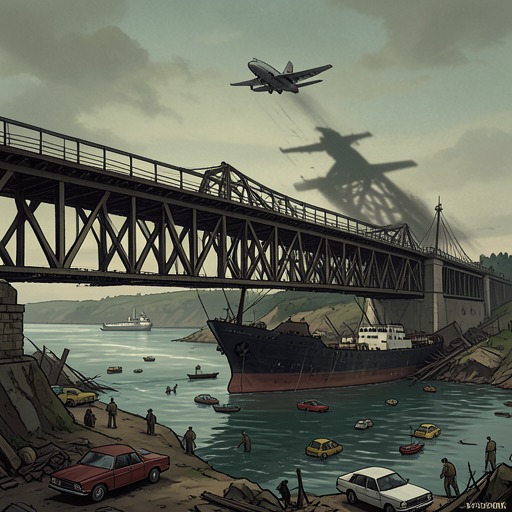
On Thursday, 5 November, the newest and northernmost bridge spanning the Bosporus is crowded with cars, trucks, bicycles, scooters, ox-carts, and people on foot. The passage is not merely an abstract naval corridor; the bridge above it is part of a lived, busy landscape. The contrast is sharply reversed when at least a dozen Russian aircraft strike the northern bridge and drop it into the water. The same attack hits the Falcon Patriot, a tanker that catches fire as its captain tries to put it aground near Sariyer. Its cargo is also burning.
The fallen bridge leaves debris that would require a major engineering effort and weeks, possibly months, to clear. Until the wreckage is removed, vessels cannot pass between the Black Sea and the Sea of Marmara, or continue onward to the Aegean Sea. The attack therefore joins a physical obstruction to a blow against the battle group’s resupply: the strait is blocked while a tanker is afire. The consequences extend beyond the immediate damage. With flight operations and maneuvering consuming fuel, the Jefferson’s remaining margin could shrink from ten days to only two to four. The carrier and its escorts risk becoming large, expensive, and useless vessels trapped inside the Black Sea.
Clearance and Return
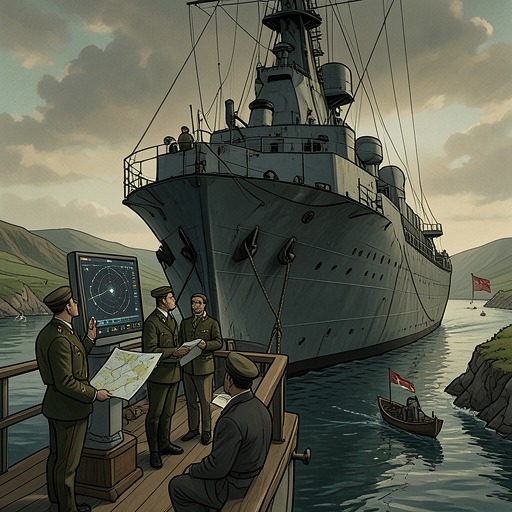
The closure changes the problem facing the American command from simply sustaining an operation to finding a way to restore access and resupply. When officials ask whether the battle group can be reached and replenished, Admiral Scott turns to Magruder, who distributes the group’s estimates. The figures make the geography concrete: the question is not only whether the ships can fight, but whether a force can pass through the closed strait and deliver what the carrier’s aircraft need.
In the epilogue, on 15 November, the U.S.S. Thomas Jefferson approaches the strait from the north and slowly cruises southwest into it. The same pilot, Ismet Ecevit, who guided the carrier through on its earlier passage is again on the bridge. By then, U.S. Army engineers and Navy Seabees have reported the Bosporus clear to navigate, and orders to go home have followed. The return passage reverses the opening movement: the ship that entered the Black Sea through the corridor can leave only once it has been cleared again. In this sequence, the Bosporus Strait functions as a geographic threshold, a contested military chokepoint, and finally the condition that makes the battle group’s homeward journey possible.