Livadia Palace
AfterburnLivadia Palace is a sprawling former imperial summer residence whose history makes it more than a setting: it connects the Russian monarchy, the 1945 Yalta Conference, and the transfer of the Crimean Military District to UN control. Known in the narrative as the White Palace, it stands in Livadia, less than two miles west of Yalta. The palace and its broad park become a stage on which different eras of Russian history meet, while a later attack on a helicopter brings the surrounding story back from political ceremony to immediate danger.
Setting and Imperial History
Livadia was a village near Yalta where the czars began building summer palaces in the 1860s. Nicholas II erected his summer residence there in 1912; the resulting White Palace is described as sprawling and luxurious. These details establish the site first as a place shaped by imperial power and seasonal residence. Its later political importance does not erase that origin: the palace remains a royal residence even as the events associated with it give the building successive meanings beyond its original use.
The palace’s proximity to Yalta places it in a specific Crimean landscape, rather than leaving it as an abstract seat of authority. The village lies less than two miles west of the city, and the palace grounds include a broad, level park in front of the building. That open ground matters in the later ceremony: officials, chairs, a raised stage, and a large podium occupy a space that had belonged to the palace’s grounds. The setting thus supports both private imperial grandeur and public political display, although the account gives no details about the palace’s rooms or architectural style beyond its scale and luxury.
The Yalta Conference and Historical Memory
In February 1945, the White Palace was the site of the Yalta Conference, where Franklin D. Roosevelt, Winston Churchill, and Joseph Stalin carved up postwar Europe. The narrative characterizes the meeting as infamous as well as famous and says that the leaders unwittingly launched the Cold War that followed. The palace is therefore attached to a consequential historical irony: a conference intended to shape the postwar order is presented as helping inaugurate a prolonged period of confrontation.
That history gives the site’s later political use an explicit resonance. The palace does not merely witness a change in officials; it is described as the place where another era of Russian history is to begin. The comparison is grounded in the repetition of high-level political action at the same location. In 1945, leaders negotiated the division of postwar Europe; later, General Boychenko turns the Crimean Military District over to UN control. The episodes are distinct, but their placement at the same palace links them as moments when authority over a broader political order is being rearranged.
The Transfer Ceremony
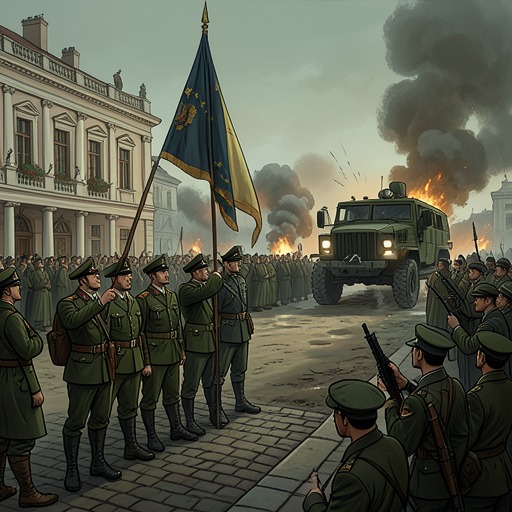
For the transfer, a stage is erected in the broad, level park in front of the White Palace. Chairs are set out for UN and Russian officials, and a massive wooden podium, already arranged with dozens of microphones, dominates the prepared space. These concrete details make the handover a public ceremony rather than an unseen administrative act. The stage establishes a focal point, the chairs gather the representatives of the two sides, and the microphones make the podium the center of the proceedings.
The ceremony’s arrangement also gives the palace a role in how the transfer is presented. Boychenko turns over the Crimean Military District to UN control there, and the event is framed as the inauguration of another era. The account does not specify the ceremony’s speeches or describe the reactions of those attending, so its significance rests on the action and setting that are given: a military district changes hands before assembled officials, at a palace already associated with decisions over Europe’s future. The contrast between the luxurious former residence and the utilitarian abundance of microphones and chairs underscores how the grounds have been adapted to public authority.
Wartime Action and Narrative Significance
Livadia Palace is also connected with a later, violent episode involving a Sea Stallion helicopter. After rising from his hiding place, Matt “Tombstone” Magruder jogs back toward the helicopter, which he had feared was the target of a strafing run. It now rests at a sharp angle, with flames visible. This brief scene places the palace’s associated action far from the measured display of the transfer ceremony: the same location’s narrative reaches from official proceedings to a damaged aircraft and a return made under threat.
Across these episodes, the palace serves as a historical marker and an operational setting. Its imperial origins, the 1945 conference, the transfer of the Crimean Military District, and the helicopter under attack are not presented as one continuous event; rather, their juxtaposition lets the location accumulate significance. The White Palace is at once a former royal residence, a remembered venue for decisions about Europe, and a place associated with the precarious military situation of the later conflict. Its importance lies in that layering: political authority is repeatedly staged there, but the surrounding story shows that formal acts and prepared platforms cannot keep violence at a distance.