Russia
AfterburnRussia is the central but disintegrating state behind the book’s widening conflict: its post-Soviet political breakdown becomes civil war, its armed forces are shown struggling to sustain themselves, and competing authorities make the future of its remaining territory uncertain. The country is not presented as a single, coherent actor. Leonov’s Blues and Marshal Krasilnikov’s Reds fight for control, while the crisis around Crimea exposes how little agreement remains over who can speak or act in Russia’s name.
A state coming apart
The collapse begins with the failure of the old Soviet order. After Gorbachev withdrew from Europe and lost control of reforms intended to limit the damage of a failing economy, the revived Union itself began to disintegrate. The narrative links the country’s later military and political disasters to that longer unravelling: Russia’s crisis is not a sudden disturbance but the consequence of an authority that has been losing its capacity to govern.
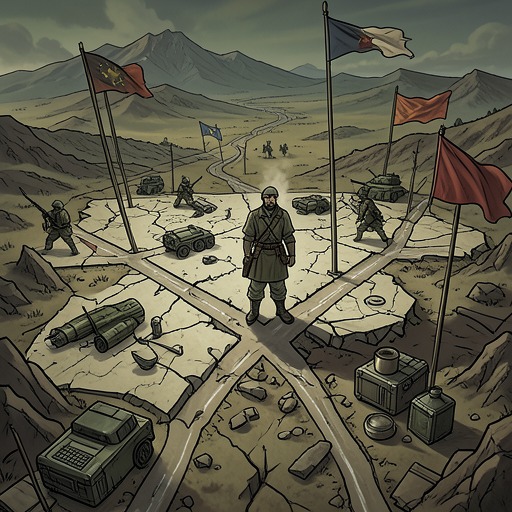
The gamble in Norway is described as the final blow to the Motherland. By the time Dmitriev looks back on it, a populist leader, Leonov, has displaced the discredited hard-liners, but a political solution has already become elusive. Leonov’s Popular Democratic Front—the Blues—are locked in all-out combat with the hard-line Reds under Marshal Krasilnikov. The conflict is therefore both a struggle over power and a sign that the state’s political divisions have become armed ones.
Civil war and failing capacity
The fighting is not confined to a remote front. Leonov and Krasilnikov’s forces battle in the streets of Moscow and in a hundred other Russian cities, while the country moves toward what the narrative calls total anarchy. Seven months before one later assessment, the troops were already short of food, clothing, ammunition, boots, and nearly everything else a modern army required. Conditions have since worsened, and the civil war continues without a clear-cut government.
These details make material scarcity part of Russia’s political story. The military is not simply divided between rival commanders; its ability to function is undermined by the absence of basic supplies. At the same time, the conflict’s persistence prevents either faction from consolidating an uncontested national authority. The result is a country whose armies continue to fight even as the institutions and resources needed to sustain them fail.
The breakdown also changes the meaning of Russia’s borders. American forces land on the Kola Peninsula, on territory once treated as sacrosanct, while the Blues and Reds fight across the country. The incursion is presented alongside the internal war, not as an isolated episode: a weakened state that cannot settle its own succession is increasingly exposed to intervention from outside.
Ukraine and the contest over territory
The crisis reaches beyond Russia proper. Ukraine is described as one of the Soviet Union’s founding states in 1922, but its people had never fully reconciled themselves to Russian domination; the narrative emphasizes that Ukrainians were not ethnically Russian. That history complicates any effort to treat the fighting across former Soviet territory as merely an internal Russian dispute. The instability creates the danger that United Nations and U.S. forces in the area will be drawn into hostilities they are trying to avoid.
Three days after the accidental sinking of a Russian submarine in the southern Black Sea, Boychenko, the de facto military ruler of the Crimean Peninsula, offers to surrender. His proposal makes Crimea a test of what remains of Russian authority: the peninsula is governed by a military leader whose control is practical rather than clearly rooted in a settled national government, and any transfer risks intersecting with the wider fighting.
The geography around Kerch gives that contest a concrete edge. Kerch lies at the eastern tip of Crimea, overlooking the Kerch Strait, which connects the Black Sea to the Sea of Azov and separates Crimea from the Taman Peninsula and Russia proper. The strait is only five kilometers wide at that point. In a story of disintegrating borders, this narrow passage is both a physical link and a line of separation between the peninsula and the Russian mainland.
Competing claims to command
The struggle over Crimea sharpens when Dmitriev announces that he is assuming command of the Crimean Military District. He declares Boychenko an enemy of the state and says he will be arrested as a traitor when found. The announcement does not settle the question of legitimacy; instead, it makes visible the rival claims at the heart of Russia’s collapse. Boychenko has exercised de facto military rule, while Dmitriev invokes the state’s authority to remove him.
Dmitriev also addresses the United States from Washington’s perspective through a recorded statement. He insists that Russian forces have not intentionally fired on American ships and describes the tanker sunk during the attack on the Bosporus bridge as an accidental target, comparing it to an earlier incident. His denial acknowledges the danger of direct U.S.–Russian confrontation even as Russian actions have already put American vessels at risk. The country’s internal fragmentation thus carries consequences far beyond its borders.
That possibility is made explicit in a discussion of whether to strike Russia directly and threaten an expanded war against a real enemy rather than Ukrainians or other Russians. The proposal frames intervention as a potential escalation, not a settled decision. It also reveals the paradox of the conflict: Russia’s weakness invites pressure, but attacking it could transform a tangled regional crisis into a larger war.
Crimea and Russia’s uncertain future
Russian soldiers’ attachment to the territory is represented through the personal stakes of a commander whose twelve-year-old son lives in base housing at Glazivska, a few kilometers north of Kerch. He says that he and his people will not simply abandon their homes and loved ones to what he calls Ukrainian genocides; if protecting those homes requires them to fight fellow Russians, they will do so. The passage presents this as his stated justification, not as an independently established account of events. Its force lies in the contradiction it exposes: the defense of home can become a reason to fight people on the same side of a national divide.
By the final assessment, the United Nations has protested that Crimea is under its protection, but the protest appears to carry little weight. The peninsula’s possible loss is described as a potential final blow to Krasilnikov’s hard-line rule over what remains of Russia. The wording remains conditional, and the future is expressly uncertain. Russia’s trajectory therefore ends not with a restored national settlement, but with its authority still contested, its territory threatened, and the outcome of its fragmentation unresolved.