Bosporus Bridge
AfterburnThe Bosporus Bridge was both a major physical crossing and, on November 5, 1006, the site of a sudden collapse that transformed a busy route into debris across the Bosporus Strait. The book introduces it not as an empty military objective but as a functioning span crowded with travelers and vehicles; its destruction then unfolds through the failure of its towers, suspension rig, and deck, with consequences reaching beyond the bridge itself to the channel below.
Setting and Structure
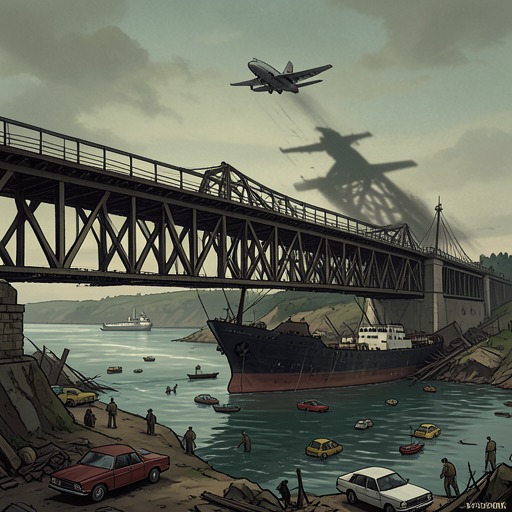
On Thursday morning, at 1006 hours Zulu plus three, the bridge was identified as the newest and northernmost of the three bridges spanning the Bosporus Strait. Its traffic included cars and trucks, but also bicycles, scooters, ox-carts, and people on foot. That varied crowd gives the structure a distinctly everyday presence: it was a route used by different kinds of travelers, not simply a military installation or an abstract landmark. The account does not state how many people were on the bridge, or identify individual travelers, but it makes clear that the span was busy when the attack began.
The bridge’s suspended deck ran between two large concrete towers. The distance between the towers across the channel was just over a thousand meters, a long span whose scale becomes consequential as its supporting structure fails. The description gives the bridge a precise physical arrangement—the suspended roadway, the towers, and the cables—so that its destruction can be followed as a sequence of structural failures rather than reported as a single, instantaneous event.
Strike and Structural Failure
The first AS-14 Kedge missile described in the sequence traveled south across the water, only a few feet above its dark surface. It struck the base of the westernmost tower, where its warhead detonated. The missile’s low passage over the water and its impact at the tower’s base place the violence directly against the bridge’s supporting structure; the span’s collapse follows through that vulnerable framework.
The failure spread from the northern half of the suspension rig to the southern half. As the northern section gave way, the southern section began to fail as well. The eastern tower then sagged heavily toward the north, while concrete splintered and the structure’s movement intensified. These details distinguish the collapse from a simple image of a roadway falling: the supporting rig failed across the bridge, and the towers and cables moved in a connected, deteriorating system.
Oscillations built until the main cables snapped. The deck’s box sections then fell into the strait. The narration moves from the missile’s impact to progressive structural breakdown, ending with the roadway no longer suspended above the channel but scattered into it. The sequence preserves the distinction between the initial strike and the subsequent collapse: the missile hit a tower, the suspension system failed, and the deck came down as the cables gave way.
Aftermath and Strategic Consequence
The collapse altered the channel as well as the crossing. The navigable passage up the center of the Bosporus was only a few hundred yards wide at most. Once smoke and spray had cleared, observers aboard nearby vessels could see that the channel was almost completely blocked. The bridge’s failure therefore had an immediate consequence for movement on the water: its broken deck occupied much of a passage already narrow enough to leave little room around the wreckage. The account establishes the obstruction but does not specify how long it lasted or what vessels were ultimately able to pass.
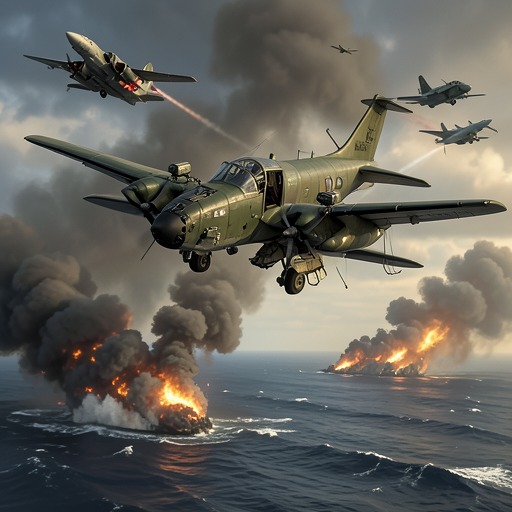
A later report from Air Ops aboard the Thomas Jefferson confirmed that Russian aircraft had hit the northern Bosporus bridge and sent it into the water. The same report said the Falcon Patriot tanker had been hit and was burning, placing the bridge’s destruction within a wider attack at sea. That operational confirmation echoes the earlier physical account: the bridge is not merely described as damaged, but as having been dumped into the water, where its remains now interfere with navigation.
Narrative Significance
The bridge’s importance in these passages lies in the contrast between ordinary use and sudden strategic violence. At the outset, its crowded surface joins cars, trucks, bicycles, scooters, carts, and pedestrians in a single shared crossing. The missile attack turns that familiar mixture of movement into a mass of falling vehicles and people, while the collapse carries the damage from the roadway into the waterway below. The account does not quantify casualties, so the human cost cannot be specified more precisely; it does, however, state that vehicles and people spilled into the gulf as the northern structure failed.
Its destruction also links two kinds of vulnerability. Above the water, a long suspended span depends on towers, rigging, and cables that fail in succession. Below, the narrow navigable channel cannot easily absorb the debris from that failure. The bridge thus functions in the narrative as more than a damaged landmark: its collapse converts an attack on a crossing into an obstruction of the Bosporus Strait itself.