The White House
AfterburnThe White House is where the Crimea operation becomes a question of national policy rather than military movement alone. Its Cabinet Room hosts arguments over a United Nations role, the surrender of Crimea, and the authority to place American forces under international command; later, it becomes a site for reviewing the consequences of those choices as the mission deteriorates.
Setting and Institutional Role
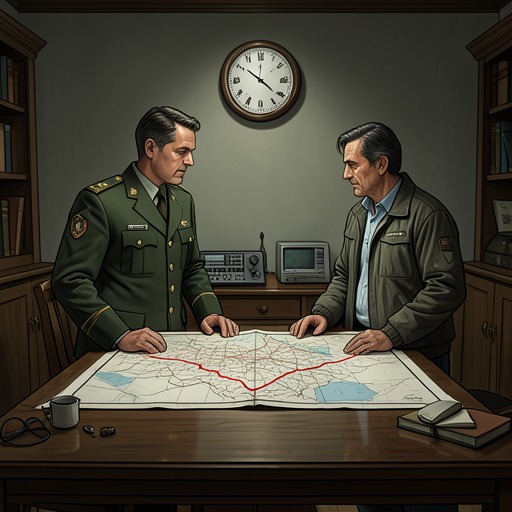
The Cabinet Room in the White House, Washington, D.C., is identified as the setting for two consequential policy scenes. On Monday, 2 November, at 1047 hours, the President and advisers meet there as the prospect of receiving the surrender of Crimea comes into focus. On Friday, 6 November, at 0847 hours, the room hosts another meeting, this time with a video image of Vice-Admiral Dmitriev on the screen. The repeated return to the Cabinet Room gives the White House a role beyond that of a backdrop: it is where military developments are converted into recommendations, permissions, and renewed disputes over what the United States should do.
The deliberations take place against the strategic premise that victory in the relevant Russian conflict could open the way to a United Nations-brokered peace throughout the Russian Federation. The carrier battle group is entering a dangerous, landlocked theater in part to reinforce the United Nations position, while a Marine Expeditionary Unit has already been moved to waters off Poti. The White House discussions therefore concern more than whether to send forces into a crisis. They concern how much military weight to lend an international settlement, and who should direct that weight.
The Crimea Decision
At the 2 November meeting, Robert Heideman presents the surrender of Crimea as an opportunity. The President, Herb Waring, is unexpectedly receptive: despite recent criticism of his foreign policy, advice to concentrate on domestic problems, and the growth of isolationist opposition, Heideman’s case has struck a chord. Matthew Magruder is surprised by Waring’s evident interest, underscoring that the proposal is not an obvious or politically effortless choice.
Waring tests the central condition of the proposal: General Boychenko will surrender to the United Nations, but the United Nations will proceed only if the American carrier battle group participates. The question at the table is thus both diplomatic and operational. The force’s presence may help secure a surrender, but cooperation also raises the long-debated issue of placing American forces under United Nations commanders. The discussion culminates in a recommendation to the President that the battle group in the Black Sea be placed under United Nations command and cooperate in receiving Crimea’s surrender. In this way, the White House becomes the decision point at which a proposed peacekeeping role acquires a concrete command implication.
Authority and the Military Chain of Command
The proposal exists alongside a restrictive National Command Authority directive: American forces are not to involve themselves in fighting between the Reds and the Blues. The mission is also compared on paper with Operation Restore Hope, the costly and abortive United Nations-requested Marine operation in Somalia from 1992 to 1994. These limits and precedents sharpen the policy problem. The administration is considering a substantial role in a volatile regional crisis while formally excluding participation in one dimension of the conflict.
The decision made in Washington is transmitted to the forces at sea. The United Nations asks for operational authority over U.S. forces in the Crimean Peacekeeping Operational Zone, and Washington grants it. Admiral Tarrant tells his officers that, for the mission’s duration, his immediate superior will be the United Nations commander; he also insists that the President remains commander in chief and that the officers must obey his orders. The battle group is to operate under United Nations command until the President says otherwise. The White House’s choice therefore alters the active chain of command, even as the military leadership emphasizes the continuing authority of the American President. The arrangement exposes the tension between international delegation and national command without resolving it in the announcement itself.
Review Amid a Worsening Crisis
By the 6 November meeting, the White House is responding to events rather than considering the policy in the abstract. Within twenty-four hours of the attack on the Bosporus bridge, the Russian embassy in Washington has delivered a tape. The President has seen it, and his advisory group is reviewing it. The scene places Dmitriev’s drawn face before the officials as they confront a crisis connected to the surrender of Crimea and the coup that has left a shore party trapped ashore.
The advisers do not share one assessment. Gordon West, the White House Chief of Staff, judges the effort a major failure, while still distinguishing a sound strategic concept from its botched execution. Samantha Reed refuses to recommend any action that would deepen American military involvement and objects to sending in the Marines at further risk. Their opposed positions return the room to the conflict already embedded in the original decision: the desire to use American power to support a negotiated outcome against the danger that intervention will expand beyond its intended limits.
Narrative Significance
The White House scenes frame the mission through institutional disagreement rather than presenting government as a single, settled will. Heideman advances a proposal, Waring weighs political opportunity and risk, the National Command Authority’s restriction defines a boundary, and the United Nations’ request changes the operational command relationship. The resulting order is then carried to officers at sea, where it must be reconciled with their continuing duty to the President. Later, the embassy-delivered tape and the sharply different judgments of West and Reed show how quickly strategic promise can give way to arguments about failure, escalation, and responsibility. The White House is consequently both the origin of the mission’s political authorization and the venue where its mounting costs are contested.