Kerch
AfterburnKerch is a strategic center on the Crimean Peninsula, where the campaign’s competing claims over Crimea meet the immediate demands of a major military operation. Its naval port, nearby airfield, and access to the Arsincevo fueling dock make the surrounding area both a landing ground for U.S. Marines and a crucial resupply point for the carrier Jefferson.
Geographic and Strategic Setting
Arsincevo lies on the southern outskirts of Kerch’s urban sprawl. Its naval port sits directly to the north, almost adjacent to the tank farm, while a major airfield is visible nearby. This close arrangement of town, port, fuel storage, and airfield gives the area an unusually concentrated military and logistical character.
The action is located on the Kerch Peninsula, where the narrative places Kerch’s naval facilities and Arsincevo’s fueling dock in relation to one another. The dock is south of the naval base and just offshore, putting a fleet replenishment operation close to the port and airfield infrastructure that shapes the surrounding battle.
Crimea’s Contested Setting
Kerch’s importance sits within the larger dispute over Crimea. The peninsula had long been regarded geographically as part of Ukraine, while the Russian Federation bordered it to the east across the strait. The book also describes Ukraine as a republic whose people were not simply interchangeable with Russians, and notes that Ukrainians were using Russia’s civil war to strengthen their position, especially in Crimea.
The dispute was not only about territory: the old disagreement between Kiev and Moscow over ownership of the peninsula and the Black Sea Fleet remained unresolved. In a political exchange, Admiral Scott insists that the wider area is tearing itself apart, while the Secretary points out that Ukraine has not yet attacked. Kerch’s military infrastructure therefore belongs to a landscape where territorial claims, a Russian civil war, and the prospect of further conflict overlap.
Landing and Military Activity
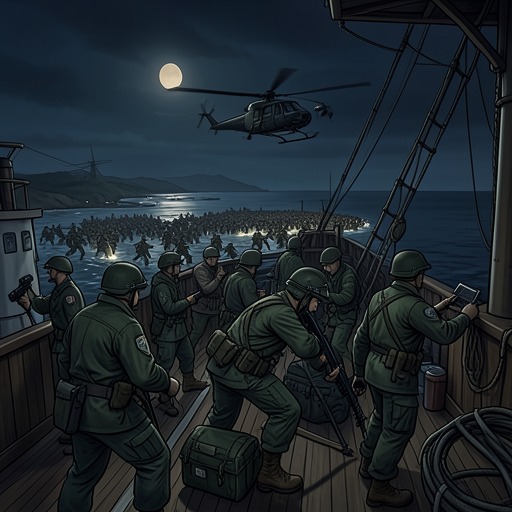
On Saturday, 7 November, by 0830 hours, U.S. Marines were firmly ashore at Arsincevo and moving across the beach by several means, including dozens of LVTP-7 amphibious vehicles carrying twenty men apiece. The landing places forces on the outskirts of Kerch, near the port and fuel installations, rather than treating the town as a distant backdrop.
By 0905 hours, the Jefferson was at the Arsincevo fueling dock. The location connects the advance ashore to the carrier group’s immediate needs: the dock is not merely adjacent to a military objective but becomes an active point in the operation to keep the carrier’s aircraft flying.
Fuel, Access, and the Carrier’s Vulnerability
The Jefferson’s predicament makes Kerch’s fuel facilities strategically consequential. Although the carrier is nuclear-powered and does not need fuel for its own propulsion, its aircraft consume aviation fuel. The ship requires replenishment of expendable supplies every two to three weeks, and its aviation-fuel reserves would not last more than ten days under ordinary conditions—less with a heavy flight schedule, a major strike, or an extended battle.
That margin contracts sharply when aircraft operate around the clock: the ten-day allowance could fall to only two to four days. Once those supplies ran out, the Jefferson and its escorts would be stranded in the Black Sea by the closing of the Bosporus, reduced to what the narrative calls large, expensive, useless toys. Kerch’s nearby dock thus offers a practical answer to an urgent shortage, but the broader geography makes clear why a single refueling operation cannot erase the fleet’s vulnerability.
At Arsincevo, Russian-provided information about the fueling point has proved accurate. The aviation gasoline has been tested and judged to meet the Jefferson’s demanding standards; the remaining task is to pump nearly three million gallons, about nine thousand tons, aboard. Flight-deck operations have been suspended during the transfer, underlining the trade-off: the carrier must pause one part of its combat activity to restore the fuel that makes sustained air operations possible.
Narrative Significance
Kerch’s role is defined by the way its geography turns into operational consequence. The nearby landing, naval port, airfield, tank farm, and offshore dock bring ground combat and fleet logistics into the same compact setting. At the same time, the carrier’s dependence on aviation fuel and the closed strait make resupply a question of access as much as quantity. Kerch is therefore more than a place where forces meet: it is a temporary hinge between the Marines’ foothold ashore and the carrier group’s ability to continue operating in an increasingly constrained sea.