Kerch Strait
AfterburnKerch Strait is the narrow waterway at the eastern edge of Crimea, separating the peninsula from Russia and connecting the Black Sea with the Sea of Azov. In the novel, its importance is at once geographical and operational: it marks the point where Crimea meets the mainland, and it becomes a planned crossing for troops seeking to leave the peninsula.
Geography and Setting
The strait occupies a precise position in the book’s description of Crimea. The peninsula extends north into Ukraine, while Russia borders it to the east across the narrow passage and beyond the Sea of Azov. The strait thus gives physical form to a political geography in which Crimea is connected to Ukraine by land but faces Russia across a short stretch of water.
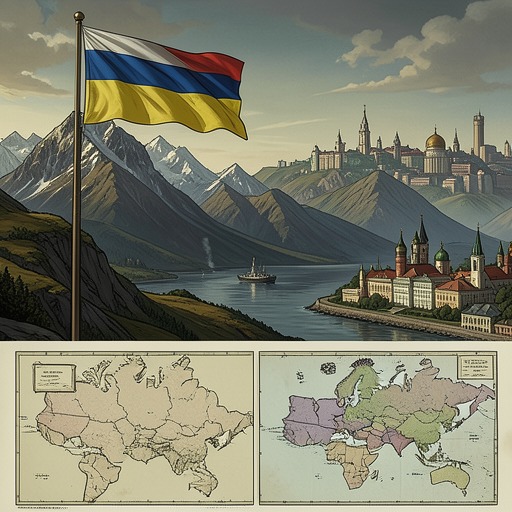
A map sequence places the passage within the broader eastern shoreline of the Black Sea. The view runs northwest from Hopa, a Turkish port, to Kerch at Crimea’s easternmost tip, where the straits guard the entrance to the Sea of Azov. Poti is also prominent on this map, but Kerch and its adjoining waterway occupy the point where the Black Sea coast turns toward the northern sea. The description at Kerch makes the scale unusually concrete: at the point indicated, the strait is only five kilometers wide.
A Passage Between Crimea and the Mainland
The narrative turns that narrowness into a practical route. After Arsincevo, Boychenko’s troops are expected to cross Kerch Strait and join Krasilnikov’s forces on the other side. The crossing is presented as part of a promised journey home: the troops remain loyal to Boychenko in particular because he has promised to find a way for them to leave Crimea. Yet they do not know that he himself will be leaving them, making the strait a route shaped by both their expectation and the information withheld from them.
The crossing is not described as a completed movement in these passages. Instead, the route is discussed as a plan, with Kerch serving as the destination and the strait as the obstacle and link between the peninsula and the mainland. That distinction matters: the waterway’s strategic function is established before the account confirms that the troops have crossed it.
Kerch as a Military Objective
A later map discussion isolates Kerch as a seaport at Crimea’s easternmost tip, overlooking the passage between the Black Sea and the Sea of Azov. The map makes the route legible as a military problem: troops approaching Kerch would have to pass through a narrow channel, while control of the port would give them access to the crossing.
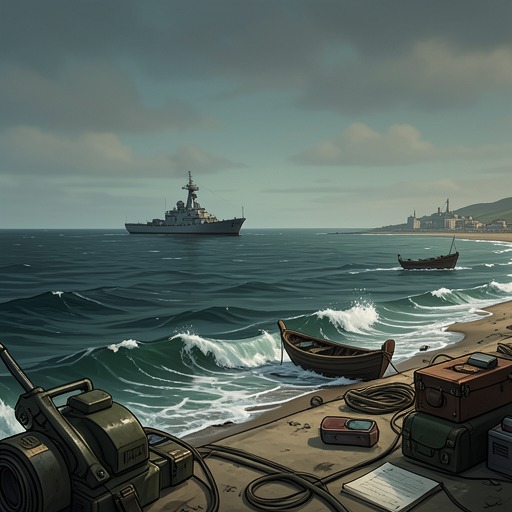
The Americans’ anticipated arrival at Kerch adds a naval dimension to the plan. They are expected to provide transport for Boychenko’s troops across the strait. The location therefore connects a ground movement out of Crimea to American naval assistance; Kerch is not merely a point on the coast but the place where the proposed evacuation can be carried out.
Narrative Significance
The strait’s repeated appearance in maps and plans gives geography a direct role in the story’s decisions. Its five-kilometer width makes the separation measurable, but the planned crossing carries consequences beyond distance: it is tied to the troops’ hope of returning home, their loyalty to Boychenko, and his concealed departure. By making Kerch the focus of a transport plan, the novel turns a boundary on the map into a test of who can leave Crimea, by what means, and with whose help.