Poti
AfterburnPoti is a Georgian port on the Black Sea where a humanitarian mission becomes inseparable from the military risks of intervention. Set close to the Turkish border and amid a shattered coastal landscape, the city is selected as the point at which relief might enter war-ravaged Georgia. Securing it, however, requires forces to operate inside a confined and vulnerable sea, making Poti both a practical gateway and a measure of how precarious the mission has become.
Setting and Strategic Position
Poti lies on the Georgian coast, about fifty miles from Hopa and the Turkish border. In a wider operational view, it appears along the coast running from Hopa eastward to Kerch, at the far end of the Crimean Peninsula and near the narrow entrance to the Sea of Azov. Poti’s position thus connects the immediate Georgian crisis to a much broader Black Sea theater. A map of the area also places a cluster of green icons thirty miles offshore, locating activity at sea in close relation to the port without specifying more about those icons in the available account.
The importance of that coastline is heightened by the contested politics of the region. Ukraine had long been uneasy with its status as one of the Union’s largest and most productive republics, and the novel stresses that ethnic Ukrainians were not Russians. As the Russian Civil War creates an opening, Ukrainians seek to strengthen their position, especially in Crimea. The peninsula is geographically associated with Ukraine, while the Russian Federation borders it to the east; the old dispute between Kiev and Moscow over Crimea and the Black Sea Fleet remains unresolved. Poti is not identified as the center of that dispute, but its location puts the Georgian mission within the same unsettled regional geography.
The Port as a Humanitarian Objective
Poti’s defining role in the plot is as the port that the United Nations needs opened for aid. MEU-25 reaches the Black Sea a few days before the Jefferson, carrying orders from the National Command Authority to establish a secure port there. The purpose is to allow United Nations humanitarian aid to begin flowing into Georgia, described as a small country on the southern slopes of the Caucasus Mountains that has been ravaged by war. The order makes the port more than a coastal landmark: access to it is a condition for delivering assistance.
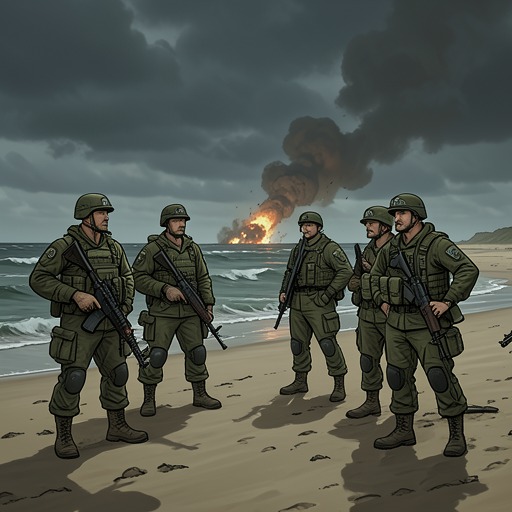
MEU-25 is organized for such a task. It includes the landing platform dock Little Rock, the USS Saipan amphibious assault ship, and the USS Guadalcanal amphibious assault ship, together with transports and escorts. The force is assigned to carry a reinforced Marine Battalion Landing Team wherever it is needed. Its arrival before the Jefferson gives the operation a sequence: an amphibious unit is already tasked with making the port secure, and the carrier group follows to add its air wing to the United Nations’ arguments. The account establishes the mission and its intended purpose, but the evidence here does not establish that aid successfully begins flowing through Poti.
War-Ravaged Coast and Arrival
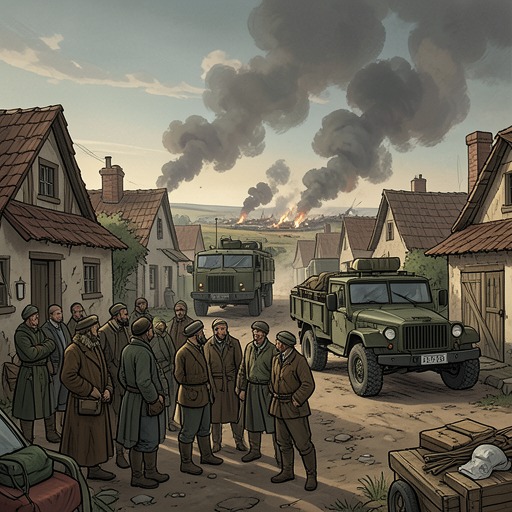
The city’s appearance makes the need for assistance visible. As a United Nations Black Hawk lifts clear of the ground, Poti spreads out below: shattered white buildings crowd the water’s edge. The contrast between damaged structures and the Black Sea’s bright surface gives the port a sharply divided aspect, at once a place of destruction and a potential channel into the country. The scene does not present Poti as an abstract point on a military map; it is a damaged city seen from the air, whose condition gives urgency to the mission.
That view also sets the scale of the task. The objective is not simply to arrive offshore, but to secure a working port in a country whose coastal settlements have been affected by war. The force’s orders connect local security to a wider relief effort, while the presence of American naval power makes that effort part of a contested international intervention. Poti therefore concentrates two different kinds of purpose in one location: the practical need to open a route for aid and the political effort to support peace through armed presence.
Operational Risk and Narrative Significance
The mission unfolds in a Black Sea described as a landlocked potential death trap for the naval group entering it. The Jefferson’s air wing is sent to reinforce the United Nations’ position, but the carrier’s ability to remain effective depends on supplies as well as combat power. A modern carrier requires replenishment of expendables every two to three weeks; although the Jefferson is nuclear-powered, its aircraft consume fuel and other supplies. Its sources of resupply are the tankers that follow the battle group, and sustained high-tempo flying can sharply shorten the available margin.
The danger is not that Poti itself is stated to be a supply base for the carrier. Rather, the port’s humanitarian importance sits within the larger vulnerability of naval operations in the Black Sea. Later, the Jefferson and its escorts face the prospect of being locked inside the sea by the closing of the Bosporus Strait, with only a limited period of useful operation remaining. In this way, Poti’s story function reaches beyond the planned opening of a relief route: it anchors a mission whose humanitarian promise depends on access, security, and a military presence exposed to the constraints of geography. The city’s ruined waterfront and the fleet’s logistical predicament are different images of the same problem—how to make intervention effective when both people and forces are hemmed in by the conditions around them.