Ukraine
AfterburnUkraine is a persistent political and military force in the novel’s Black Sea crisis, not a distant background to the fighting. Its relationship with Russia remains unsettled, its army is expected to turn south, and the disputed status of Crimea makes Ukrainian action a matter of both territorial control and competing national claims. By the closing events, Ukrainian landing craft are reported ashore on the peninsula, while the UN protests their advance.
Political and territorial setting
Ukraine is described as having been uncomfortable with its political role, and its alignment remains in flux. After prolonged approaches to various union treaties, the country’s position is still unresolved. The narrative links this uncertainty to the broader instability of the Russian Civil War: Ukrainians take advantage of that conflict, while the prospect of renewed Russian attention to the south makes Ukraine a continuing concern rather than a temporary distraction.
The dispute over Crimea gives that concern a concrete geographic focus. The novel identifies a longstanding disagreement between Kyiv and Moscow over ownership of the peninsula. Crimea is therefore not simply a stretch of territory between competing forces; its control carries the weight of incompatible political claims. In the later crisis, a character’s insistence that Crimea is their homeland further underscores how a military map and a sense of belonging can point toward different answers about who should govern it.
Military presence and rising danger
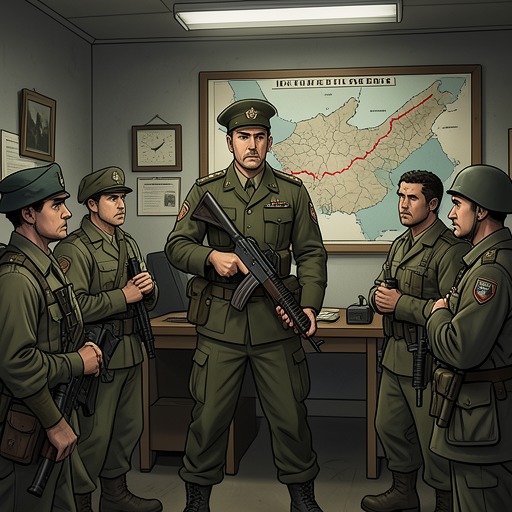
The Ukrainian army is described as likely to turn its attention southward. Later, the Ukrainian Fifth and Seventh National Armies appear in the same strategic picture as a U.S. carrier battle group, placing Ukrainian forces within the region’s widening military calculations. The available account does not specify the armies’ immediate orders or positions, but their presence makes clear that Ukraine is treated as an active military actor, not merely the object of decisions made by Russia or outside powers.
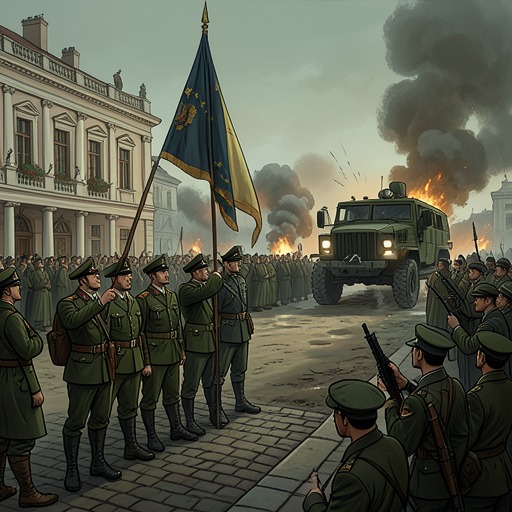
As the crisis worsens, Ukraine enters the discussion both as a prospective attacker and as the subject of political argument. A possible Ukrainian invasion is anticipated in official remarks, while another speaker invokes a genocide already committed against Ukrainians. These statements frame the threat in sharply different terms: one emphasizes the danger of future military action, the other the memory and consequences of earlier violence. The narrative presents such claims as part of the escalating debate, rather than resolving the competing arguments in the fragments describing them.
Crimea and the international response
The possibility of abandoning Crimea to Ukraine becomes an explicit issue as the military situation deteriorates. At the same time, the Jefferson battle group is reported to be about one hundred nautical miles out, a detail that places the regional crisis in relation to a nearby U.S. naval force without, by itself, establishing what action that force will take. Elsewhere, the prospect of receiving a directive to begin bombing illustrates how quickly the confrontation could move from political pressure to direct military action.
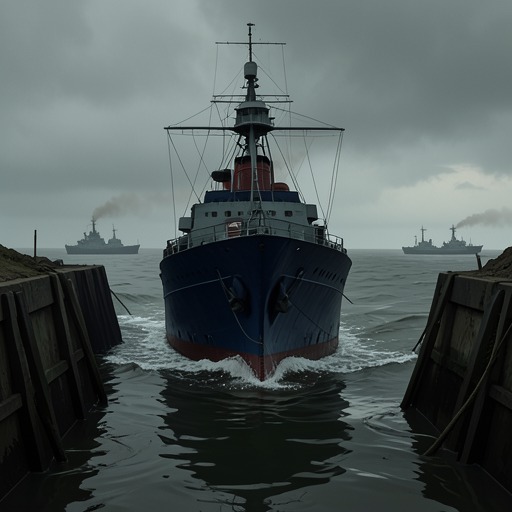
The closing reports shift the account from anticipated invasion to events on the ground. Ukrainian landing craft are said to be coming ashore at Mikolaivka, with the report describing landings on the peninsula. The UN protests and insists on its position regarding Crimea. The passage does not establish the final outcome of the landing or the full terms of the UN response, but it marks a consequential change: Ukrainian involvement is no longer only a feared possibility discussed by officials; it is reported as a physical presence on contested territory.
Narrative significance
Ukraine’s role develops through recurring tension between uncertain political alignment, military capability, and the contested meaning of Crimea. Early references establish the country as a persistent concern amid the Russian Civil War; later ones bring its armies into the region’s operational picture and place the possibility of invasion before decision-makers. The reports of landings and the UN protest then sharpen the conflict over who can act in Crimea and who has the authority to determine its status.
The novel also sets strategic language against the human and historical meanings attached to the peninsula. A map can mark territory, forces can approach it, and governments can dispute ownership, yet the claim that Crimea is a homeland resists reduction to a line of control. Ukraine’s significance in the story lies in that collision: its military moves intensify the crisis, while the unresolved political and personal claims behind them prevent the conflict from appearing as a simple contest of forces.