Taman Peninsula
AfterburnThe Taman Peninsula is a strategic landmark in the Black Sea crisis: the narrow waters between it and the Kerch Peninsula become the setting for an attempt to trap a carrier force and exhaust its aviation fuel. The book gives little independent description of Taman’s landscape; instead, its importance emerges through the geography of the nearby strait, the contest over Crimea, and the perilous business of refueling a carrier close to shore.
Geography and the Crimean Dispute
Taman is presented in relation to the Kerch Peninsula and the narrow waters between them. At the eastern tip of the Kerch Peninsula lies the port city of Kerch, overlooking the Kerch Strait, which connects the Black Sea to the Sea of Azov. At that point the strait is only five kilometers wide, making the adjoining peninsulas part of a confined maritime passage rather than an open sea approach.
That geography sits within a larger dispute over Crimea. The peninsula of Crimea was described as having long been considered part of Ukraine, whose mainland lies to its north, while Russia borders it to the east. The political claim was not settled by geography alone: Ukraine had been uneasy with its position as a republic of the Union, and the narrative emphasizes that ethnic Ukrainians were not Russians. With Russia consumed by civil war, the old dispute between Kyiv and Moscow over Crimea and the Black Sea Fleet remained active, and Ukraine appeared poised to settle the issue. Taman enters this conflict as a strategic counterpart to Kerch, not as the subject of a separate territorial claim.
A Naval Trap at Kerch
The peninsula becomes operationally significant when Dmitriev predicts that the carrier force will head straight into the pocket south of Kerch and Taman. His plan depends on the force’s constrained position: he expects to make it expend the last of its aviation gasoline, then seize the advantage. The geography is therefore not merely a backdrop to the threat. The pocket’s position helps explain why Dmitriev believes the carrier can be cornered and deprived of the fuel needed to maneuver or sustain its aircraft.
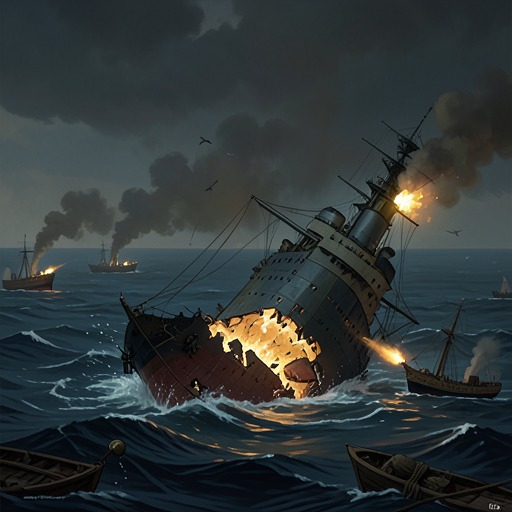
During Operation Ranger, the carrier is brought into the narrow waters between the Taman and Kerch Peninsulas, facing south with its starboard side toward the landing beaches to the west. The shore party is hooking up fueling lines. The maneuver places a huge, vulnerable ship alongside an active landing operation, where the practical need to refuel meets the danger of operating in confined waters. Taman’s role is defined by that juxtaposition: it marks one edge of the space in which the carrier’s vulnerability becomes concrete.
Political and Narrative Significance
The novel places this naval contest against a conflict in which the status of Crimea remains contested and military power is already in motion. In a debate over intervention, Admiral Scott objects that the whole area is tearing itself apart, while the reply stresses that Ukraine has not yet attacked. That exchange keeps the crisis unresolved: the risk surrounding Crimea is both a military problem and an argument about whether intervention can preserve peace.
The book also briefly frames Crimea as a homeland. Matthew “Tombstone” Magruder says he has not personally met the man under discussion, then acknowledges that Crimea is their homeland, based on what he has heard and read. The aside does not establish a distinct history for Taman, but it places the peninsula’s surrounding waters beside the human meaning attached to the contested territory. By the time the carrier enters the narrow channel and fueling lines are being handled, the region’s political abstractions have narrowed into a physical predicament: ships, shore, fuel, and a passage with little room to escape.