Turkey
AfterburnTurkey occupies the story’s narrow space between geography and diplomacy: its coast and waters lie along routes used by forces entering the Black Sea, while its decisions about passage and access can complicate an international operation. It is neither presented as a simple ally nor as an outright opponent. Instead, Turkey’s careful neutrality, cool dealings with United States officials, and later refusal to grant requested military access make its restraint an active force in the crisis.
Geography and Strategic Position
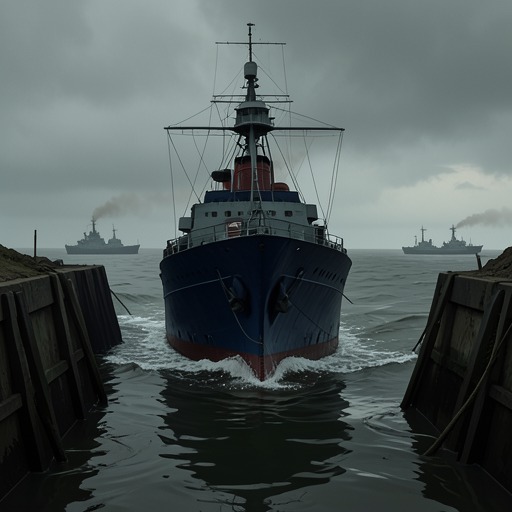
Turkey’s strategic importance is grounded in the routes around its territory. A submarine commander worries that the Turks might detect his vessel if it follows the American ships into the straits. The concern makes Turkish surveillance part of the calculations surrounding naval movement, even before Turkey directly intervenes in the action. A Russian officer dismisses the danger as manageable, reasoning that Turkey is remaining neutral; the exchange establishes that passage is possible, but politically exposed.
The coast also shapes the characters’ experience of the Black Sea. After entering what feels to Tombstone like a confined, landlocked sea, he sees the northern Anatolian coast about twenty miles to the south, a strip between the gray water and sky. The detail gives strategic geography a personal scale: the shore is close enough to be plainly visible, but the sea’s boundedness contributes to his sense of claustrophobia. Elsewhere, a Russian pilot flying north of the Bosporus Strait sees the Turkish coast ahead. The coast is thus not distant background but a recurring reference point for movement through contested air and water.
Turkey’s territorial claims further complicate that setting. In the Aegean Sea, it claims a six-mile limit for its territorial waters. That figure matters because military passage is not merely a question of navigation: it takes place against defined claims over where national waters begin. The account does not turn the limit into a legal ruling or describe a specific dispute over it, but places it among the boundaries that make movement through the region politically sensitive.
Neutrality and Regional Tensions
Turkey’s neutrality is presented as deliberate rather than effortless. One assessment links the country’s restraint to relations with Greece, which remain strained and have had serious repercussions. The political balance narrows Turkey’s freedom to cooperate openly with parties it regards as aligned with Greece, even as it limits the risks of direct defiance of the United Nations. In this account, neutrality means navigating competing pressures, not standing outside them.
A Russian officer suggests that Turkey could have blocked the Americans’ passage or denied them the right to sail through Turkish waters. Another speaker answers that Turkey is playing a careful game: it does not want to cooperate with those it believes to be Greece’s allies, but it will not defy the United Nations. The distinction is important. Turkey’s caution may impede American plans, yet the same caution restrains it from challenging the international institution openly. The resulting policy is conditional and tactical, not a clear alignment with either side.
The uncertainty around this stance accompanies a wider conflict over authority and intervention. The United Nations has asked the United States to provide military and technological expertise to enforce a newly imposed no-fly zone, and the Jefferson is sent toward Poti to add its air wing to the United Nations’ arguments. United States officials, meanwhile, have been debating whether American forces should serve under United Nations commanders. Turkey’s position matters within that wider structure because operations framed as international enforcement still depend on access through a region where local governments retain their own interests and limits.
Access, Deployment, and Friction
Relations with United States naval officials are described as formally correct but almost icy. Turkish authorities have been difficult about allowing a carrier battle group to traverse their territorial waters, and the officials involved in those dealings occupy a low position in the command hierarchy. The combination makes the friction both practical and institutional: the battle group’s movement depends on negotiations conducted through officials with limited rank, while the diplomatic tone offers little sign of warmth.
The deployment toward Georgia is itself constrained. The National Command Authority directs that United States forces must not become involved in fighting between the Russian Red and Blue factions; the Marines are to go ashore at Poti only under that restriction. The mission therefore carries a gap between its international purpose and its permitted scope. Turkey’s place in the surrounding geography adds another condition to a deployment already bounded by policy: the United States can contribute force to the United Nations’ position, but cannot treat access, command, or the limits of intervention as settled.
The contrast between initial passage concerns and later access disputes is consequential. Early discussion entertains the possibility that Turkey could deny the Americans passage, while later scenes describe an actual refusal to grant overflight privileges or access to the American battle group. The refusal brings the earlier uncertainty into the open as a crisis in operational cooperation. It is not simply an unfriendly gesture: it affects whether United States forces can reach or support their ships, and prompts senior officials to discuss an amphibious operation as a possible means of gaining access.
The Crisis and Turkey’s Narrative Role
The stakes rise sharply when Russia is reported to have attacked Turkish territory and civilians have died. Scott responds by arguing that Russia has brought Turkey into a war, while the refusal of overflight and access leaves the United States unable to treat Turkey as a dependable route to its own forces. The Secretary of State questions whether the discussion amounts to proposing war against Turkey, since Turkey had been considered on the American side. Scott answers that this assumption is now debatable. The exchange captures the disintegration of easy categories: a state previously treated as a partner is also an authority denying access during an emergency.
Turkey’s significance lies in this reversal and in the tension it exposes between strategic dependence and political autonomy. Its location makes passage consequential; its cautious neutrality makes cooperation uncertain; and its later refusal places an allied assumption under pressure at the very moment Russian violence raises the stakes. The narrative does not reduce Turkey’s conduct to a single motive or resolve the dispute over its choices. Instead, it makes the country a test of how far international and American military plans can reach when local consent is conditional—and how quickly a diplomatic obstacle can become part of the battlefield crisis.