Black Sea
AfterburnThe Black Sea is the confined maritime arena at the heart of the novel’s international crisis: an American carrier battle group enters it for the first time in U.S. naval history, ostensibly to help keep peace in Crimea as the Russian Civil War continues. Yet the sea is no neutral corridor. It lies beside a peninsula claimed through competing histories and political interests, while the force sent to stabilize the region arrives amid a conflict that its presence may not be able to contain.
A Contested Shore
The Black Sea’s significance begins with Crimea. The narrative describes the peninsula as geographically associated with Ukraine, whose mainland extends north of it, while Russia borders it to the east. That geography gives the dispute a visible shape, but it does not settle ownership. Ukraine is presented as a large, productive republic whose population and political identity cannot simply be treated as Russian; ethnic Ukrainians are expressly distinguished from Russians. The conflict over the shore is therefore also a conflict over who belongs to it and who may claim authority there.
The Russian Civil War changes the balance around the peninsula. Ukraine is described as using Russia’s internal weakness to strengthen its position, particularly in Crimea. An older disagreement between Ukraine and Russia over ownership of both Crimea and the Black Sea Fleet remains unresolved, and the war appears to give Ukraine an opening to settle it. The sea consequently carries more than naval traffic: control of its adjoining territory and fleet is bound up with the shifting power of states already under pressure.
Passage and Intervention
The American group’s arrival is presented as a historic first, but not as a simple show of force. Its stated mission is vague: to help maintain peace in Crimea while the Russian Civil War unfolds. The broader calculation is larger still. The narrative links victories in the conflict to the possibility of a United Nations-brokered peace throughout the Russian Federation, making the group’s voyage part of an effort whose intended reach exceeds the immediate coastline.
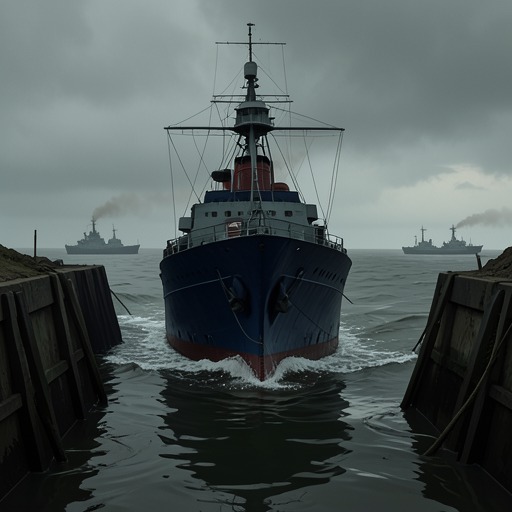
The approach is marked by the Dardanelles. A report from the Krimsky Komsomolets confirms that the American battle group is entering the straits; Dmitriev responds as though an expected threshold has finally been crossed, and his fatigue is apparent. The moment makes the sea’s geography part of the action: entry into the operational area is not instantaneous, but a passage that others can watch and anticipate. The group has not yet reached a settled peacekeeping role merely by arriving. Its presence introduces another armed power into a region whose political settlement remains uncertain.
An Exposed Maritime Theater
The Black Sea is also rendered through the conditions aboard ship. On Friday, 30 October, at 1710 hours, as the U.S.S. Thomas Jefferson moves through the sea, clouds close over the sky and a strengthening northeast wind meets the ship. A low gray ceiling completes the scene. The weather does not determine the political crisis, but it gives the carrier’s movement a concrete, restricted atmosphere: the force advances under conditions that offer little sense of openness or safety.
That physical unease echoes the description of the voyage as entry into a potential death trap. The group is sailing into a space where a peacekeeping purpose sits beside the prospect of violent entanglement. The contrast is central to the setting’s function. The Black Sea is at once the route by which the United States can intervene and the enclosed arena in which intervention may expose its ships and personnel to dangers that a broad diplomatic purpose cannot erase.
Homeland, Violence, and the Limits of Peace
The peninsula’s claims are not presented only as abstractions of state policy. In one exchange, a character recognizes Crimea as a homeland, and the thought is connected to history reaching back before the Russian Revolution. The brief reflection gives territorial conflict a human and historical dimension: a map can identify borders, but it cannot make a homeland politically uncomplicated or erase the memories attached to it.
The novel repeatedly tests the language of peace against events that unsettle it. During a policy dispute, an American official argues that intervention is needed to maintain peace; Admiral Scott counters that the whole area is coming apart. The response that Ukraine has not yet attacked makes the disagreement sharper: the case for intervention rests partly on preventing a possible escalation, while the surrounding crisis is already described as disintegrating. Elsewhere in the Black Sea narrative, shootings bring ambulances within twenty minutes and medical personnel provide first aid, while Matthew “Tombstone” Magruder withholds authorization to release wounded Navy personnel. The passage shows the human consequences of violence and the decisions that follow it, without turning the presence of a peacekeeping force into proof that peace has been secured.
Across these episodes, the Black Sea functions as more than a geographical backdrop. Its approaches organize the arrival of the carrier group; its adjoining peninsula concentrates disputes over identity, ownership, and military power; and its political vocabulary of peace is continually tested by the possibility and fact of violence. The sea’s decisive narrative tension lies in that mismatch: the American force enters with a peacekeeping rationale, but the contested shore gives no assurance that its arrival can produce the peace it is meant to defend.