Subtle minds
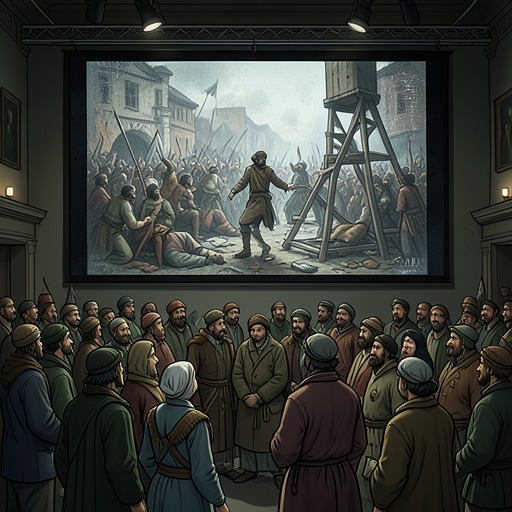
LimonovSubtle minds are the post-communist era’s practiced skeptics: diplomats, journalists, and observers who make a specialty of contradicting official accounts, media clichés, and well-intentioned illusions. In Emmanuel Carrère’s account, their suspicion can puncture complacent certainties, especially when public outrage has been stirred by manipulated evidence. But skepticism has its own political danger. In the debate over Bosnia, the insistence that matters are more complicated than they appear risks obscuring the responsibility of those carrying out ethnic cleansing. The concept names both a habit of interpretation and the uneasy question of when that habit becomes evasion.
The Romanian Setting
Carrère first encounters subtle minds in Romania, where they thrive amid the wreckage of communism. Their defining gesture is systematic contradiction: they resist the official line, but also the media’s familiar formulas and the illusions of people who believe themselves to be acting from good intentions. They are sworn enemies of political correctness, suspicious of accounts that arrange complicated events into reassuring moral patterns. This skepticism gives them an appearance of independence from conventional opinion, and a taste for claims that sound more knowing because they offend it.
The examples Carrère gives show how far this counter-reading can go. The KGB and the Securitate, denounced by the naive as institutions of death and darkness, are recast as something like France’s elite administrative school. Radovan Karadžić’s poetry becomes a test case for the same contrarian method: the subtle minds maintain that it is not as bad as people say. They make a comparable argument about the scientific work for which Elena Ceauşescu received honorary doctorates from universities across her country. The point is not simply that official judgments may be wrong. Their characteristic move is to treat condemnation itself as a reason to reopen the case—and, sometimes, to make the condemned seem less culpable than the consensus suggests.
Romania gives this posture a particularly potent setting. Carrère describes the country as two-faced, rigged, and deceitful, and notes that mass graves which stirred indignant compassion in the West were themselves sinister masquerades. A false or manipulated spectacle can discredit the response it was designed to provoke; the discovery of deception gives the skeptic evidence that moral certainty can be abused. Yet a real instance of fabricated evidence does not automatically validate every counterclaim made in its wake. The subtle minds’ standing rests partly on their ability to identify that distinction, and partly on the authority they gain by seeming to see through appearances when others do not.
Influence and Political Authority
The subtle minds are not merely a salon of provocative interpreters. Carrère says they had the ear of François Mitterrand and left their mark on his foreign policy. In this account, Romania is their El Dorado: a place where political speech, public evidence, and appearances are so entangled that suspicion can seem like the only sensible response. Their influence matters because a style of argument that begins as skepticism about received accounts can help shape decisions beyond the conversation in which it was first advanced.
Carrère’s description does not establish that every challenge they make is false, or that distrust of media and official discourse is itself illegitimate. Instead, it draws attention to the asymmetry between exposing a mistake and establishing a new account. The subtle minds gain force by identifying the naïveté or self-interest behind conventional narratives; their claims then acquire the aura of realism. But demonstrating that one public account is compromised does not, by itself, settle what happened or who bears responsibility. The gap between debunking and explanation is where their method becomes politically consequential.
Bosnia and the Uses of Complexity
Carrère recognizes the appeal of this method partly through his own uncertainty. Friends of his made regular trips to besieged Sarajevo, where they slept in bombarded buildings, crossed shattered streets under sniper fire, and lived with the possibility that each day might be their last. He later wonders why he denied himself that experience. Fear played a part, especially after he learned that Jean Hatzfeld had lost a leg to Kalashnikov fire, but so did wariness toward sacred missions, particularly those embraced by his own circle. He also questions whether values treated by his milieu as universal and eternal might someday appear grotesque or wrong.
That self-doubt leaves him receptive to the subtle minds’ account of the war. They describe Alija Izetbegović, commonly presented as an apostle of tolerance, as a Muslim fundamentalist surrounded by mujahideen and intent on creating an Islamic republic in Sarajevo. They claim that, unlike Slobodan Milošević, he had a strong interest in prolonging the siege and the war. They invoke the long history of Ottoman rule to explain Serbian resistance to another perceived imposition, and argue that close inspection of press photographs of Serbian victims reveals that one in two actually shows a Serb victim. Carrère says he nodded along: the conflict, he accepted, was more complicated than it seemed.
These claims do more than add detail to a simplified picture. Taken together, they shift attention toward Serbian grievance and away from the moral clarity of accounts centered on Serbian ethnic cleansing. Carrère’s vulnerability to them is part of the point: he admits that in politics he can too readily adopt the outlook of the last person who has spoken. His account therefore shows how a reader may move from justified suspicion of universalizing rhetoric to acceptance of a counter-narrative without having secured a reliable basis for it. Complexity can correct a blind spot, but it can also redistribute blame.
The Counterargument and the Unresolved Test
Carrère sets this hesitation beside Bernard-Henri Lévy’s objection to the appeal to complexity. Lévy argues that using the phrase to answer denunciations of Milošević and his circle amounts to excusing resignation, delay, and diplomatic cowardice. His analogy is deliberately extreme: saying that events are more complicated than they seem in this context, he contends, would resemble acknowledging the extermination of Europe’s Jews and then using complexity to qualify that fact. Against the subtle minds’ explanatory proliferation, Lévy insists that the situation is tragically simple. Carrère reports that he nodded at this argument too.
The double assent is not a resolution so much as the concept’s central tension. Carrère has listened to two incompatible political judgments and recognized something persuasive in each: subtle minds may expose the complacency of an audience eager to see itself as morally innocent, while Lévy warns that the same skepticism can shelter inaction in the face of violence. The narrative does not make complexity an automatic virtue or simplicity an automatic vice. Instead, it asks what an appeal to complexity does in a particular argument: whether it corrects a false certainty, or makes responsibility harder to name. Subtle minds remain significant in the book because they embody the seductions and risks of that question, not because their contrarianism supplies a final answer.