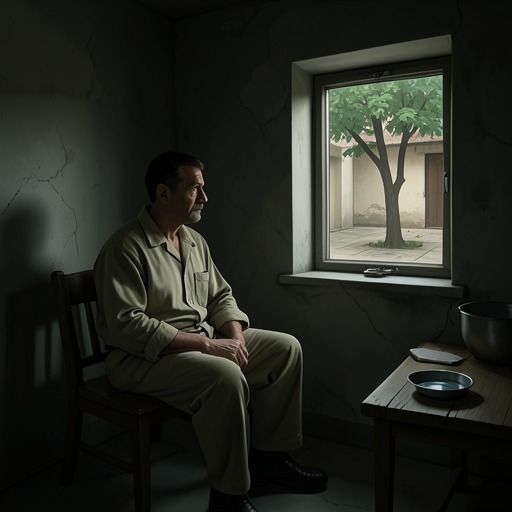
Buddhist meditation
LimonovBuddhist meditation is presented as a plain, practical discipline that Eduard Limonov adapts to prison life rather than as a conversion or an abstract doctrine. Taught by the inmate Pasha Rybkin, it gives Limonov a way to watch his own thoughts and bodily restlessness without being carried away by them. The practice recurs across radically different forms of confinement: from the isolation of Lefortovo Prison to the crowded Saratov cells and the labor regime at Penal Colony 13 at Engels. Its significance lies in this portability: meditation becomes a means of claiming attention and time where the prison controls both.
Instruction and Method
Pasha Rybkin introduces Limonov to meditation while they are in prison together. Rybkin is thirty, has spent ten years in prison, and is described as a peaceful, good-humored figure who combines the aspect of a Russian holy fool with that of an Asian ascetic. He walks in shorts and flip-flops even when his cell falls below freezing, avoids meat, drinks hot water rather than tea, and performs yoga poses. His years among criminals have not prevented him from recognizing Limonov as a wise man; their connection leads directly to the instruction.
The technique Rybkin teaches is deliberately undramatic. The practitioner sits upright, closes the eyes, and attends to breathing. The difficulty is not mastering a complicated procedure but resisting the urge to do something else: to drive thoughts away, alter the breath, or act on every impulse. Instead, thoughts are observed as they arise and pass. As attention steadies, the practitioner becomes less absorbed by the mind’s motion and may glimpse a calm zone. Agitation, boredom, and the desire to move are not treated as failures; they too can be noticed and held at a distance.
A Discipline Adapted to Confinement
Limonov responds to the instruction pragmatically and fits meditation into an already rigorous routine. At first he sits cross-legged on his cot, but he soon finds that the practice does not depend on a conspicuous posture: it can be done discreetly, wherever he is. The contrast between the apparent simplicity of sitting and the difficulty of sustained attention matters in prison, where control over space, movement, and interaction is imposed from outside. Meditation does not remove those constraints; it changes how he meets them.
At Lefortovo Prison, that inward discipline accompanies a daily insistence on physical exercise. The prison is unusually clean and not overcrowded, but its strict isolation deprives inmates of visitors and communication, while television can draw them into apathy and depression. Exercise on the roof is confined to a small fenced square, and loud music prevents prisoners in neighboring enclosures from speaking. Limonov nevertheless goes out every day, including during winter cold, and runs, does push-ups and sit-ups, and boxes the air. Meditation belongs to the same pattern of self-maintenance, though it turns attention inward rather than directing the body through exertion.
In Saratov, where cells designed for four often hold seven or eight, Limonov again makes the practice his own. When he arrives and finds every bed occupied, he lays his mattress on the floor without protest. His fellow inmates come to see him as a straightforward, considerate man: he shares parcels, does chores, avoids pointless talk, and helps others with letters or crosswords, though he prefers reading and writing to cards or chess. The meditation lesson fits this quiet, unshowy conduct. It offers no exemption from the cell’s crowded conditions; it is a skill he can carry into them.
From the Cell to the Camp
At Penal Colony 13 at Engels, the practice gains a different function because the day is organized around repetitive labor. Limonov wakes at five, before the 5:30 siren, and observes his breathing under his blanket while the barracks still sleeps. The moment is private and predictable, set just before the noise of the day begins. Once the siren sounds, wardens shout, prisoners tumble from the upper bunks, and the barracks erupts into motion. His quiet interval precedes, rather than interrupts, the imposed schedule.
The camp’s labor is often intentionally futile. After torrential rain floods the buildings, prisoners are made to empty puddles with water glasses so that the ground will be dry for roll call; the water returns as fast as they remove it. Though Limonov is sixty and exempt from forced labor, he must spend the day on cleaning tasks, including scrubbing toilets for hours. Since he cannot return to his books or notebooks until evening, he uses the repetitive work to resist drifting into daydreams. Rybkin had warned that daydreaming was the opposite of meditation. Limonov therefore attends to his inhalations, recites poems he knows by heart, or composes writing mentally, sentence by sentence and chapter by chapter.
Attention, Memory, and Inward Freedom
Meditation in the account is not a claim that Limonov can escape prison by willpower. It is a practiced way to observe experience without being wholly held by it, whether the immediate disturbance is a racing mind, the ordeal of movement through security barriers, or the monotony of camp work. During transfers through metal cages and doors, in the presence of barking police dogs and hostile guards, he learns to retreat inward to a zone of calm. The bodily conditions remain; attention is the part of his experience he can train.
The method also meets the camp’s restrictions on writing. Although writing is not formally forbidden, Limonov has little time to record his days, and a suspicious guard once examines his notebook and asks whether it contains remarks about him. After that encounter, Limonov makes discreet notes and relies on memory to expand them later. His mental composition of a book becomes another form of inward work, alongside breath-counting and the recitation of poems. When his notebooks mysteriously disappear just before his release, he has to rewrite the book from the beginning. The lost papers make visible the distinction the narrative draws between a record held by the institution and a memory cultivated within the prisoner. Buddhist meditation is thus linked not only to calm but to sustained attention: a modest practice through which Limonov preserves concentration and creative capacity amid enforced isolation, crowding, and futile labor.