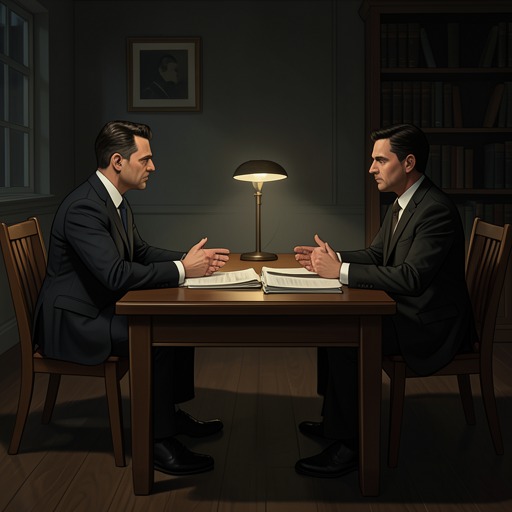
Captain Levitin-type figure
LimonovThe Captain Levitin-type figure is a recurring rival in Eduard Limonov’s private mythology: someone who seems less deserving than the person he displaces, but wins anyway. The figure begins with a workplace defeat suffered by Limonov’s father, Venyamin Savenko, and later finds its most consequential literary embodiment in Joseph Brodsky. More than a name for an enemy, it is a pattern through which Limonov interprets success: another person’s recognition becomes an affront, and the rival’s apparent advantage makes the humiliation intimate because it is witnessed by family, colleagues, or an entire cultural circle.
Origin in a Family Humiliation
The first Captain Levitin is an officer who takes over the job in which Venyamin Savenko had been flourishing. The preceding life of nightclubbing in the style of the NKVD has given Venyamin a measure of happiness and confidence; its end is not simply a professional setback. The new captain becomes the Savenko family’s sworn enemy without knowing it, because his success places the family’s loss in public view. He is described as a schemer who is not as good as Venyamin but is more successful, combining insolence with what appears to be devilish luck. The injury is sharpened by its audience: Venyamin is humiliated not only before his superiors but, worse, before his family.
As a boy, Limonov repeats his parents’ contempt for Captain Levitin, but that public loyalty does not silence his private judgment. He secretly thinks his father is somewhat pathetic and that Levitin’s son is fortunate. The contradiction is central to the motif. Limonov resents the successful rival and the humiliating arrangement that has made him successful, yet he also notices the rival’s advantage and envies the child who benefits from it. The figure therefore carries both accusation and self-reproach: it gives a name to the unfairness Limonov sees while exposing his unwillingness to accept his father’s defeat as uncomplicated proof of his father’s superiority.
From Family Story to General Rule
Limonov later turns this particular grievance into a theory of life: everyone, he believes, has a Captain Levitin. The move from one officer to a universal type makes the family memory portable. A rival need not hold the same job or belong to the same institution. What matters is the relation: one person believes that another has received the position, attention, or success that ought to have been his, and explains the difference through the other’s cunning or luck rather than through merit.
The theory also supplies a ready-made interpretation of Limonov’s own disappointments. In the account of his early response to Soviet dissidence, he dismisses figures on both sides of the political divide as important men pontificating from their respective positions of authority. He prefers the stance of the clever outsider who can exploit social disorder, rather than joining a dissident circle already occupied by celebrated figures. If he joined, he fears, he would be second fiddle. Brodsky can then be cast as the rival who has reached the front of a line Limonov refuses to enter, and whose acclaim confirms the threat of being overshadowed.
Joseph Brodsky as the Literary Rival
The book explicitly introduces Brodsky as the person Limonov will regard as his own Captain Levitin for much of his life. That comparison makes the rivalry more than a clash of temperaments: it transfers the childhood structure of displacement into the literary world. Limonov describes Brodsky as the eternal top of the class, protected by the teacher, but the narrative complicates the caricature. Brodsky’s youth included leaving school, working on a milling machine, dissecting bodies in a morgue, and traveling as a geological assistant in Yakutia. He and another young man also left for Samarkand and hijacked a plane in an attempt to reach Afghanistan. After confinement in a psychiatric hospital and painful treatment, Brodsky was arrested at twenty-three on a charge of social parasitism.
His eventual prestige does not erase the hardships that preceded it. After returning from exile in the north, he appeared occasionally in the underground kitchens of Moscow, where people venerated him and knew his poems, his trial rejoinders, and the names of those who had supported him. His reserved manner, old sweater, and place in the darkest corner only drew more attention: people gathered around him. Limonov, whose insolence and crushed-velvet jackets had made him a star before Brodsky arrived, was not pleased by the change in the room’s focus. The displacement is social and visible. Brodsky need not openly compete for attention; the others’ admiration makes him the rival simply by gathering around him.
Luck, Persona, and the Limits of the Motif
Limonov tries to protect his pride by treating Brodsky’s aura as a constructed persona. The suspicion fits the Captain Levitin pattern: apparent distinction is explained as a successful performance, not accepted as evidence that the rival might possess qualities worth recognizing. Yet the narrative leaves room for ambiguity. A friend of the narrator considers there to be some truth in the observation, while also noting that people commonly create personas and that simplicity itself is difficult to define. Brodsky is presented not as a transparent emblem of virtue but as someone whose public manner, refusal of accommodation, and literary reputation cannot be neatly separated.
Brodsky rejected publication offers from more accommodating colleagues, including invitations to join them, and his persistent conscientious objection eventually led the KGB to order him to leave in 1972. Limonov’s contemptuous response treats the exile as a fortunate route to distinction: five years, reduced to three, in the countryside, with a Nobel Prize at the finish line. In that reading, punishment becomes a lucky break and recognition becomes a jackpot. It is a revealing distortion, since the account also records the arrest, psychiatric confinement, and exile that made Brodsky’s path anything but effortless. The Captain Levitin-type figure thus identifies a real structure of rivalry while also showing how Limonov’s resentment can reduce another person’s difficult history to evidence of undeserved success.
The motif’s force lies in its repetition and its changing scale. It starts with a father losing a job and a child privately questioning the father he publicly defends; it returns when a young poet finds the room’s attention moving toward Brodsky. In both cases, the rival’s rise is experienced as a judgment on the person left behind. The concept explains why Limonov is drawn to the language of luck, scheming, and borrowed authority, but it also makes his own vulnerability legible: he is not indifferent to recognition. He fears being eclipsed, and his mockery of the successful rival keeps that fear in view even as it tries to deny it.