Glasnost (openness and transparency)
LimonovGlasnost (openness and transparency) is the policy that turns suppressed history into public knowledge—and, in the account given here, helps bring down the political order it was intended to reform. Mikhail Gorbachev presented openness as a limited, controllable concession, but once people could speak and read about the past, the disclosures reached far beyond that intended boundary. The result was not only a new public reckoning with repression but a rapid transformation of political life in the Soviet Union and Eastern Europe.
From official silence to public disclosure
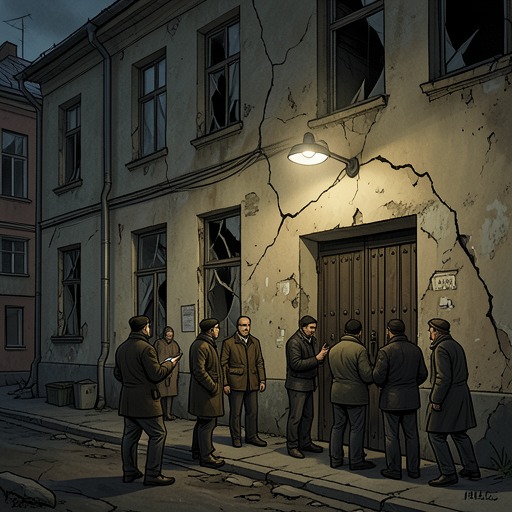
Before glasnost, the state’s suppression of reality depended on the suppression of memory. The account describes collectivization, the deaths and deportations of millions of kulaks, the famine organized by Joseph Stalin in Ukraine, and the purges of the 1930s as events that official history denied. Families could remember a father taken away in the night, but children also learned that speaking about it was dangerous. They were expected to behave as if it had never happened and to learn history from Stalin’s official Short Course. Silence was thus not merely a lack of information: it became a collective discipline, enforced by the danger attached to remembering aloud.
Aleksandr Solzhenitsyn had predicted that telling the truth would cause the whole edifice to collapse. Gorbachev, the narrator suggests, did not anticipate that consequence when he used the word glasnost in an address to assembled Communist leaders marking the seventieth anniversary of the Revolution. He imagined a localized opening that could be managed. Instead, he spoke of filling in “the blank pages of history” and acknowledged “hundreds of thousands” of victims of Stalinism, although the number, the narrator notes, ran into the tens of millions. The announcement functioned as permission: once the leadership had named the subject, the scale and implications of the disclosure could no longer be kept within the limits it had intended.
Books, names, and the recovery of memory
From 1988, works previously available only to an intellectual elite, through samizdat or smuggled foreign editions, entered public circulation. The change produced a reading frenzy. Large print runs sold out; people queued from dawn at kiosks and read on the subway, on buses, and while walking. One week Moscow was absorbed in Doctor Zhivago, the next in Vasily Grossman’s Life and Fate, followed by George Orwell’s 1984 or Robert Conquest’s histories of collectivization and the purges. What had been restricted knowledge became a shared, visible activity: readers carried the once-forbidden past into ordinary streets and conversations.
Under Andrei Sakharov’s patronage, dissidents founded the Memorial Society to name victims who had not only been killed but erased from memory. The account compares its work to Yad Vashem and connects it to Anna Akhmatova’s wish in Requiem: “I should like to call you all by name.” Memorial initially hesitated to use the word millions. Once it did, however, the scale of repression seemed to become something people had been waiting for permission to say openly. Naming the dead was more than an addition to historical knowledge: it challenged the authority of the silence that had made their disappearance appear unremarkable.
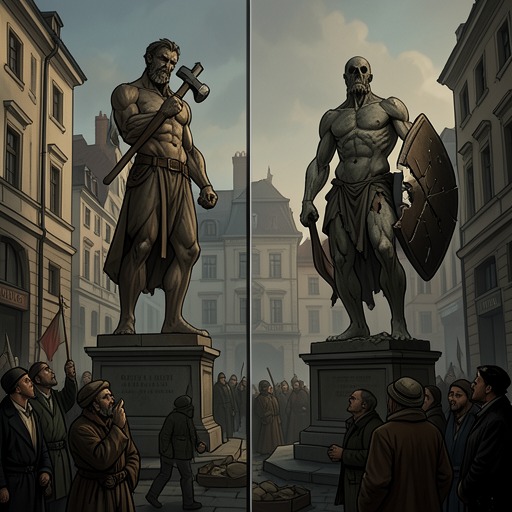
The public reassessment also reached into the state’s own language about its past. Parallels between Hitler and Stalin became commonplace, and Stalin’s so-called 5 percent theory—under which a tiny proportion of those arrested being guilty could be treated as a successful outcome—became a familiar argument in debate. The account also records the circulation of the statement, attributed to Stalin’s commissar for justice, “We must execute not only the guilty. Execution of the innocent will impress the masses even more.” Alexander Yakovlev, Gorbachev’s principal adviser, publicly emphasized that Vladimir Lenin was the first politician to use the term concentration camp. In a later television explanation of a decree rehabilitating those persecuted since 1917, Yakovlev rejected the Party’s description of the measure as clemency: “We are not pardoning them, we are asking their pardon.” He framed rehabilitation as an admission that those who had remained silent and looked away were accomplices. The process had moved from exposing crimes to asking what responsibility silence itself carried.
Political consequences beyond the Soviet Union
In this account, the liberation of history helps precipitate the collapse of Communist regimes in Eastern Europe. Recognition of the 1939 secret protocol assigning the Baltic states to the Soviet Union gave those states a forceful historical and political argument for independence. Previously, the Soviet response to such a challenge might have been military intervention; by this point, the narrator says, that option belonged to an earlier era. The year 1989 consequently becomes a sequence of rapid, largely nonviolent revolutions: what took Solidarność ten years in Poland took the Hungarians ten months, East Germans ten weeks, and Czechs ten days. With Romania as the exception, velvet revolutions brought figures such as Václav Havel to power amid public celebration. The disclosure of concealed history had become a political resource, helping turn a claim about the past into a challenge to present authority.
The same speed made the change seem almost self-evidently triumphant to many observers. Western European commentators invoked Francis Fukuyama’s “the end of history” without irony, and the narrator recalls that people, himself included, travelled to Prague or Berlin for New Year’s. Yet the celebratory account does not settle the meaning of glasnost. The narrator’s mother welcomed the Soviet bloc’s collapse, partly because of her White Russian background and because she had predicted it, but could not accept the credit being given to Gorbachev. In her view, he had not liberated people: they had taken him at his word and forced his hand, while he tried to brake a process set in motion through recklessness. The narrative presents him as at once a sorcerer’s apprentice, a demagogue, and a ninny—a judgment sharpened by her contempt for his Russian.
The dispute over openness and power
Eduard Limonov shared the mother’s hostility to the praise Gorbachev received. He resented the Soviet leader’s popularity with Western journalists, arguing that a Soviet leader should inspire fear rather than seek approval. For Limonov, glasnost and public repentance were inseparable from a humiliating retreat toward the West, including the abandonment of territory supposedly bought with the blood of twenty million Russians. The same opening that enabled the naming of victims and the exposure of state crimes could therefore look, from his political perspective, like a dismantling of national power.
The account makes that resentment concrete through a small object: a Red Army jacket whose brass buttons, the buttons of Limonov’s childhood, had been replaced with plastic. The detail stood for more than a change in uniform. Limonov read it as evidence that cost-cutting had displaced military authority and self-respect, leaving soldiers less able to command fear and respect. Where glasnost’s admirers saw the end of concealed history as a route out of authoritarian rule, Limonov saw openness, repentance, and retreat as signs that the country had already lost. The concept therefore carries two competing consequences in the narrative: it makes suppressed suffering speakable, and it exposes how quickly the recovery of truth can become entangled with arguments over national identity, strength, and political legitimacy.