World revolution
LimonovWorld revolution is the recurring political ideal through which Eduard Limonov imagines the dispossessed becoming a force capable of remaking society. It first appears as an internationalist solidarity with people at the margins and a demand for action beyond meetings and speeches. Later, the same appetite for upheaval is recast in National Bolshevik politics: a projected uprising led by outsiders, directed toward former Soviet territories, and increasingly constrained by electoral defeat, internal divisions, and state prohibition.
From internationalist solidarity to impatience
In New York, Limonov encounters world revolution through Carol, a young woman distributing leaflets for the Socialist Workers Party. She explains that the party represents American Trotskyists and advocates world revolution. The idea already suits his instinctive alignment with people he sees as having little to lose: workers and racial minorities, Arabs, gay people, the homeless, drug addicts, and Puerto Ricans. He supports Leon Trotsky as well, while suspecting that openly saying so would be awkward in Carol’s company because his admiration does not exclude Joseph Stalin.
Carol invites him to a meeting in solidarity with Palestine and warns that it could become dangerous. Limonov welcomes the prospect, but the meeting ends with speeches rather than collective action: participants disperse, go home, or continue talking in small groups. The gap between declared revolutionary purpose and routine political practice becomes immediately visible. When Carol asks what he expected, he explains that he wanted the group to remain together, obtain weapons, and attack a government building, hijack a plane, or bomb something. His answer exposes how he measures commitment: not by a shared platform or a future meeting, but by willingness to turn political feeling into immediate confrontation.
His attraction to Carol and her circle is also personal. He clings to her with the hope of sleeping with her, then learns that she has a boyfriend and returns alone to his hotel. Yet he continues to attend Socialist Workers Party meetings and agrees to distribute leaflets. The group offers something he urgently needs: the possibility of belonging to a family. That need helps explain why he keeps returning even after judging its members timid, and why he can briefly imagine joining the Hare Krishnas when he sees them chanting in the park. World revolution, in this early episode, is at once an ideological commitment, a fantasy of action, and a search for collective attachment.
The revolutionary hero and the band of losers
Leon Trotsky provides Limonov with a model of political destiny more compelling than the cautious American movement around him. He admires the bluntness of Trotsky’s revolutionary language and the story, told by an older man at Novoye russkoye slovo, of Trotsky’s transformation from a destitute émigré in New York into a commander travelling between fronts on an armored train. Limonov wants that scale of reversal for himself. The contrast makes the local Trotskyists seem inadequate to him: they speak at length about oppressed minorities and political prisoners, yet, in his view, fear the streets, the ghettos, and the poor themselves.
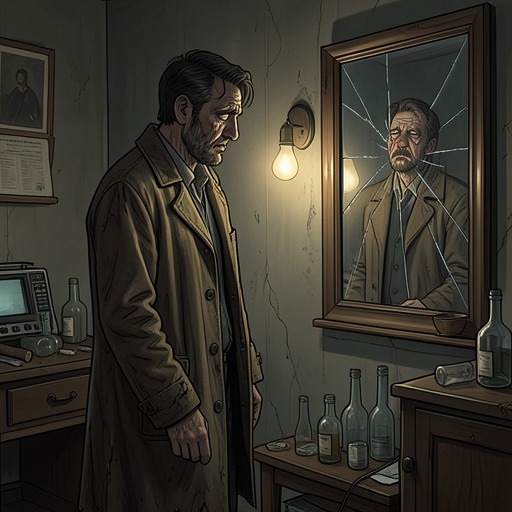
That tension between solidarity with the marginalized and contempt for insufficiently militant allies becomes a defining feature of his revolutionary imagination. In Diary of a Loser, he gives it a collective shape. The imagined movement gathers hooligans, drug dealers, people handing out brothel flyers, lonely museum visitors, poor families, retirees, unsuccessful artists, musicians, writers, lovers, and people defeated in work, money, or romance. The list does not present a disciplined political constituency. It assembles people joined by exclusion, humiliation, or frustrated desire, then transforms those conditions into a promise of collective distinction.
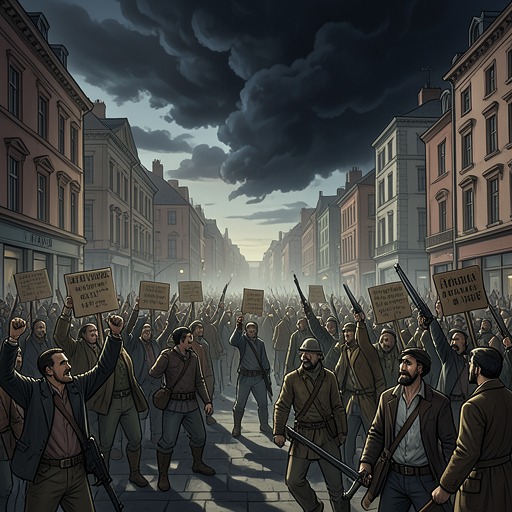
In Limonov’s imagined uprising, this heterogeneous band takes up arms, occupies cities, and destroys banks, factories, offices, and publishing houses. He places himself at its head, expecting both leadership and recognition. The revolutionary future thus answers two kinds of deprivation at once: the imagined followers will escape lives of failure, while Limonov will become the figure who gives their discontent direction. The dream’s force comes from the reversal it promises—those treated as social wreckage become the protagonists of history—but its central image also makes violence and personal glory inseparable from political liberation.
From universal revolt to a National Bolshevik project
The later National Bolshevik movement gives this desire for a revolutionary community an organization and a following. At its convention, several hundred people arrive from across Russia, although the party has about seven thousand members in total. Some delegates stay at a bunker; others are housed in a workers’ hostel. Finding a venue is difficult because owners withdraw their offers, apparently after police intervention, and the gathering faces fears of a bomb scare, police harassment, or an outright ban. When the convention nevertheless opens, Limonov sees in the delegates the result of years spent carrying copies of the party newspaper to railway stations for distribution beyond the major centers.
The gathering is not the realization of a coherent international proletarian movement. Its delegates are described as provincial young people with little money and few prospects, whose lives the party has given meaning, style, and an ideal. Their attachment makes Limonov proud, but the differences within the party are already consequential. Aleksandr Dugin’s followers favor grand historical and paramilitary references; many of the ordinary recruits gathered around Limonov are rock fans and brawlers, with little interest in that elevated fascist history. Zakhar Prilepin dislikes the references to the Freikorps, and welcomes Dugin’s eventual departure to establish a geostrategic studies center. The party’s revolutionary coalition is held together less by a shared doctrine than by a common appetite for belonging, defiance, and a forceful alternative to existing life.
Limonov tells the delegates that the time is not yet ripe for the National Bolsheviks to take power in Russia. Rather than join unpromising alliances with Orthodox antisemites or Stalin’s descendants, he proposes action on the country’s periphery, in territories left outside Russia after the Soviet Union’s collapse. He frames Russians in those former republics as abandoned and dispossessed, citing approximately 900,000 in Latvia, 11 million in Ukraine, and 5 million in Kazakhstan. The proposed campaign is to encourage insurgency and separatist republics, with the Baltic states and Central Asia identified as targets. This is a decisive change in scale and emphasis: the earlier dream gathers the world’s marginalized into a universal revolt, whereas the party’s program makes Russian grievance and the recovery of influence in former Soviet territories central to revolutionary action. When Limonov calls for volunteers to join his planned tour of Central Asia, a hundred hands rise, turning the proposal into a moment of visible collective enthusiasm.
Democratic confrontation and repression
World revolution’s later political expression also has to contend with the language and institutions of democracy. During the confrontation at the White House, several thousand patriots gather against Boris Yeltsin. The crowd includes some people who would be called fascists, but they present themselves as defenders of constitutional order, accusing the democrats of preparing dictatorship in democracy’s name. Among the rebels are Ruslan Khasbulatov and Aleksandr Rutskoy, who had stood alongside Yeltsin two years earlier. Limonov joins the occupation and spends the night moving between meetings as participants discuss, shout, drink, write communiqués, and form a new government.
At three in the morning, Limonov gains an audience with Rutskoy, whom he addresses as Comrade President. When the general appears shaken by Western governments’ support for Yeltsin, Limonov argues that the conflict is not a coup but a democratically elected parliament resisting dictatorship, and that the West will have to accept this in the name of its own principles. He urges Rutskoy to focus on what happens inside the White House and asks whether they have weapons. The episode shows Limonov adapting revolutionary rhetoric to a particular struggle over legitimacy: the language of democratic representation becomes a weapon in a confrontation whose participants are prepared to fight.
The National Bolsheviks’ later defense of imprisoned militants likewise complicates the narrator’s earlier expectations. Anna Politkovskaya had covered the trial of forty party members accused of occupying and vandalizing the presidential administration offices while shouting against Putin. They received lengthy sentences, and Politkovskaya defended them as courageous people of integrity who could inspire hope for Russia’s moral future. Yelena Bonner also supported them, despite reservations about the party’s name. Their public advocacy reveals that the movement could be understood not only through its provocative identity but also through the treatment of its members and their opposition to the government. The shifting interpretation of the National Bolsheviks makes political position, repression, and the defense of civil freedoms part of the story of what revolutionary opposition can mean.
That space narrows when a law against extremism and fascism gives the authorities power to determine what those labels cover. The Justice Ministry tells the party that the law concerns it directly. Limonov meets the minister in a suit and tie to argue that the party is neither extremist nor fascist, but its authorization is later refused. He returns to protest that Russia recognizes 130 political parties, including phantom organizations, while his has seven thousand adherents. If denied legal status, he warns, the party will have to organize secretly, and young people pushed in that direction may turn toward extremism and terrorism. The exchange does not establish that the party becomes an underground armed movement; it shows how state restriction transforms its political prospects and how Limonov uses the threat of further radicalization to contest the ban.
A revolutionary horizon without resolution
The movement’s later trajectory underscores the difference between revolutionary aspiration and political success. The Other Russia coalition, which had brought Limonov together with Garry Kasparov and others, ceases to exist after its failure in the presidential elections. Kasparov does not run, and Limonov turns instead to Strategy 31, named for Article 31 of the Russian Constitution, which guarantees the right to demonstrate. On months with thirty-one days, activists gather at Triumfalnaya Square; typically, about a hundred demonstrators face five times as many police officers, and several dozen are arrested. Limonov consequently spends a couple of days in prison on a regular basis. The movement’s repertoire has shifted from imagined armed revolt and territorial insurgency toward recurring, constitutionally framed protest under heavy police pressure.
Limonov also tries to create a national assembly of opposition forces, while Kasparov launches a platform of his own and becomes a rival. Their competition is comparatively subdued, and Limonov takes satisfaction in the fact that his website draws more visitors than Kasparov’s. His continued political activity coexists with a waning commitment to literary work and with a movement that has lost its earlier coalition. The revolutionary ideal therefore does not culminate in a seizure of power. It persists in altered forms: first as the projected uprising of the world’s losers, then as National Bolshevik organizing and geopolitical ambition, and finally as a campaign for public demonstration whose repeated outcome is arrest. The concept’s significance lies in that movement between promise and constraint—and in the unresolved tension between solidarity with the excluded and the authoritarian, national, and violent forms through which Limonov tries to make their revolt real.