Ordinary crime contrasted with state violence
LimonovOrdinary crime contrasted with state violence is a recurring moral framework in the book, sharpened by Eduard Limonov’s imprisonment among men convicted of serious crimes. The contrast does not excuse their acts: it asks why individual violence brings long punishment while violence exercised by the state can be concealed, defended as necessary, or rewarded. Prison becomes the place where that unequal judgment is made visible—in the cell, in the camp routine, and in Limonov’s response to the hostage killings at Dubrovka Theater.
Prison as a comparative setting
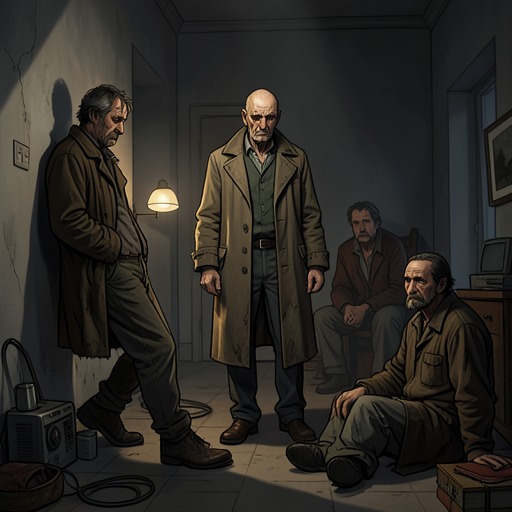
Limonov first encounters this contrast inside Lefortovo Prison, where he is held without knowing what he and his companions are accused of. He has not seen a lawyer, cannot receive visitors, and does not know when the trial will begin or whether anyone outside is discussing his arrest. The prison is clean and uncrowded, unlike many Russian prisons, but its strict isolation exerts its own pressure: inmates can watch television all day, while the exercise area on the roof gives each man only a small fenced square. Loud music prevents prisoners in neighboring enclosures from speaking to one another. The institution controls both contact and the possibility of movement.
Limonov responds by insisting on his allotted half hour outdoors every day, even when it is minus twenty-five degrees. He runs, does push-ups and sit-ups, and boxes the icy air on his concrete square. The guards are irritated at having to leave their warm room for one prisoner, yet impressed by his persistence; his politeness and education earn him the nickname Professor. This scene sets individual self-discipline against institutional control. His exercise does not undo the isolation, but it shows the narrow space in which a prisoner can still impose a routine of his own.
At Saratov, the conditions reverse: rather than isolation, the immediate pressure is overcrowding. Cells designed for four hold seven or eight, and when Limonov arrives every bed is taken. He lays his mattress on the floor without complaint, accepting that the newest arrival should be least comfortable. He avoids needless words, does chores, shares packages, and learns the unwritten rules. These details matter to the contrast because the book presents prison not as a single undifferentiated punishment but as a social order, with formal restrictions and informal obligations shaping daily conduct.
Criminal responsibility and recognition
Many of Limonov’s Saratov cellmates are ordinary criminals serving long sentences for serious offenses. Most have been charged under Article 105, paragraph 2, for murder with aggravating circumstances. Limonov is proud that these men respect him and regard his National Bolshevik Party as a formidable gang, but the more consequential change is in what he chooses to write about. Across three books about prison, he gives less space to posing as a political celebrity than to the lives of his cellmates. Men ask him to write their stories, and he does so, producing dozens of short portraits.
Those portraits preserve different circumstances rather than flattening the prisoners into a single category. The Engels gang consists of eight organized criminals who bled an industrial city dry, shot rivals and police, and received sentences ranging from twenty-two years to life. Another inmate, close to release, has spent weeks describing the future he imagines with his bride-to-be; the day before he is due out, a letter tells him she has moved in with someone else. Limonov tries to comfort him, while privately thinking of Nastia. In another account, two young cousins have raped and killed an eleven-year-old girl. Limonov is fascinated and troubled by the misery and shame he perceives around them; when one of the boys, facing a lifetime in a harsh camp, wishes him luck, the farewell overwhelms him.
Attention to these men is not absolution. Limonov says he does not judge them, calls himself their brother, and writes at their request, but the book does not erase what they have done. Instead, it brings their crimes and their punishment into view together. The prisoners’ acts have names, victims, charges, and sentences; their accounts become intimate enough that the reader must see the people serving those sentences as more than their offenses. Limonov’s insistence that he is one of them reflects a shared condition of confinement, not a claim that all actions are morally identical.
Dubrovka as a test of the distinction
On the evening of October 23, 2002, Limonov’s cellmates are watching a crime film that depicts police as heroes and criminals as monsters. He objects to that portrayal, but the others prefer the movie to reality. When news interrupts the program to report that Chechen terrorists have taken a Moscow theater audience hostage, they want to switch back. Limonov insists on watching. For the next fifty-seven hours he follows the coverage, through the dawn gas attack on October 26, which kills hostages as well as terrorists.
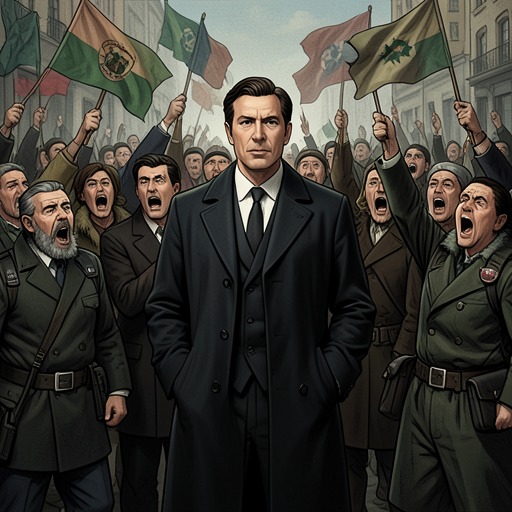
The event bears directly on his own position: he is charged with terrorism and his trial is approaching, so the country’s spreading paranoia threatens to affect his case. But the moral comparison is larger than self-interest. In Limonov’s eyes, the crimes of his cellmates, committed in moments of passion or drunkenness and punished with years of imprisonment, are set against the state’s killing of people in the theater. The difference is not that the prisoners’ violence is harmless; it is that state violence operates at a vastly greater scale while its agents may be decorated rather than sentenced.
From television reports in his cell, Limonov reaches conclusions that the book says align with those of Anna Politkovskaya, who can follow events more closely. Both fear a bloodbath from the outset. After it happens, both suspect that officials are lying about the number of dead and that little was done to save the hostages. Limonov also recalls rumors that the 1999 attacks were committed not by Chechens but by the Federal Security Service with the president’s endorsement. The narrative presents these as persistent rumors, not established fact; their significance is that they shape his suspicion of official accounts and his changing language about Vladimir Putin.
Accountability and political power
The contrast extends beyond a single hostage crisis. The book places the prisoners’ long sentences beside the state’s violence at Dubrovka Theater and the deaths of the Kursk submarine crew over eight days beneath the Barents Sea, as well as the massacre at the Beslan Hostage Crisis. Its point is not simply that officials commit violence, but that public language and punishment distribute responsibility unevenly. Ordinary perpetrators remain identifiable and confined; state power can frame lethal action as a defense of the country and continue to command public attention on different terms.
The prison camp at Engels gives this argument a quieter, institutional form. Limonov wakes before the 5:30 siren, observes his breathing, and anticipates the barracks’ sudden uproar. The prisoners eat kasha, thin soup, and black bread; everything edible is consumed, a rule that explains why their garbage contains little beyond cigarette butts. Work, too, is organized to exhaust rather than accomplish anything. After rain floods buildings, inmates spend the day emptying puddles with drinking glasses, only for the water to return. Limonov recognizes the task as a camp tradition of futile labor, designed to demoralize. At sixty, though exempt from forced labor, he is kept from his books and notebooks and assigned four hours to clean toilets that would take about one hour. Here coercion does not appear as a spectacular act of killing; it is built into the management of time, labor, and deprivation.
Against that system, Limonov’s writing gives space to people whom official categories might leave as criminals, detainees, or disposable bodies. The contrast remains deliberately uncomfortable: he can respect the men who have committed terrible crimes, and he can condemn the state’s violence without pretending that the two are equivalent in scale, authority, or consequence. What prison reveals is a hierarchy of accountability. The incarcerated are made to answer for their acts; the state, even when its actions produce mass death or deliberately futile suffering, can claim necessity and preserve its power.