Samizdat
LimonovSamizdat is the informal system through which banned writing was copied and passed from reader to reader in the Soviet Union. Rather than relying on official publication, it made a fragile, labor-intensive network of readers into its means of circulation: one copy could generate several more, carrying literature and testimony beyond the reach of ordinary publishing. The book presents it both as a practical literary channel and as a formative environment for Eduard’s early ambitions as a writer.
Definition and Circulation
The word is explained as meaning self-published. In practice, the process begins with a reader receiving a text and making further copies in turn. Because copies could be carbon copies of carbon copies, a work might arrive barely legible; its physical degradation records the number of hands through which it had passed. The method enabled banned writing to circulate without making it an official publication, and linked readers through repeated acts of copying and exchange.
The material passed this way was not limited to poetry. The narrative names works by Bulgakov, Mandelstam, Anna Akhmatova, Tsvetaeva, Pilnyak, and Platonov among the literature circulating through samizdat. It also carried writing whose public significance arose from the circumstances of its production and transmission, including a transcript of Joseph Brodsky’s trial.
Bookstore 41 as a Meeting Point
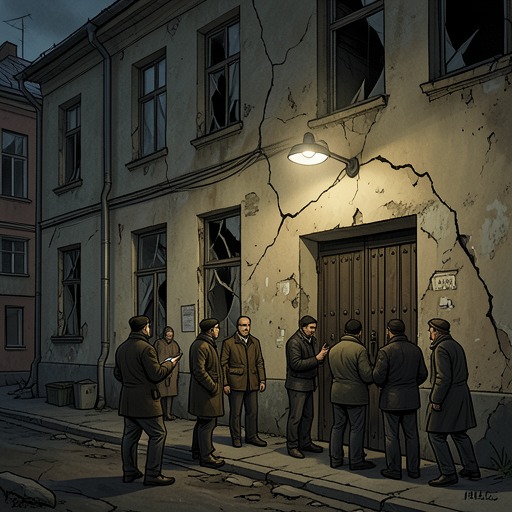
In Kharkov, bookstore 41 becomes one local center of this network. Eduard works as an itinerant bookseller, displaying used books at places such as a movie-theater lobby or the zoo entrance. The sales are meager, but the bookstore that supplies his boxes is also a meeting place for the city’s artists and poets. After closing, when the metal shutters are down, they stay to drink and talk and exchange clandestine texts.
Eduard’s attendance exacts a concrete cost: he often misses the last streetcar and walks two hours through the night and snow to his distant workers’ suburb. That journey places the exchange outside ordinary working hours and everyday convenience. At 41, samizdat is not an abstract idea but an activity sustained by a small circle willing to gather, read, and pass on what could not be obtained through official channels.
One memorable arrival is an extremely faint copy of Joseph Brodsky’s poem Procession, brought from Leningrad. The connoisseurs estimate that it is a fifth- or sixth-generation carbon copy. Its condition makes the chain of transmission visible, while the group’s attention to the poem shows that its value is not determined simply by ease of access or print quality. Eduard later judged it a pastiche of Marina Tsvetaeva, yet also saw it as corresponding to the social and cultural development of Kharkov and the bookstore’s regulars.
Eduard’s First Circulation as a Poet
Samizdat also marks a step in Eduard’s own development. Anna reads his poems favorably and shows them to Motrich, who agrees; Eduard then reads them at the bookstore and assembles a collection by copying it out ten times by hand. The collection circulates only among the immediate clientele of 41. At this point, no one else is copying his work, so his reach remains limited even as the circulation gives him the standing of a poet within that circle.
The book describes a progression in dissident literary recognition: a writer’s work first circulates in a small samizdat circle, then is copied by others, and may eventually appear abroad as tamizdat. Doctor Zhivago is given as an example of the latter. Eduard’s ten handwritten copies place him at an early, modest point in this progression; the distinction matters because the status of poet offers recognition among people whose lives may otherwise be marked by hardship, but does not itself guarantee wider readership.
Brodsky’s Trial Transcript
The circulation of Brodsky’s trial transcript demonstrates how samizdat could turn a largely unnoticed proceeding into a widely consequential text. A journalist present at the hearing recorded the exchange in shorthand, and the transcript then circulated through samizdat. The book says that this account electrified an entire generation. In this instance, the network transmits not only a literary work but a record of a confrontation between a poet and the authorities, making the hearing available to readers far beyond those in the courtroom.
Across these episodes, samizdat has no single scale or effect: it brings a faint poem from Leningrad to a Kharkov bookstore, gives Eduard a small readership, and carries a trial record into a wider dissident culture. Its significance lies in the mechanism itself—a work’s survival and audience depend on readers who copy and pass it on.