Prison as spiritual discipline
LimonovFor Eduard Limonov, prison becomes more than confinement: it is a discipline through which he trains his body, attention, and capacity to endure. The prisons and camp do not offer the same conditions. Lefortovo imposes isolation, Saratov brings crowding and the negotiations of shared life, and Penal Colony 13 at Engels organizes the day around compulsory, often futile labor. Across these settings, Limonov responds by establishing practices that give his time and mind a structure the institutions cannot wholly dictate. The culminating paradox is that he longs to leave, yet fears that freedom outside may cost him the more inward freedom he has achieved inside.
Institutions and Their Different Pressures
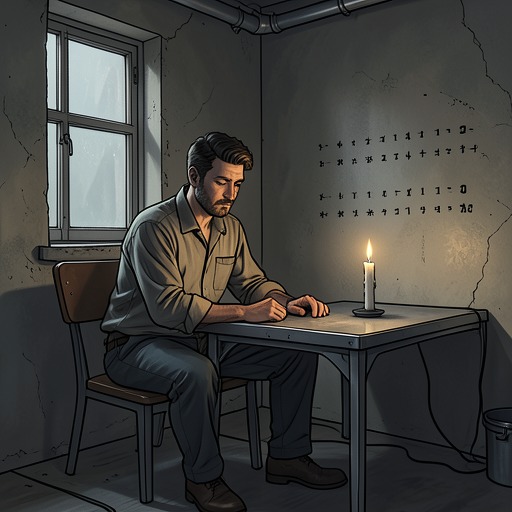
At Lefortovo Prison, the pressure is not dirt, overcrowding, or the threat of assault, but isolation. The cells are private, white, and sterile, with televisions that can hold inmates in an apathetic spell. Exercise is restricted to small, fenced-off spaces on the roof, where deafening music prevents prisoners from hearing one another. Many stay in bed rather than go outside. The institution thus narrows not only movement and contact but the opportunities to choose how a day is spent. Limonov answers that pressure with an insistence on leaving his cell: even in winter, when it is dark and minus twenty-five degrees, he goes to the roof for half an hour. He runs on his allotted patch of concrete, does push-ups and sit-ups, and boxes the icy air. His routine is a physical counterweight to the prison’s enforced passivity.
Saratov presents a different test. Cells built for four may hold seven or eight, and when Limonov arrives every bed is occupied. He lays his mattress on the ground without protest, accepting the discomfort as the lot of the latest arrival. Rather than announce his status as an intellectual, political prisoner, or celebrity, he settles into the practical terms of shared life. He does not play cards or chess, preferring to read or write on his cot, but lends a hand when another inmate needs help writing to his girlfriend or completing a crossword. The contrast matters: discipline here does not mean withdrawal from everyone. It also means learning the unwritten rules, sharing what arrives in a package, doing chores, and helping without turning assistance into a performance.
A Day Made into Practice
At Engels, the discipline must accommodate the routines of a work camp. Limonov is sixty and exempt from forced labor, but he cannot spend the daytime reading, writing, or meditating in his barracks. His schedule begins before the official wake-up: the siren sounds at 5:30, while he wakes at five and observes his breathing beneath his blanket. The quiet interval belongs to him. He knows how much time remains before the barracks erupt into motion, and experiences the approaching noise as a motor waiting for its key to turn. The carefully kept distinction between that solitary attention and the sudden collective rush gives the morning a form: inward composure first, then the camp’s demands.
Prison routine also reaches the body in less elevated ways. At breakfast, inmates eat kasha, thin soup, and black bread, guarding their tin bowls as they eat. The food lacks vitamins and saps their energy. Limonov, a nonsmoker, uses the brief break when others go out for cigarettes to get to the toilets early. Such details place his discipline within the ordinary material conditions of camp life, rather than above them. His attention to bodily rhythms and to the sequence of the day is one means of inhabiting a routine otherwise arranged by the institution.
Futile Labor and Interior Work
The work at Engels is officially part of rehabilitation, but the tasks can serve no practical purpose. Torrential rain floods the buildings; the administration demands dry ground at each of three daily roll calls, with television at stake. Inmates spend hours emptying puddles with water glasses, only for the water to return. Limonov briefly considers whether masonry could solve the drainage problem, then recognizes that the absurdity is not a mistake to be corrected but a feature of the camp’s tradition. The exercise of making labor pointless wears inmates down. Even the cleaning assigned to him, despite his exemption from forced labor, is stretched beyond its practical duration: a row of toilets that could be scrubbed in an hour is allotted four, and he cleans it four times over without daydreaming.
That refusal to let tedious work dissolve his attention is supported by an inward practice. Pasha Rybkin, whom Limonov knew in Saratov as a practitioner of yoga, had warned him that daydreaming was the opposite of meditation. At Engels, Limonov therefore counts and lengthens his inhalations, following the air from his nostrils to his lower abdomen and back. Alternatively, he recites poems he knows by heart, attending closely to each verse. Most often, he composes in his head. Like Aleksandr Solzhenitsyn before him, he builds sentences, paragraphs, and chapters mentally, memorizing them as he goes. The work of remembering turns hours in which he cannot readily write into a means of strengthening the memory on which his writing depends.
When he does use a notebook, he writes cautiously. A suspicious guard once examines it in silence and asks whether Limonov writes about him. After that, Limonov softens his notes, relying on memory to restore their fuller form after release. The caution is vindicated when his notebooks mysteriously disappear just before he leaves the camp. He must rewrite the book he composed there from the beginning; he considers the loss all the better for it. In this episode, discipline includes not only sustained mental composition but adaptation to surveillance, uncertainty, and the possible disappearance of the written record.
Confinement as Monastery, Freedom as Risk
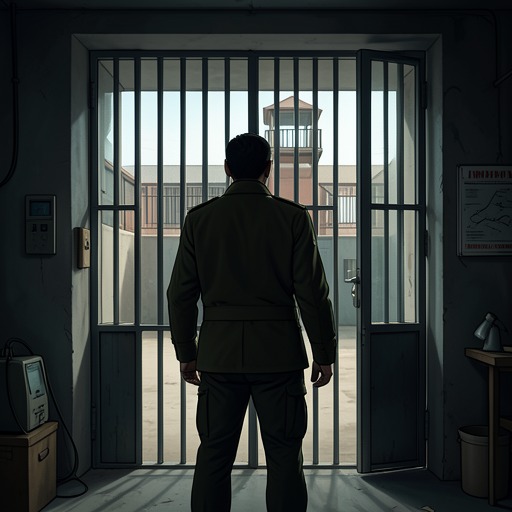
By the time a television crew arrives to film his departure, Limonov has made the camp into something other than the hell its images are intended to convey. The production seeks sinister faces, lizards, mud, and garbage, while he conscientiously performs the roll-call scene, giving his name and the articles under which he was sentenced. He also continues a supposedly ordinary conversation in the mess hall as the director asks the inmates to act as if the cameras were absent. The staged image of prison and Limonov’s experience of it do not coincide: the crew frames captivity as spectacle, while he has made its repeated routines the setting for concentrated inner work.
As the other inmates compete to appear beside him, Limonov privately regrets agreeing to the television appearance and feels the strangeness of leaving. He wants his freedom, to see Nastia and the people in his party; at the same time, he knows he will no longer be the person he was in the camp. The three daily roll calls have become his services, meditation his prayer, and the camp as hospitable to him as a monastery is to a monk. This is not a claim that the work camp is harmless: its pointless labor, restrictions, and exhaustion remain part of the account. The point is that his method of meeting them has altered what the place means to him. He fears that release might deprive him of a truer freedom formed there, and sees the camp’s ending as the end of the best chapter of his life. Prison as spiritual discipline is therefore both an achievement of self-command and a paradox: the institution confines him, but the practices he makes within it become a liberty he is reluctant to lose.