Soviet memory and communist nostalgia
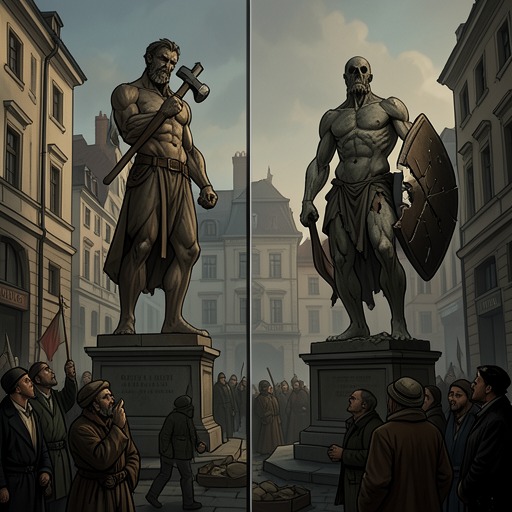
LimonovSoviet memory and communist nostalgia in Emmanuel Carrère’s account are not simple opposites of truth and falsehood: they are competing ways of living with a past that was both a childhood world and a system of repression. Soviet authorities tried to make violence disappear from public history, while Glasnost allowed people to recover what had been suppressed. After the Soviet Union’s collapse, memories of modest security, meaningful work, and childhood innocence could coexist with knowledge of terror—and become material for political argument. Vladimir Putin’s appeal to that remembered world helps explain why Eduard Limonov, despite his opposition to Putin, is not outside the emotional field of Soviet nostalgia.
Erasure and the recovery of memory
The account presents historical falsification as a practical instrument of Soviet power. In one anecdote, subscribers to the Great Soviet Encyclopedia were told to cut out its entry praising Lavrentiy Beria after his disgrace and execution, then replace it with an article on the Bering Strait. The alphabetical order remained intact, but Beria was made to seem as if he had never existed. After Nikita Khrushchev fell, libraries likewise had to remove One Day in the Life of Ivan Denisovich from old copies of Novy mir. These acts make the suppression of memory tangible: history could be revised not only in official accounts but with scissors and altered pages.
That public erasure reached into families. Children who saw their fathers taken away in 1937 knew both what had happened and that speaking of it was dangerous; they learned to behave as if the loss had never occurred. The text links this enforced silence to a larger public acceptance of history as officially compiled under Joseph Stalin. In that order, the suppression of reality depended on teaching people not merely to repeat a lie, but eventually to inhabit it. The silenced family memory therefore exposes the gap between an individual’s knowledge and the history a society is permitted to tell.
Glasnost and the return of the past
The decisive change associated with Mikhail Gorbachev’s early years in power is not described simply as administrative reform. Carrère emphasizes that people became free to write history as they saw it. At the seventieth anniversary of the October Revolution, Gorbachev spoke of filling in history’s blank pages and acknowledged hundreds of thousands of Stalinism’s victims; the actual toll, the narrative stresses, ran into the tens of millions. The discrepancy captures both the limits of the initial admission and the force of the opening it created.
From 1988, books previously available only to an intellectual minority through samizdat or smuggled foreign editions reached a mass readership. Large print runs sold out; people queued at kiosks at dawn and read in public transport and on the street. Doctor Zhivago, Vasily Grossman’s Life and Fate, 1984, and Robert Conquest’s histories of collectivization and the purges became subjects of collective attention. The change was not only the disclosure of particular crimes: a public once trained not to name them began to speak about them together.
The Memorial Society gave that recovery an institutional form. Founded under the patronage of Andrei Sakharov, it sought to name victims who had been killed and then erased from memory. Its hesitation over the word millions, followed by its eventual use, registers how difficult it was to convert private knowledge into public language—and how readily the suppressed scale of the crimes became speakable once the taboo weakened. The account presents this as a change in collective self-understanding, not merely a correction to a list of historical facts.
Childhood memory after communism
For Zakhar Prilepin and his provincial contemporaries, the Soviet Union was not chiefly an abstract political system remembered from adulthood. They were about fifteen when communism collapsed, and they recalled childhood as a time when life made sense: money was scarce, but so were the goods it might buy; houses were maintained; a boy could admire a grandfather known as the best tractor driver on his collective farm. Their nostalgia is grounded in ordinary structures of dignity and comprehension, rather than in a claim that the past had been free of repression.
The contrast is with the humiliating poverty of their parents after the collapse. People who had been modest but proud lost not only their means but their pride. Meanwhile, the young men themselves encountered a new social hierarchy: precarious work loading crates, sweeping courtyards, plastering walls, or guarding parking lots, while affluent drivers arrived in SUVs and shouted into mobile phones. Their resentment thus joins childhood remembrance to a material experience of post-Soviet inequality. The remembered world can seem better not because it offered abundance, but because its limits appeared shared and its social meanings more legible.
Putin’s political use of Soviet memory
Carrère places Vladimir Putin’s appeal within this divide between historical judgment and personal memory. Putin’s background, as presented here, resembles Limonov’s in important respects: a modest family, a father who was a junior officer, a mother who worked in a factory, and childhood shaped by patriotism, the Great Patriotic War, and the prestige of the state security organs. Putin regarded perestroika with suspicion and the fall of the Soviet empire as a catastrophe. In the disorder of the early 1990s he too experienced defeat, reduced to driving a cab before he rose to power.
Once in office, Putin could turn remembrance into state policy. He could order school textbooks to stop teaching what he considered bad things about Stalin and bring NGOs and liberal opponents into line; the narrative contrasts his perfunctory bow at Sakharov’s tomb with the visible bust of Felix Dzerzhinsky on his desk. His political language, however, addresses a real wound: the sense that condemning communism as equivalent to Nazism also condemns the lives, beliefs, sacrifices, and childhood memories of generations who lived under it. The argument does not erase the atrocities. Rather, it explains the emotional appeal of insisting that communism was also heroic, beautiful, and bound up with childhood.
Limonov between nostalgia and opposition
Limonov stands inside this conflict rather than safely outside it. Carrère judges that Putin speaks to the hearts of people across Russia, beginning with Limonov, and suggests that Limonov might say and do much the same if he held Putin’s power. Yet Limonov occupies the incongruous position of a virtuous opposition figure, defending democracy and human rights alongside people whose values he has often despised. His political opposition does not settle his relationship to the Soviet past; it makes that relationship more unstable, because the emotional and historical language Putin mobilizes is not alien to him.
The book’s smaller scenes also show how Soviet habits and meanings persist in personal life. Limonov once liked to unsettle a Paris room by describing his father as a Chekist, then narrowed the claim by calling him essentially a gendarme. Carrère qualifies the image: his father had been an NKVD orderly stationed at a factory during the war and later organized soldiers’ cultural activities, a modest role within a system of supervision. Elsewhere, the Russian word khozyain, meaning master of the house but carrying a nuance of feudal authority, connects Limonov’s domestic standing with Stalin as master of the Soviet Union. These details do not resolve the moral history of the system. They show how its roles and vocabulary could persist in family recollection and everyday authority.
Memory in the account therefore remains double-edged. The recovery of suppressed crimes challenges the state’s authority to dictate what happened; nostalgia preserves the meanings ordinary people attached to the lives they actually lived. Putin’s success lies partly in speaking to that attachment, while Limonov’s place in the opposition reveals that historical truth does not automatically dissolve emotional inheritance. The past returns not as one settled verdict, but as a struggle over what can be remembered without denying either the violence or the lives that were lived within its shadow.