Class resentment
LimonovClass resentment in Eduard Limonov’s American years is more than hostility toward the rich: it is the pressure produced by living close to wealth while feeling excluded from its security and recognition. It sharpens his view of literary and social hierarchies, turns envy into revolutionary fantasy, and gives form to Diary of a Loser. The concept’s force comes from an unresolved contradiction: Eduard can recognize kindness in a wealthy employer, yet still ask why wealth and opportunity belong to him rather than to Eduard.
Literary position and social setting
At Novoye russkoye slovo, Eduard finds a warm, reassuring refuge. Its Russian-speaking staff welcome him with coffee, sweet tea, vodka, pickled cucumbers, and the affectionate address Eduard Venyaminovich. For someone newly arrived in the United States without English, the newspaper offers company and familiarity. But its comfort also carries a cost: the office feels like an old folks’ home, inhabited by émigrés whose hopes of a new life have ebbed into nostalgia, small quarrels, and unfulfilled dreams of return. Eduard fears being confined within that world, which seems to him to smell of tombs and cat urine.
His shared dislike of Vladimir Nabokov marks a difference as well as a kinship. Eduard’s hostility comes from class hatred and disdain for literary writing, while the émigrés resent Nabokov for turning away from the community and its preferred kind of fiction. He does not want his own antipathy to make him one of them. The scene places resentment inside a cultural hierarchy: Eduard is not merely resisting the wealthy, but also rejecting a literary world he sees as stale and unable to make room for his ambitions. His attempts to sell pieces about Kharkiv thugs and the Moscow underground, like his poems, attract no interest; polemic appears to offer the remaining route toward notice.
Wealth at close quarters
As a frequent guest in Steven Gray’s home, Eduard encounters wealth not as an abstraction but as an intimate daily environment. Steven is an art-loving host with a Russian grandmother, a taste for Russian visitors, and a genuine interest in Eduard’s accounts of Soviet life. Eduard tells him about psychiatric hospitalization and entanglements with the KGB, shaping those experiences toward familiar stories of political confinement. In return, he watches Steven move through a life supported by inherited money: after an absorbing conversation, Steven goes upstairs to put on a ten-thousand-dollar suit before lunch at a restaurant whose cheapest meal, Eduard calculates, would feed a Puerto Rican family for a month.
The proximity complicates Eduard’s resentment. He imagines how Steven would manage if he had to survive by his own wits, dropped into the jungle with nothing but his body and a knife. Yet he also concedes that Steven is humane and civilized, unlike the crude Soviet caricature of the capitalist as a cruel, bloated exploiter of the poor. That recognition does not settle the underlying question of unequal fortune. Steven’s decency disproves an easy stereotype, but does not explain why he possesses inherited wealth while Eduard does not. The gap between personal character and social position keeps resentment alive even after caricature fails.
Revolution and the loser’s imagined army
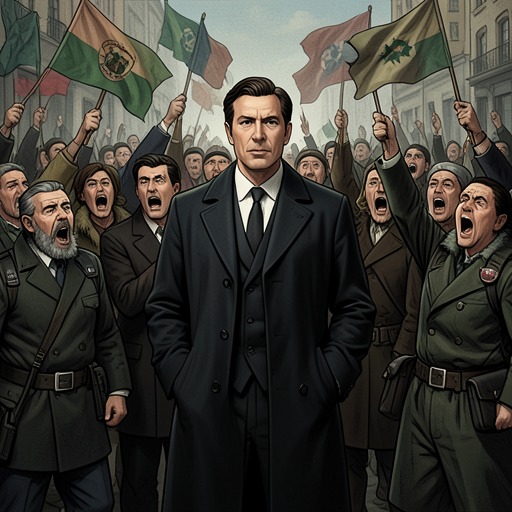
Eduard’s answer to that inequality is revolution, not gradual reform or political talk. His imagined remedy is explicitly violent: heads on spikes, and a break with the compromises he associates with social reformers. He considers leaving the United States to join the Palestinians or Gaddafi, and imagines dying in Beirut in a burst of Uzi fire. In that fantasy, death would become worthwhile if the publication of It’s Me, Eddie had first made him famous. The thought reveals that his rebellion is bound up with recognition: he wants not only to overturn the order that excludes him, but to become publicly known within it. An unknown soldier’s death would have no such compensation.
The idea becomes more sustained when Eduard resumes writing in New York City. Instead of poems or a conventional story, he fills short prose pieces, often no longer than a page, with resentment, envy, class hatred, sadistic fantasies, and an absence of apology. These writings later form Diary of a Loser. Its imagined insurgent gathering draws together people marked by failure or exclusion: the poor, the unlucky in love or work, people who linger alone in museums or libraries, artists whose work does not sell, and others who feel pushed to the margins. The list does not describe a single class with a common occupation; it creates a coalition out of thwarted desire and social humiliation.
In the book’s culminating fantasy, this assembled band takes up arms, occupies cities, and destroys banks, factories, offices, and publishing houses. Eduard places himself at its head, imagining that the losers will distinguish themselves and that they will know and love him. The passage links class resentment to a double wish: the destruction of institutions that distribute wealth and status, and the elevation of the writer who can give the excluded a collective name. The leader of the losers seeks to reverse the hierarchy without ceasing to desire recognition.
Domestic dependence and emotional reversal
The class conflict also enters Eduard’s life at home. He could, like Jenny, treat their position in Steven’s house as a stroke of good fortune: she enjoys a magnificent house and the pleasures of wealth without bearing its costs, except when Steven’s visits require everyone to work. Eduard instead tells her that she is the maid and he is the maid’s lover, using the arrangement to provoke her. Jenny does not respond with anger. She points out that no one is forcing him to stay.
Her answer exposes the practical limit of his defiance. At thirty-five, after having rarely lived in decent surroundings, Eduard has acquired a taste for luxury and cannot bear the prospect of returning to the Embassy Hotel and idling in Central Park. His resentment of class position coexists with dependence on the comforts it provides. The fantasy of attacking the wealthy order does not remove his wish to remain sheltered within it.
When Jenny later tells him she will move to California, marry the man she has been seeing, and have his child, Eduard presents himself as understanding, but the separation surprises and devastates him. He had expected to be the one to leave, and had relied on the belief that Jenny loved him as a source of refuge. Her departure returns him to what he experiences as a hostile world. The episode does not reduce his class resentment to a quarrel over money: it shows how material comfort, emotional security, and the desire to be chosen have become entangled. The loser’s army promises collective glory, but in private Eduard is left with the loss of one person who had been waiting for him.