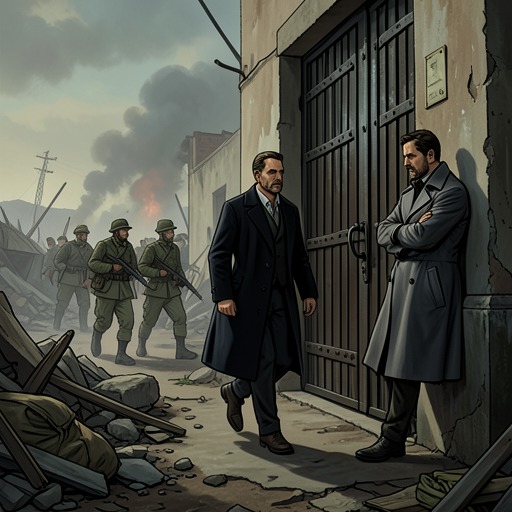
The reversal of victim and perpetrator roles
LimonovThe reversal of victim and perpetrator roles is a recurring moral and political pattern in the book: those who suffer violence may later inflict it, and people who try to remain on the side of victims must adjust their loyalties as the balance of power changes. The concept does not mean that every side is equally responsible. Instead, it tests whether a witness can acknowledge inconvenient facts while still recognizing the difference between the stronger and weaker party in a particular situation.
Sarajevo and the choice of a vantage point
During the siege of Sarajevo, the choice facing observers was also a choice of where to stand. In the first days, it was still possible to drive from one side to the other, though doing so meant risking a frightening journey. After that, the alternatives were to follow events from within the besieged city or from the positions of those besieging it. Jean Hatzfeld and Jean Rolin chose the side where the shells were falling, not the side from which they were fired. Their choice rested on an asymmetry: one side was weaker and the other stronger. It did not require them to regard everyone on the weaker side as innocent or everyone on the stronger side as irredeemably wicked.
Hatzfeld’s own injury makes the problem of judgment concrete. His first instinct was to believe that Serbian snipers had caught him in an ambush intended to kill a journalist. After a year in hospital, he returned to Sarajevo to investigate. He concluded that the shots that cost him his leg had, as luck would have it, been fired by Bosnian militiamen. The later finding did not erase his injury or make the initial suspicion unreasonable; it changed his understanding of who had caused it. His return matters because he was willing to investigate a fact that contradicted his first account rather than protect that account from revision.
Partiality without false equivalence
The book treats this willingness to revise as compatible with taking sides. Honest attention to the complexity of events does not, in its account, require the conclusion that one side is just as bad as the other. A choice remains necessary, especially when one group is besieged and the other is doing the besieging. The observer can record wrongdoing by those being attacked and still recognize the imbalance between their position and that of their attackers.
The same ethical difficulty appears when the alignment of suffering shifts. Rolin experiences an undeniable satisfaction at the thought that, for once, Serbs are taking the blows. But the book presents that reaction as temporary rather than as a lasting warrant for retaliation: the wheel turns again. The account then points to the International Criminal Tribunal for the former Yugoslavia, which prosecutes Serbian war criminals, while Croatian and Bosnian counterparts are left to what the passage describes as the predictable leniency of their own courts. It also notes reports on the horrible conditions faced by vanquished Serbs in their enclaves in Kosovo. These details prevent sympathy from becoming a fixed possession of one national or political group. The person who was vulnerable in one phase may be vulnerable again after the balance changes.
The demands of witness
The resulting principle is difficult because it requires more than sympathy for the injured. A witness must be prepared to recognize suffering on any side, to acknowledge even the motivations of torturers, and to put forward facts that challenge the witness’s own opinions. At the same time, attention to complexity must not become an excuse to avoid judgment. The book describes the reversal as sinister: the torturer can become the victim, and the victim can become the torturer. The corresponding discipline is to adapt quickly enough to remain on the side of whoever is being victimized now, rather than treating a former victim’s status as permanent absolution.
That position distinguishes shifting solidarity from a claim that victim and perpetrator are interchangeable in every circumstance. Hatzfeld’s discovery about who fired the shots changes his understanding of his own injury; it does not turn the injury into an abstraction. Rolin’s moment of satisfaction registers the force of a reversal, but does not settle the moral question for good. The book’s emphasis is on repeated reassessment: identify who is weaker in the present situation, notice when that situation changes, and resist the comfort of an allegiance that no longer answers to the facts.
Limonov and the underdog
The concept also clarifies the apparently erratic course of Eduard Limonov’s political sympathies. After a two-month National Bolshevik tour through Kazakhstan, Turkmenistan, Tajikistan, and Uzbekistan, he returns with a new attachment to Central Asia. He is less drawn to the Russians living there—the people whose circumstances had initially taken him to the region—than to Uzbeks, Kazakhs, Tajiks, and Turkmens. He admires what he sees as their pride, poverty, hospitality, sensitivity to insult, and traditions of violence and vendetta. The narrator notes his transformation in imagined role: leaving with Gabriele D’Annunzio in mind, Limonov returns inspired by Lawrence of Arabia, envisioning himself as a liberator of Uzbek and Kazakh mountain dwellers who resent their local dictators.
His change of attitude toward Islam is another sharp reversal. Influenced by his Serbian friends, he had been set against it; after the tour, he swears by Muslims and extends his admiration to the Chechens, praising their frugality, guerrilla tactics, and elegant cruelty. Yet the passage finds a consistency beneath these changes: Limonov likes the underdogs. Its examples set the skinny against the fat, the poor against the rich, and self-confessed assholes against the legion of the virtuous. His sympathies move between populations and causes, but the narrator reads their direction as constant: he has always sided with those he considers weaker.
Significance
The reversal is therefore both a warning about political innocence and a test of continuing attention. Victimhood does not prevent a person or group from later inflicting harm; past suffering cannot settle who needs support in the present. But recognizing that reversal does not oblige the observer to flatten unequal situations into moral equivalence. The book joins factual honesty to an unstable, renewable solidarity: follow the evidence, register changes in power, and move toward the side where violence is being endured rather than delivered.